You just finished your Common App personal statement. You feel good about it. Then you open the UC application and realize you need four more essays, and they're nothing like what you just wrote. If that sounds like your situation right now, our California essay experts can take the UC side off your plate entirely.
The UC PIQs are a set of four short essays (350 words each) required by all UC schools, while the Common App personal statement is a single 650-word essay submitted to hundreds of colleges nationwide. They look similar on the surface, but they're built for completely different purposes. And if you treat them the same way, you're going to have a problem with one application or the other.
This article covers the key format and tone differences, what admissions readers at each actually look for, and a practical strategy for students doing both.
The Quick UC PIQ vs Common App Essay Difference: Format Side by Side
Here's the fast version before we get into the details.
| UC PIQs | Common App Essay |
Number of essays | 4 (chosen from 8 prompts) | 1 (chosen from 7 prompts) |
Word limit | 350 words each | 650 words |
Total words written | 1,400 | 650 |
Application | UC Apply only | 900+ colleges |
Deadline | November 1–30 | Varies (Nov–Jan typically) |
Writing style evaluated? | No | Yes |
Activities section | Up to 30 activities / 500 chars each | Up to 10 activities / 150 chars each |
UC PIQs ask for four focused snapshots; the Common App essay asks for one complete portrait.
That last row, the activities section, is one that most students miss entirely. We'll cover it later in this article, because it changes how you should plan both applications. You can find full deadline details on UC's official admissions site.
What Do UC Admissions Readers Look for vs Common App?
This is the part that trips students up the most, and it's worth spending time here.
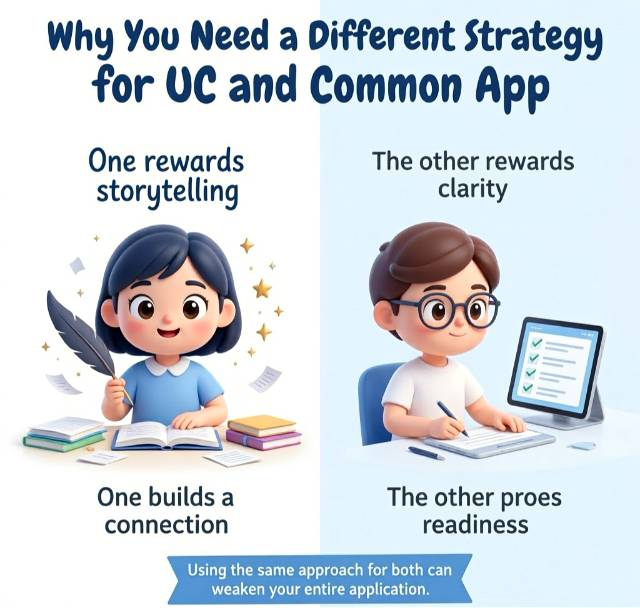
- Common App admissions readers are looking for values, self-awareness, vulnerability, and craft. Literary quality actually matters. A strong hook, a meaningful arc, a line that makes them feel something those things move the needle. The personal statement is your chance to show who you are as a person and a thinker.
- UC readers work from a different framework. They're evaluating what you've done, what impact you've had, and how you've contributed to your community or field. UC explicitly states that writing style and grammar are not evaluated the same way they care about content and clarity, not craft.
For UC, the question is "What did you do?" For Common App, the question is "Who are you because of what you did?"
Here's a concrete example:
Say you led your school's debate team to a state title. For Common App, you might open mid-moment in the final round, weave in your fears about public speaking from years earlier, and close with a reflection on what leadership taught you about yourself. For UC, you'd skip the narrative setup, state your role clearly, describe specific actions you took to train your team, and quantify the outcome. Same story. Completely different approach.
For UC, the question is "What did you do?" For Common App, the question is "Who are you because of what you did?"
For the full guide on writing the Common App personal statement, including how to find your topic, structure your draft, and nail the opening, see how to write a Common App essay. |
Can You Reuse Your Common App Essay for UC? (The Real Answer)
No, you can't submit the same essay. But can you adapt the same topic? Sometimes, yes, with the right changes.
Here's what that actually looks like:
What you CAN adapt | What you must write fresh |
The core topic or story (with reframing) | The narrative arc and literary structure |
Factual details and accomplishments | Reflective or emotional language |
Themes that map to a UC prompt | The "here's how it changed me" ending |
Content from your activities section | Any dramatic openings or hooks |
The keyword is adapt, not shorten. A lot of students try to cut their 650-word personal statement down to 350 words and call it a UC essay. That doesn't work. The structure, tone, and emphasis are all different. You need to strip it down to the facts and rebuild from scratch for UC.
Adapting isn't copying, it's taking the same raw material and building a completely different kind of essay.
If you're a transfer student applying to both UC and Common App schools, the comparison on this page applies, but your essay types are different. UC transfer applicants write PIQs (1 required + 3 optional, 350 words each), while Common App transfer applicants write a separate 250–650 word transfer essay. For the full breakdown of how those two differ, see our UC transfer PIQ guide and transfer personal statement vs transfer essay. |
You cannot submit the same essay, but you can adapt the same topic stripped of literary structure, reframed as evidence and action, and rebuilt for UC's 350-word format.
The Tone Difference UC PIQ vs Common App
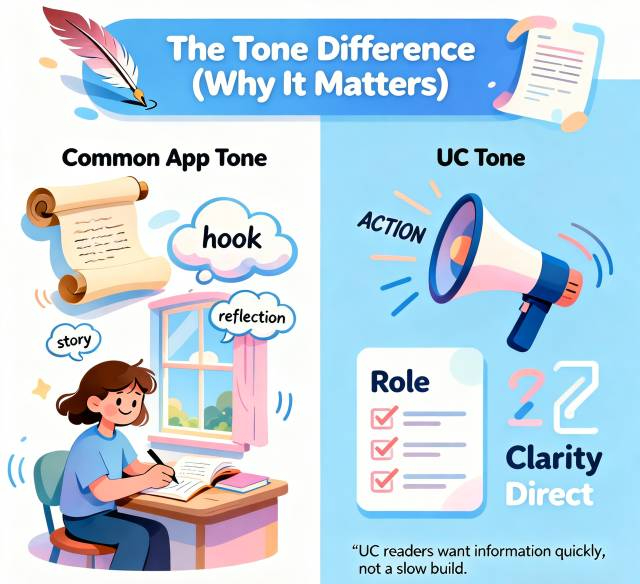
- Common App personal statements reward strong opening lines. You've probably been told to start with a scene, a surprising detail, or a line that hooks the reader. That works beautifully for Common App.
- For UC, that same instinct can hurt you. UC readers process hundreds of essays quickly. They're looking for information, not entertainment. A dramatic three-sentence setup before you get to the point reads as wasted space. UC readers don't want your best first paragraph. They want your first fact.
If you've spent months training yourself to write literary openings for the Common App, you'll need to consciously switch gears for UC. Start with your subject. State your role. Then build from there.
Compare these two openings for the same story, a student who started a peer tutoring program:
Common App version: The fluorescent lights in Room 114 buzzed every Tuesday at 3 p.m. I didn't notice them anymore I was too busy watching Darius finally understand derivatives.
UC version: I founded a peer tutoring program at my school after noticing that office hours were inaccessible for students who worked after school.
Both are valid. Neither is wrong. But only one belongs in each application.
?
Highlight Your Strengths in UC Essays
Present your achievements and skills in the most effective way
Prompt Strategy: Overlapping Topics Across Both Applications
Here's something students stress about unnecessarily: using the same topic in both applications. Common App and UC are separate applications submitted to separate schools. UC readers never see your Common App, and vice versa. If your best story is your debate captaincy, tell it in both, just frame it differently for each.
What you do need to avoid is using the same story across your four UC PIQs. Since UC readers see all four at once, repetition there makes you look one-dimensional.
Here's how the prompts map across both applications, useful for planning both without accidentally writing the same essay twice:
| UC PIQ Prompt | Common App Prompt | Shared Territory | Key Execution Difference |
|---|
| Prompt 1 (Leadership) | Prompt 5 (Accomplishment/growth) | Taking initiative and making an impact | UC: name your actions and measurable outcome. Common App: explore what leading revealed about you |
| Prompt 2 (Creativity) | Prompt 1 (Background/identity/talent) | Expressing who you are through what you make or do | UC: show a specific creative output and its effect. Common App: connect creativity to identity and values |
| Prompt 3 (Talent/Skill) | Prompt 5 (Accomplishment/growth) | A skill developed and demonstrated over time | UC: trace the development with evidence. Common App: focus on what growth felt like from the inside |
| Prompt 4 (Educational Opportunity/Barrier) | Prompt 2 (Challenge/setback/failure) | Overcoming something that affected your learning | UC: connect directly to academic readiness. Common App: explore emotional arc and personal meaning |
| Prompt 5 (Significant Challenge) | Prompt 2 (Challenge/setback/failure) | The most direct pairing nearly the same prompt | UC: emphasise what you did and how it affected academic performance. Common App: emphasise vulnerability, growth, and self awareness |
| Prompt 6 (Academic Subject) | Prompt 6 (Captivating topic/idea) | Intellectual passion for a field | UC: Show what you did because of the interest. Common App: explore why the idea captivates you |
| Prompt 7 (Community Contribution) | Prompt 1 (Background/identity/community) | Belonging to and shaping a community | UC: focus on your specific actions and outcomes. Common App: focus on identity, belonging, and meaning |
| Prompt 8 (Wild Card) | Prompt 7 (Topic of your choice) | Both are open ended safety valves | UC: fill a gap your other 3 essays left open. Common App: find a story that doesn't fit prompts 1–6 |
If You're a Transfer Student Applying to Both
The comparison on this page changes shape for transfer applicants. UC transfer students write 1 required essay about major preparation plus 3 chosen from 7 optional prompts all at 350 words each. Common App transfer applicants write a separate 250–650 word transfer essay explaining why they're leaving and why the new school is the right fit. These are fundamentally different essays with different purposes: the UC PIQs are about who you are, the Common App transfer essay is about a decision you've made.
The most important thing to know: the UC PIQs and the Common App transfer essay do not overlap. You're not adapting one for the other, you're writing two completely separate essays for two completely separate applications. For the full UC transfer PIQ breakdown, see our UC transfer PIQ guide. For the Common App transfer essay, see our Common App transfer essay guide.
The Activities Section: UC PIQ vs Common App Essay Difference Most Students Miss
This one doesn't get talked about enough, and it genuinely changes how you should approach both applications.
| UC allows up to 30 activities with 500 character descriptions for each. Common App allows up to 10 activities with 150 character descriptions. |
That's a massive difference. Your UC activities section is a 500-character opportunity. Don't waste it with a title and bullet points.
The practical implication: write your UC activities section first. You have more space, so you can be specific and detailed. Then compress those descriptions for Common App, cutting to the essential facts within the 150-character limit.
This section is separate from your PIQs entirely. If you want the full breakdown on how to fill it out strategically, we cover it in depth in our guide on how to fill out the UC application activities section. |
Which Should You Write First UC PIQ vs Common App?
If your deadlines give you flexibility, write your Common App personal statement first.
Here's why: the Common App essay forces deeper self-reflection. You're asking yourself what matters to you, what experiences have shaped you, and how to articulate that in 650 words. That process surfaces the stories that feel most authentic and those are exactly the stories you'll want to adapt and build out for your UC PIQs.
The Common App essay is the long game. Write it first to discover what matters, then distill it for UC.
That said, if your UC deadline falls before your Common App deadline, or you have a rolling admission school on your Common App list, prioritize based on what's due first. The ideal order is useful guidance, not a hard rule.
Here's the practical split most students face:
UC's November 30 deadline lands after Common App Early Decision (November 1) but before Regular Decision (January 1–15). If you're applying ED to a Common App school, you're writing both simultaneously. Start your Common App personal statement in August, get a working draft by late September, then shift to UC PIQs in October with the Common App largely done. If you're applying Regular Decision only, the Common App deadline gives you breathing room to finish your UC PIQs first (November 30), then use December to polish your personal statement before the January deadline. Either way, don't treat UC PIQs as an afterthought after your personal statement is done. They're a separate writing challenge that needs dedicated time. |
One thing most students underestimate: if you're applying to competitive Common App schools, you're not just writing one personal statement. Most selective schools require supplemental essays, "why this school," short answers, and community essays ranging from 150 to 650 words each.
A realistic total writing load for a student applying to 8–10 schools looks like: 4 UC PIQs + 1 personal statement + 6–12 supplements. The concision skills you build writing UC PIQs in 350 words translate directly to supplements, which is another reason writing UC first has practical value beyond just self-reflection.
A Quick UC PIQ vs Common App Essay Comparison Checklist
Before you hit submit on either application, run through this:
Common App:
- Does it tell a clear narrative arc?
- Does it show insight, self-awareness, and craft?
- Is it 650 words or under?
- Does the opening pull the reader in?
UC PIQs:
- Does each one start clearly, without a long setup?
- Does each one show evidence of action and impact, not just reflection?
- Is each one 350 words or under?
- Do your four PIQs together show four different sides of you?
Both:
- Are you accidentally submitting near-identical content to the same school?
- Does your activities section match what you've written about in your essays?
- Have you had someone else read both with fresh eyes?
Write UC PIQs With Clarity and Impact
Learn how to structure answers that are clear, focused, and engaging
- Clear response structure
- Focused content development
- Strong opening and closing
- Editing for clarity