What Does a Personal Statement Need to Accomplish?
A personal statement has one job: to make an admissions reader understand something specific about you that your grades and activities list cannot show.
It is the one place in your application where the person reading your file stops looking at data and starts listening to you. Everything else reports what you have done. The personal statement explains how you think, what you value, and where you are going.
What a personal statement is not: it is not a five paragraph essay with a thesis and a restatement. It is not a chronological list of accomplishments. It is not a letter explaining your weaknesses. It is a piece of narrative writing that reveals your character through a specific experience and connects that experience to where you are headed.
For undergraduates, the personal statement is typically the Common App essay or a school specific prompt.
For graduate applicants, it sometimes goes by other names, including statement of purpose or personal history statement, but the core task is the same: show the reader who you are by being specific.
The range of formats matters less than the principle driving all of them, which is specificity over generality at every decision point.
What Makes a Good Personal Statement?
A good personal statement opens with a scene only you could have lived, reveals how you think rather than listing what you have done, and closes by connecting your past to where you are going next.
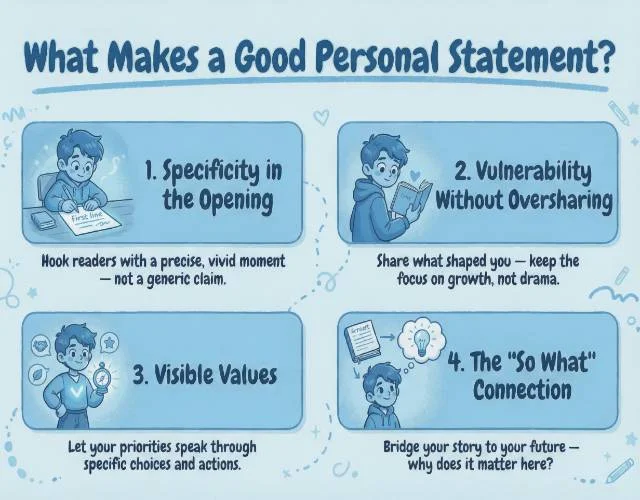
1Specificity in the Opening
Not “I have always loved science” but “The summer I was twelve, I took apart the family washing machine to find out why it made noise.” The second sentence tells you something about a specific person. The first applies to thousands of applicants simultaneously.
Admissions officers identify generic openers within the first sentence. Specificity in sentence one is the change that produces the clearest improvement in any draft.
CollegeEssay.org’s personal statement writers flag the generic opener as a recurring pattern in first drafts from otherwise capable applicants.
2Vulnerability Without Oversharing
The best statements let the reader feel close to the writer by the time they reach the last line. That does not mean revealing trauma or private hardship for its own sake. It means being honest about a genuine tension, a moment of doubt, or a decision that was harder than it appeared.
Essays written entirely from an analytical stance, without any emotional exposure, do not make the reader feel they know the applicant. Essays that drop the reader into an honest moment do.
3Visible Values
By the end of a strong personal statement, the reader should be able to name three or four things you stand for without having been told explicitly. These might be intellectual curiosity, community, precision, or resilience. They emerge from the specific examples you choose and the way you reflect on them.
When you read back through a draft, ask yourself: what would a stranger conclude about what matters to me? If the answer is vague, the essay needs more specific moments.
4The “So What” Connection
For every experience you describe, the essay must answer: what did this reveal about how I think or act? A student who catalogued invasive plant species and stopped there has told a story.
A student who catalogued those species, then connected that pattern of noticing to a research interest and a way of operating in the world, has written a personal statement. The difference is not length. It is a reflection.
How Should You Structure a Personal Statement?
A personal statement opens with a specific scene, builds through body paragraphs that connect that scene to how you think, and closes by naming the program and your next step.
1. The opening paragraph
2. The body paragraphs
3. The closing
On word count: the Common App accepts personal statements between 250 and 650 words. Most strong statements run 550 to 650. Under 500 typically signals an underdeveloped response.
For a paragraph by paragraph breakdown of each section, see our personal statement format guide.
If you understand the structure but cannot land on the opening scene, if you know it needs to be specific and true to you but cannot identify which moment it should be, or cannot make the language work once you find it, our personal statement writing service is built for exactly that problem. You bring the experiences and the program context; we shape them into the opening that gets the reader to slow down.
How to Start a Personal Statement: The Opening Line Framework
The strongest personal statement opening puts the reader inside a specific moment before explaining anything about you. Five opening types consistently get flagged and signal in the first sentence that the essay was not written specifically enough.
“A personal statement is your chance to tell the admissions committee who you are.” This fails because it tells the reader something they already know. The person holding your file is the admissions committee.
“Have you ever wondered what drives a person to succeed?” This fails because it hands the reader a question they did not ask and positions you as the one asking rather than the one with the answer.
“I have always loved biology.” This fails because it applies to thousands of applicants simultaneously. The word “always” signals a claim without a specific moment to support it.
“Growing up was not easy.” This fails because it is a setup rather than a story. It prepares the reader for something without showing them anything yet.
Any sentence that begins with someone else’s words fails because the reader came to hear from you. A quote delays that by at least one sentence, and that first sentence is the one the reader uses to decide whether to slow down.
The strong alternative puts the reader inside a specific moment. It names a place, a time, an action, or a tension. The reader learns something from sentence one.
Here is the same student, two versions of the same opening:
- Weak“I have always been passionate about environmental science and knew from a young age that I wanted to make a difference.”
- Strong“The summer before ninth grade, I catalogued 47 species of invasive plants along a two mile stretch of the Delaware River and sent the list to the county parks department. They did not write back.”
Both come from the same student writing about the same experience. The second shows you what the first only claims, and it opens a question: what happened next? That question is what carries a reader through 650 words about a person they have never met.
Before you write, list five adjectives that describe how you operate. These might be words like observant, stubborn, methodical, skeptical, or generous.
For each adjective, find a specific moment when that quality was visible in your actions. Your opening scene should come from one of those moments.
This approach gives you a story to tell before you sit down to write it, rather than trying to construct a story and a character at the same time.
How to Write a Personal Statement for College Step by Step
Writing a strong personal statement requires brainstorming before outlining, outlining before drafting, and drafting before revising for voice. Skipping any step produces a draft that is harder to fix than one built in order.
Step 1Read the Prompt Carefully
The Common App provides seven prompts for the 2025 to 2026 cycle. Choose the one that fits your story, not the one that sounds most impressive. A prompt that fits your actual experience will produce a stronger essay than a prompt you have to stretch to meet.
For help matching your story to the right prompt, our personal statement prompts guide walks you through each of the seven Common App options with examples.
Step 2List Your Adjectives
Write five words that describe how you think and operate. These become the backbone of what your essay needs to communicate. If you cannot name them before you write, the essay will struggle to show them after.
CollegeEssay.org’s writing team reviews personal statement drafts at every stage of this sequence and finds the adjective step is the one writers skip.
Step 3Find the Scene
Identify the specific moment that shows at least two of your adjectives in action. This is your opening.
The scene should be small enough to fit in one paragraph and specific enough that only you could have lived it.
Step 4Draft Without Editing
Write the full statement from beginning to end without stopping to improve the language. Get the story down before you try to refine it.
A revised draft of an honest story is almost always stronger than a polished draft of a vague one.
Step 5Run the “So What” Test
For every experience you describe, ask: does this sentence show how I think? If the answer is no, cut it or rewrite it so it does.
An experience that does not connect to how you operate belongs in your activities list, not in 650 words of narrative.
Step 6Read it to Someone Who Does not Know You Well
If they can name one specific thing they learned about you by the end, the essay is working. If they say “this sounds like you” without being able to say what they learned, the essay needs more specificity.
The goal is not to sound like yourself. It is to show yourself specifically enough that a stranger recognizes you.
Step 7Proofread Last
Grammar errors matter and should be corrected. They matter less than a vague story told grammatically. Fix the story first, then fix the sentences.
What Should You Not Write in a Personal Statement?
Personal statements fail when they open with a generic claim, repeat the activities list, or close without naming the specific program. Each one signals that the essay was not written specifically enough for this applicant.
1Cliche Topics at Cliche Depth
Mission trip epiphanies, sports injury comebacks, and immigrant grandparent tributes are not disqualifying topics. Students have written outstanding statements on all three. But they require execution specific enough that the story could not belong to anyone else.
If your opening line could appear in 500 other essays on the same topic, the essay needs a more specific entry point.
2Repeating the Activities List
Your activities section already tells the reader what you have done. The personal statement should add a dimension that the rest of the application cannot.
If the essay describes what you did in a program without connecting it to how that experience changed the way you think, you have used the essay to repeat information the reader already has rather than to advance it.
3A Weakness Named Without Resolution
It is acceptable to address a low grade, a gap, or a failure. The statement must show what changed afterward and what you learned from it. A weakness described without growth signals a lack of reflection, which is exactly the opposite of what the essay is designed to demonstrate.
4Language That is Too Formal
Write at the level of a conversation with a teacher you respect. If you would not say a sentence out loud to someone you trust, rewrite it. The reader wants to hear your voice. A register that does not belong to you signals a draft that has been edited away from the person who lived the story.
5A Generic Closing
“I believe this institution will help me achieve my goals” tells the reader nothing specific. Name a course, a faculty research area, or a program feature. Show that you have thought about this program in particular, not about programs as a category. The closing is your last opportunity to distinguish this essay from one any other applicant could have submitted.
You have the steps, the framework, and the common mistakes to cut. The next problem is executing this in your own voice under a real deadline, which is harder than the steps suggest when every sentence needs to sound like you and better than your first draft at the same time. A professional personal statement writer handles that translation: your stories, your program, your goals, returned as a draft that meets the standard you now know to look for.
How Long Should a Personal Statement Be?
Most personal statements run between 500 and 650 words. The Common App sets a hard ceiling of 650, and you should use at least 500. An essay under 500 words typically reads as underdeveloped, and an essay padded to the limit with filler is weaker than a tight 600 word draft.
For UCAS applications in the UK, the limit is 4,000 characters, which works out to roughly 550 words. For graduate programs, requirements vary between 500 and 1,000 words, and some programs request up to two pages. Always confirm the specific word or character limit in the program’s application instructions before you begin drafting.
What Does a Strong Personal Statement Opening Look Like?
A strong personal statement opening puts the reader inside a specific scene and opens a question the rest of the essay answers.
Here is a student writing about learning to cook from her grandmother:
- Weak“My grandmother has always been an important figure in my life, and the time we spent in the kitchen together taught me values that I carry with me today.”
- Strong“My grandmother never used recipes. Every time I asked how much flour, she said ’until it looks right’ and turned back to the stove. The summer I was fourteen, I followed her around the kitchen with a notebook and wrote down what ’looks right’ actually meant in every dish she made.”
The weak version makes a claim. The strong version opens a question. The reader of the strong version wants to know what was in that notebook, and that question is the pull that carries someone through 650 words about a person they have never met.
The strong version also shows two character qualities without naming them: precision and the drive to understand systems. Those qualities carry through the rest of the statement and give the reader a coherent picture of who the applicant is. The weak version shows neither.
For fully annotated examples across different topics, program types, and application contexts, see our personal statement examples library.
You can now identify what a strong personal statement does differently from a weak one, and you have the framework to apply it. Writing one under a deadline that sounds like you, builds from a specific opening, and holds its argument through the close is a different problem from understanding the principles. If you would rather have someone who has worked on thousands of these statements handle it, get CollegeEssay.org’s personal statement service and submit knowing the essay is doing its job.
Frequently Asked Questions
No. Starting a personal statement with someone else’s quote delays your voice by at least one sentence and is one of five opening types admissions officers flag immediately.
The reader came to learn about you, and opening with another person’s words delays that by at least a full sentence. Lead with your own voice from sentence one, in a scene that puts the reader inside a specific moment from your life.