The most common UC Personal Insight Question mistakes are: writing in a formal academic tone, wasting words on slow openings, telling instead of showing, not answering the full prompt, naming a specific UC campus, overlapping topics across four essays, and using clichés.
This guide covers all 10 with before/after examples and a self audit checklist. If you're not yet familiar with how UC PIQs work, start with the complete guide to UC personal insight questions first.
The good news? Almost every common mistake is preventable. This article covers the 10 most frequent ones, organized by category, with concrete before/after examples and a self-audit checklist you can run on your own drafts before you hit submit. If you'd rather have someone else catch them for you, our expert UC essay review service does exactly that.
Why UC Essays Get It Wrong More Than Students Realize
The UC Personal Insight Questions aren't like other college essays. They're short 350 words, and they're read fast, by people managing dozens of applications per day. That format creates a specific set of traps that most students don't know exist.
The 350 word limit is actually the root cause of many mistakes. Students either try to cram in too much and end up vague, or they play it safe and end up saying nothing at all. UC's own published admissions guidance flags common pitfalls like repeating topics across essays or writing too formally, but most students never see it.
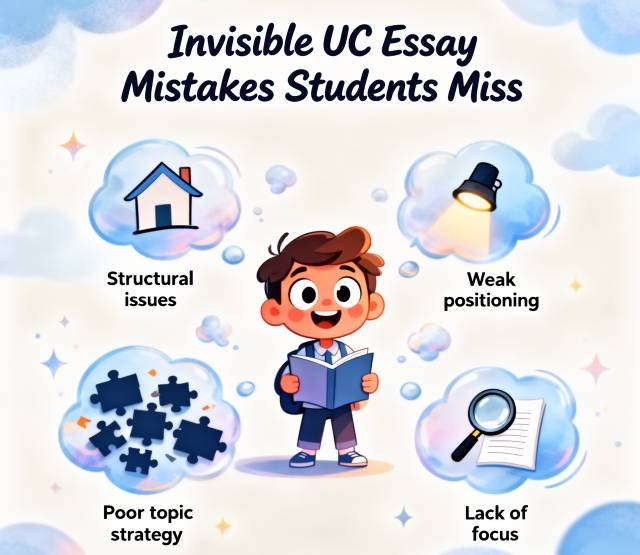
"Most UC essay mistakes aren't accidents, they're just things no one told you to look for."
Different mistakes are easiest to catch at different stages. Use this before you read the full list it tells you where to focus your attention right now:
| Draft Stage | Mistakes to Focus On | Why Now |
|---|
| First draft getting it down | #4 (Full prompt), #6 (Topic overlap), #9 (Activities list repeat) | Structural mistakes are cheapest to fix before you're attached to the writing |
| Revision shaping the essay | #1 (Academic tone), #2 (Slow start), #3 (No specifics), #7 (Clichés), #8 (Acronyms) | Sentence-level mistakes are easier to spot once the structure is settled |
| Pre-submission final check | #5 (Campus name), #10 (No self-audit), checklist | These are invisible until everything else is done check them last |
UC PIQ Mistake #1: Writing Like It's a Class Essay
A lot of students slip into academic mode when the pressure's on. The sentences get longer. The vocabulary gets fancier. The passive voice creeps in. Before long, the essay sounds like a term paper.
UC readers don't want polished academic writing. They want your actual voice the way you'd explain something to a teacher you actually like. Over-formal writing signals that you don't understand what a PIQ is supposed to do.
Before: "Through sustained engagement with extracurricular activities, I have developed transferable skills applicable to a collegiate environment."
After: "I spent three years running the school's robotics club from a team of four kids to a 28-person program that made state finals. I didn't know I could do that."
The second version tells a reader something. The first tells them nothing.
Fix it: Write your first draft like you're explaining the story to a trusted teacher. Use "I." Use short sentences. Then go back and clean it up but don't clean out the personality. |
UC PIQ Mistake #2: Are You Wasting Words on a Slow Start?
You only have 350 words. A three-sentence intro that sets a scene or restates the prompt costs you roughly 10% of your entire essay before you've said anything real.
This is one of the most common UC PIQ mistakes and one of the easiest to fix. Readers don't need a runway. They need your actual essay.
Before: "The wind moved through the tall grass as I stood on the field, reflecting on how far I'd come since that difficult afternoon two years ago when everything changed."
After: "I made a huge mistake in the third inning, and it cost us the regional title."
The second version is already in the story. The first one is still warming up.
Fix it: Find your second or third sentence the one where something actually happens and make that your opening. Cut everything before it. |
UC PIQ Mistake #3: Telling Instead of Showing (No Specifics)
"I'm a hard worker." "I'm passionate about helping others." "This experience taught me the value of perseverance."
Every applicant says something like this. Without a specific moment, a specific outcome, or a specific detail only you could provide, these sentences are invisible to admissions readers.
Before: "I am determined and don't give up easily when faced with challenges."
After: "I stayed after practice every Tuesday for three months until I could clear 5'9". My coach thought I'd quit. I didn't."
The difference isn't effort it's specificity. Numbers, names, outcomes, and concrete moments make claims real.
Fix it: Go through your essay and circle every abstract claim. For each one, ask: what's the specific moment that proves this? Write that moment instead. |
UC PIQ Mistake #4: Are You Answering the Full UC Prompt?
Each UC Personal Insight Question has multiple parts. Students often answer one part really well and ignore the rest then wonder why the essay feels incomplete.
Take Prompt 5, for example. It asks about a challenge or failure AND what you learned from it AND how it affected your academic development. Writing 350 words only about the challenge itself without getting to the last two parts leaves readers with an unfinished answer. That's a problem.
Fix it: Before you draft, break the prompt into sub-questions. Write them out. Then confirm every sub-question gets at least one or two sentences. If one part is missing entirely, the essay isn't done yet. |
UC PIQ MistaKe #5: Mentioning a Specific UC Campus
This one surprises people, but it's a real issue. If you write "when I join Berkeley's research program" or "I'm excited to contribute to UCLA's community," every other UC campus you applied to reads that exact essay and it reads like you don't actually want to be there.
Naming one campus can quietly hurt your application at every other campus on your list.
Fix it: Search your essays for any campus name before submitting. Replace "UCLA" or "Berkeley" with "the UC system" or leave the institution unnamed. Your essays should work for all your UC applications equally. |
Even better: draft UC-agnostic from the start. If you write "the UC campus I'm applying to" instead of a specific name during drafting, you never have to patch the wording later, and patched wording often reads as awkward even after the name is removed. |
?
Improve Your UC PIQ Drafts
Get detailed feedback to refine and strengthen your answers
UC PIQ Mistake #6: Overlapping Topics Across Your Four Essays
UC readers evaluate your four essays together, not individually. If all four showcase the same trait leadership in class, leadership in sports, leadership in community service, leadership in your job you've used 1,400 words to say one thing about yourself.
The opportunity here is to show multiple dimensions of who you are. Four essays, four different things a reader learns about you. That's the goal. For more on how to approach topic selection so this doesn't happen, see how to choose which 4 UC PIQs to answer.
"The constellation check: after drafting all four, ask does a reader know four different things about you? If not, something's overlapping."
There's a related mistake that's harder to spot: four essays with different topics that all end the same way. If every reflection closes with a version of "this taught me the value of hard work" or "I learned I can handle more than I thought," the essays feel repetitive even though the topics aren't. UC readers evaluate tone and reflection across all four, not just topics. Vary not just what you write about but what each essay reveals about how you think.
Fix it: Map out what each essay reveals before you commit to topics. If two essays are showing the same quality in different settings, one needs to change. |
UC PIQ Mistake #7: Using Clichés and Generic Language
You know these when you read them: "I've always been passionate about..." "This experience taught me that hard work pays off..." "Through determination and perseverance, I overcame..."
Clichés are the fingerprint of AI generated content and of essays written on autopilot. Admissions readers recognize them immediately, and they flatten your voice to nothing.
Common phrases to delete:
- "I've always been passionate about"
- "This experience taught me"
- "I learned that hard work pays off"
- "I stepped outside my comfort zone"
- "Made me the person I am today"
- "Changed my perspective on life"
- "Gave me a new outlook"
- "I realized the importance of"
Fix it: For every cliché you find, ask: what's the version only I could write? If someone else could have written that sentence, rewrite it. |
UC PIQ Mistake #8: Using Acronyms, Slang, or Informal Shortcuts
Your school knows what NHS stands for. DECA makes sense in your district. But UC admissions readers handle thousands of applications from schools across California and beyond they may not know your school's specific clubs, programs, or shorthand.
Unexplained acronyms create friction. Casual slang signals a lack of care for the reader.
Fix it: Spell out every organization name on first use. Treat it like writing for a professional audience you've never met clear and considered, but still in your own voice. |
UC PIQ Mistake #9: Writing Essays That Mirror Your Activities List
Your UC application already includes your activities and awards. Your PIQs exist to add depth to give context, meaning, and personality to what's already there.
When students use their essays to re-list achievements, they waste the one place in the application where they can actually speak as a person, not a resumé.
Fix it: For every essay topic you're considering, ask: "What does this reveal that isn't already visible in my application?" If the honest answer is "not much," pick a different angle or a different topic entirely. |
UC PIQ Mistake #10: Submitting Without a Self-Audit
Most students proofread. Few students actually audit. There's a real difference. Proofreading catches typos. Auditing catches strategic errors the kind that don't look wrong on the surface but quietly weaken the essay.
Use the checklist below before you submit anything.
UC Essay Self Audit Checklist (Run This Before You Submit)
Run this checklist on every UC PIQ draft before you submit it to catch the strategic errors a casual proofread misses.
- My opening sentence doesn't restate the prompt or set a scene
- I answered every sub-question in the prompt
- I used at least one specific moment, name, or number
- I don't mention a specific UC campus by name
- My four essay topics reveal four different things about me
- No clichés or phrases anyone could have written
- All acronyms are spelled out on first use
- My tone sounds like me talking to a trusted adult, not a formal paper
- The essay is under 350 words and doesn't feel padded
- I haven't listed achievements already covered in my activities section
- At least one person with UC admissions knowledge has read this
- I read it out loud and it sounded natural
"If you can check every box on this list, your essay is in better shape than most."
UC Transfer Applicants: 3 Additional Mistakes
If you're applying as a transfer student, the 10 mistakes above all apply to your PIQs. But transfer applicants also make three mistakes that freshmen never face:
Transfer Mistake 1: Treating the Required Prompt like a Resume Summary
The major preparation essay isn't a list of your courses and grades. It's a 350-word argument that you're ready for upper division coursework. Every sentence needs to be evidence of readiness for a specific course, a specific project, a specific skill, not a transcript in prose form.
Transfer Mistake 2: Writing About High School Instead of Community College
Many transfer students default to high school stories because that's what college essay guides focus on. UC admissions wants to hear about your time at community college, the classes you took, the responsibilities you held, and the person you became. Your CC years are your primary credential. Use them.
Transfer Mistake 3: Writing Defensively About the Transfer Path
Some transfer applicants spend words explaining why they didn't go straight to a four-year school. You don't need to apologise for the transfer path. UC isn't looking for regret; they're looking for proof you've made the most of where you've been.
Simplify Your UC PIQ Writing Process
Follow a clear, step-by-step approach to complete your essays
- Easy writing framework
- Step by step guidance
- Prompt breakdown support
- Editing and revisions