The UC application activities section is a structured list of up to 20 entries across 6 categories: awards, educational preparation programs, extracurriculars, other coursework, volunteering, and work experience, with up to 350 characters per description.
You just finished writing your UC PIQs, you're feeling good, and then you notice it: a whole separate section asking you to list your activities, awards, and experiences. It's not as scary as it looks.The UC application activities section is where you list and briefly describe up to 20 activities, awards, and experiences that show who you are outside the classroom. If you'd rather have someone guide you through the whole UC application, our UC application help service covers both the PIQs and the activities section.
This guide walks you through all 6 categories, how to write descriptions that actually stand out, how to order your list, and crucially, what to do if you feel like you don't have enough activities to fill the slots.
If you're still working on your PIQs, our how to write your UC personal insight questions guide covers that side in depth.
What Is the UC Activities Section (and Why It Matters)?
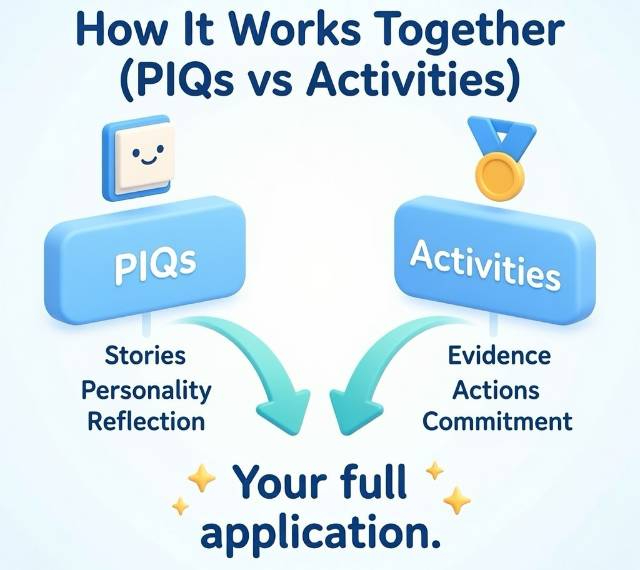
The activities section is a required part of the UC application, sitting alongside your PIQs, GPA, and course history. You can list up to 20 total entries across 6 categories.
Admissions readers use this section to understand who you are beyond your transcript. They're looking for patterns: What did you commit to? What did you lead? What did you actually do when you weren't in class?
Your PIQs tell stories about you. The activities section shows the list of ingredients those stories came from. They work together, not in competition.
"The activities section isn't about how many things you've done it's about showing the effort and growth behind the things you chose."
One related section students frequently confuse with the activities section: the Additional Comments field (also called "Challenges & Circumstances" in some application cycles). These are different things. The activities section is a structured list of what you've done. The Additional Comments field is a 550-word free-response space for context that doesn't fit anywhere else, a gap in your record, a family circumstance that affected your grades, or an unusual situation admissions needs to understand. If something significant about your background or record needs explanation, that's where it goes. Don't bury it in an activities description, and don't leave it unsaid just because it doesn't fit a category. For UC's official guidance on the Additional Comments field, see UC's application resource page. |
The 6 Categories Explained for UC Activities (With Character Limits)
The UC application sorts your entries into 6 distinct categories. You'll need to pick the right one for each activity, and each category has its own character limits for descriptions.
Category | What Goes Here | Description Limit |
Awards or Honors | Scholarships, academic awards, recognition include level (school, regional, national) and grade received | 250 characters |
Educational Preparation Programs | Structured programs like AVID, Upward Bound, or GEAR UP | 350 characters |
Extracurricular Activities | Clubs, sports, arts, student government list your role, hours/week, weeks/year | 350 characters |
Other Coursework | College classes, online courses, community college units taken outside your high school | 350 characters |
Volunteering / Community Service | Org name, hours/week, weeks/year, and what you did | 350 characters |
Work Experience | Jobs, paid gigs, internships include employer, job title, hours/week, weeks/year | 350 characters |
One note on placement: if you're unsure which category fits, go with the one that most closely matches the primary nature of the activity. There's no penalty for judgment calls.
"When you're unsure which category to use, choose the one that best matches the primary nature of the activity. There's no penalty for judgment calls."
Note for Transfer applicants: The same 6 categories apply to you. A few things worth knowing specifically: community college clubs and organisations go under Extracurricular Activities, just as high school clubs do. Jobs held during your community college years go under Work Experience. Community college coursework taken as part of your regular enrollment does not go in the Other Coursework category, that's for additional courses taken outside your enrolled institution. Use Other Coursework for online courses, dual enrollment, or programmes taken in addition to your CC studies. For the full UC transfer application guide, see UC transfer personal insight questions. |
How to Write UC Activities Descriptions That Actually Stand Out
You've got roughly 350 characters per entry about two to three sentences. Every word needs to pull its weight.
One quick note before you start: the activity name has its own separate field. Your 350 description characters are purely for what you did and what happened, don't use any of them to restate the activity name you already entered above.
The most common mistake students make is writing about the organization instead of themselves. Admissions doesn't need to know what debate club is. They need to know what you did in debate club, and what happened because of it.
Here's the difference in practice:
Weak Description | Strong Description |
"Member of school debate club. Participated in competitions and practiced every week." | "Competed in 14 regional tournaments as 2nd speaker; helped team reach state finals for first time in 6 years. Led practice sessions for incoming members." |
"Volunteered at local food bank on weekends to help the community." | "Sorted and distributed 2,000+ lbs of food monthly. Coordinated Saturday shifts for a 12-person volunteer team after regular coordinator moved." |
Notice what changes: specificity, numbers, and ownership. The strong versions tell you what this person actually contributed not just that they showed up.
A few rules to follow when writing your descriptions:
- Lead with your role or title if it's meaningful
- Use numbers whenever possible (members, events, hours, dollars raised)
- Active voice, present tense for ongoing activities, past tense for completed ones
- Don't explain the activity, explain your role in it
Building a 350-Character Description: Step by Step
Starting material: "I worked at a coffee shop." (29 characters too thin)
Step 1: Add your role and scope: "Barista at local café, 15 hrs/week, 48 weeks/year." (51 characters)
Step 2: Add one specific responsibility: "Barista at local café, 15 hrs/week, 48 weeks/year. Trained 4 new hires on espresso protocols and opening procedures." (119 characters)
Step 3: Add one outcome or achievement: "Barista at local café, 15 hrs/week, 48 weeks/year. Trained 4 new hires on espresso protocols. Promoted to shift lead after 6 months; managed morning crew of 5." (163 characters)
Step 4: Use remaining characters for anything that reveals character: "Barista at local café, 15 hrs/week, 48 weeks/year. Trained 4 new hires on opening protocols. Promoted to shift lead after 6 months; managed crew of 5. Balanced this with AP coursework and maintained 3.8 GPA." (213 characters still 137 to spare)
"Don't write what the organization does. Write what you did and what it changed."
?
Write UC Essays That Stand Out
Create unique and memorable responses for your application
How to Order Your UC Activities List Strategically
The UC application doesn't rank your categories for you. You decide what comes first.
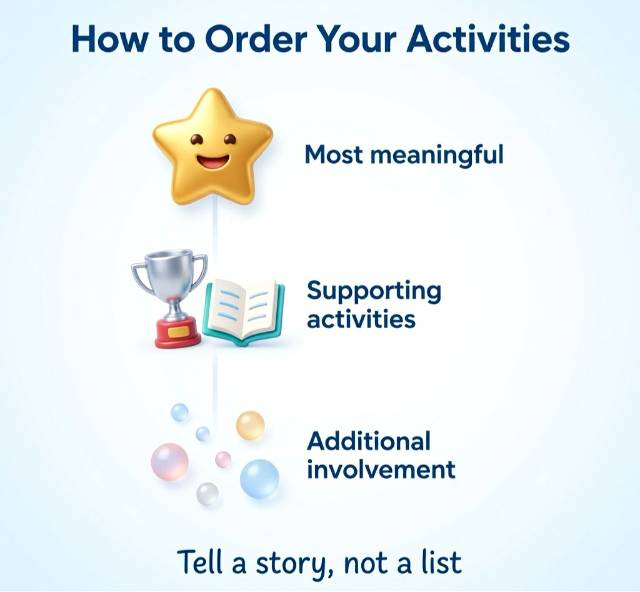
Put your most meaningful activities at the top, not necessarily the most prestigious, but the ones that best represent who you are. If you want admissions to remember you as a community organizer, your community work should lead. If you're a competitive athlete who's also a musician, think about which one defines you more and lead with that.
Read your list from top to bottom and ask: Does this tell a coherent story, or does it look like a random collection of things you signed up for? The best lists feel intentional. There's a thread running through them.
If you have a clear identity arc in science research, mentorship, or public health, group related activities together so that the arc is visible. Don't bury your most important entries in the middle.
"Read your list top-to-bottom like an admissions officer will does it tell a coherent story, or does it feel like a random collection of things?"
What If You Don't Have 20 UC Activities?
Most UC applicants list between 8 and 15 activities. Not filling all 20 slots is normal and does not hurt your application.
What hurts you is padding your list with things you attended twice. Admissions readers can spot filler, and a thin entry draws attention to itself. A list of 10 activities done deeply is stronger than 20 activities done barely.
That said, many students undercount because they forget what counts. Here's what you might be leaving off:
- Part-time or seasonal jobs, even babysitting, cashier work, or mowing lawns count as Work Experience
- Family caregiving, if you care for a sibling, parent, or relative, that's a real commitment and goes under Volunteering/Community Service or Work Experience
- Independent learning, teaching yourself to code, studying a language on your own, writing music, or running an online community all count as extracurriculars
- Informal leadership: organizing a neighborhood cleanup, running a Discord server for your school's students, and helping a friend's family with translation
The goal isn't to hit 20. The goal is an honest, complete picture of how you actually spend your time.
"A list of 10 activities done deeply is stronger than 20 activities done barely."
UC Activities Section vs. Common App Activities List
If you're applying to both UC schools and Common App schools, here's what's different between the two sections:
| Feature | UC Application | Common App |
Total slots | 20 (activities + awards combined) | 10 activities + 5 honors (separate sections) |
Categories | 6 structured categories | One list with an activity-type dropdown |
Character limit | Up to 350 chars (600 for some fields) | 150 characters for descriptions |
Awards placement | Inside the 20-slot section | Separate Honors section |
Fill out the UC activities section first. It's more comprehensive, and once it's done, the Common App version is easier to build from you're compressing rather than creating. For full guidance on how the two applications differ beyond the activities section, see UC PIQ vs Common App essay.
"If you're applying to both, fill out the UC activities section first, it's the more comprehensive one, and it makes the Common App version easier to build from."
Common Mistakes to Avoid in the UC Activities Section
A few things that come up again and again in UC activities sections:
- Writing about the org, not yourself. We covered this above. Your description should be about your role, not a summary of what the organization does.
- Using all your characters in context. Don't spend 200 of your 350 characters explaining what Model UN is. Spend them on what you did in it.
- Listing activities in a random order. Your list tells a story. If it reads like a sign-up sheet, reorder it.
- Forgetting paid work, family responsibilities, and informal activities. These count. Don't leave them off because they don't feel "impressive enough."
- Leaving hours/week or weeks/year vague. These fields matter to admissions uses them to gauge actual time commitment, not just participation. A few practical notes: average across the year if your hours varied (a sport that ran 10 hrs/week in season but 0 off-season might honestly average to 3–4 hrs/week).
Count the summers in weeks/year if you continued the activity. For informal activities like family caregiving or independent learning, estimate conservatively by rounding down rather than up. Admissions readers are experienced at spotting inflated numbers, and a believable 8 hrs/week reads better than an implausible 25.
"The biggest mistake students make in the activities section is writing the Wikipedia entry for their club instead of their own story in it."
Turn Ideas Into Structured UC Essays
Organize your thoughts into clear and impactful responses
- Idea organization support
- Logical essay structure
- Smooth transitions
- Editing for clarity