You're applying to transfer to a UC, and you have four essays to write: one required, three your choice.
This guide covers exactly what the required major preparation question is asking for, how to choose the right three optional prompts from the list of seven, and what makes strong transfer PIQs different from freshman ones. If you're starting from scratch, you should be able to leave with a clear plan for all four.
How UC Transfer PIQs Work (The 1+3 Structure)
Transfer applicants don't pick from 8 prompts like freshmen; they answer 1 required essay and choose 3 from a different list of 7.
Here's how it breaks down:
| Freshman Applicants | Transfer Applicants |
Total essays | 4 | 4 |
Required | None | 1 (major preparation) |
Choice from | 8 optional prompts | 7 optional prompts |
Word limit | 350 words each | 350 words each |
The 7 optional prompts for transfers are the same as freshman prompts 1–5, 7, and 8. Prompt 6, the one about an academic subject you're passionate about, is not on the transfer list. That's intentional: the required question already covers similar academic territory.
Each response has a 350-word cap. There's no minimum, but you'll want to use most of that space. For a broad overview of how UC PIQs work in general, start with this complete guide to UC personal insight questions.
"UC transfer Personal Insight Questions are four short essays, one required prompt about major preparation, plus three chosen from seven optional prompts, each capped at 350 words."
How UC Admissions Reads Your Transfer PIQs Differently
UC admissions officers evaluate PIQ responses on four criteria: clarity, context, initiative, and impact. Not storytelling flair. Not a compelling hook. Whether your response directly answers the question with specific evidence.
This matters more for transfer applicants than for freshmen. The UC application has no letters of recommendation and no alumni interviews. For freshman applicants, high school transcripts and course rigor provide significant context. For transfer applicants, that context is thinner; your community college transcript tells them what you took, but not who you are or whether you can handle upper-division work at a research university. The PIQs carry more of that weight.
The required major preparation essay carries the most weight of your four. UC readers treat it as the primary evidence of readiness, not a formality. The three optional essays fill in the rest of the picture.
One practical consequence: UC readers are not looking for literary craft. They are reading quickly, evaluating for substance. Open with a direct answer to the prompt. Do not use your first 50 words to set a scene.
The Required UC Transfer PIQ: Major Preparation
This is the essay you can't skip, and it's the most important one you'll write.
The full prompt: "Please describe how you have prepared for your intended major, including your readiness to succeed in your upper-division courses once you enroll at the university." |
Admissions readers want to see three things here: that you know where you're headed, that you've taken concrete steps to get ready, and that you can handle upper-division coursework at a UC campus. This isn't the place for vague enthusiasm. It's the place for specifics.
What to include:
- Relevant coursework at your community college (course names, not just "I took classes")
If you've completed IGETC (Intersegmental General Education Transfer Curriculum), mention it it signals to UC admissions that you've met general education requirements and can focus entirely on upper division major coursework from day one. Don't lead with it, but include it as one concrete piece of your preparation evidence.
- A research project, internship, or work experience tied to your field
- A specific moment or assignment that deepened your interest or changed your thinking
- Any skills you've built that directly transfer to your intended major
One timing note specific to UC transfers: if you're applying under the Transfer Admission Guarantee (TAG), your application deadline is September 30, two months before the standard November 30 deadline. TAG is available at six UC campuses (UC Davis, UC Irvine, UC Merced, UC Riverside, UC Santa Barbara, and UC Santa Cruz, not Berkeley or UCLA) and guarantees admission if you meet the GPA and coursework requirements. Your PIQs are submitted as part of the same application, so TAG applicants should have all four essays drafted well before October. For UC's official TAG details, visit UC's TAG page.
What to avoid:
- "I've always been passionate about..." (every applicant writes this)
- Listing courses without explaining what you learned or how they connect
- Talking about high school experiences when you have richer community college material available
One practical note: you need a declared major to transfer. Undecided isn't an option, so this prompt should reflect a genuine and specific direction. |
This is the one essay where admissions wants to see that you know exactly where you're headed and have already started walking that path.
A strong approach: open with a specific moment or discovery that sharpened your focus, then connect it to what you've done since. Let the reader feel your trajectory, not just hear about it.
What a Strong Major Preparation PIQ Looks Like (Annotated)
The semester I took Cell Biology and Organic Chemistry back-to-back wasn't an accident. I wanted to know before transferring whether I could handle the pace, not just pass, but actually absorb the material under pressure. I could.
(Opens with a decision, not a passion claim, immediately signals agency and self-awareness)
In my Cell Biology lab, we ran gel electrophoresis without a step by step protocol. When my sample failed to separate, I had to work backward through the procedure to identify the error I'd under-dyed the sample by 30 seconds. The iterative troubleshooting that took is exactly what upper-division research labs expect. I know because I've since read the methods sections of three papers from labs at my target campus.
(Concrete lab moment proves readiness without asserting a specific action, specific error, specific fix)
I've completed IGETC and added a statistics course specifically because my intended research area requires quantitative analysis. I'm not arriving to decide if I can handle this. I've already decided.
(IGETC mentions signals preparation; statistics course shows forward planning; closing line reframes readiness as settled, not aspirational)
What makes this work: it never uses the words "passionate" or "always loved." Every sentence is evidence. The opening is a decision, the body is proof, the close is confidence without arrogance.
The 7 Optional UC Transfer Prompts (Full List)
Pick three of these. Read them all before deciding.
UC PIQ Prompt 1: Describe an example of your leadership experience in which you have positively influenced others, helped resolve disputes, or contributed to group efforts over time. Best for: Students with team leadership in work, student government, clubs, or community organizing. UC PIQ Prompt 2: Every person has a creative side, and it can be expressed in many ways: problem solving, original and innovative thinking, and artistically, to name a few. Describe how you express your creative side. Best for: Students whose work or studies involve design, creative problem-solving, or artistic projects not just people who paint. UC PIQ Prompt 3: What would you say is your greatest talent or skill? How have you developed and demonstrated that talent over time? Best for: Students with a standout technical, interpersonal, or professional skill they can trace across time. UC PIQ Prompt 4: Describe how you have taken advantage of a significant educational opportunity or worked to overcome an educational barrier you have faced. Best for: Students who navigated real obstacles financial, personal, structural to reach community college and thrive there. UC PIQ Prompt 5: Describe the most significant challenge you have faced and the steps you have taken to overcome this challenge. How has this challenge affected your academic achievement? Best for: Students whose path included a genuine setback and a real recovery. Don't use this for minor inconveniences. UC PIQ Prompt 7: What have you done to make your school or your community a better place? Best for: Students with meaningful volunteer work, advocacy, or community involvement especially if tied to your major or personal values. UC PIQ Prompt 8: Beyond what has already been shared in your application, what do you want UC to know about you? Best for: Students who have a compelling story, identity, or experience that doesn't fit anywhere else. Use this when you have something genuinely important left to say. Applying to UCLA specifically? The optional prompt recommendations above apply across all UC campuses, but UCLA has its own admissions context acceptance rates, IGETC considerations, and what the UCLA admissions office weights most heavily in PIQs. See the UCLA transfer essay guide for UCLA-specific examples and strategy. |
You now know the structure, the required question, and which three optional prompts fit your material. The next problem is sitting down and writing four distinct 350-word essays that each do something different before a hard deadline in November. If that's where you're stuck, our CollegeEssay.org's transfer PIQ writers can handle all four: you tell them your prompts, your stories, and your major, and they return drafts you can review and refine. |
How to Pick Your 3 Optional UC Prompts
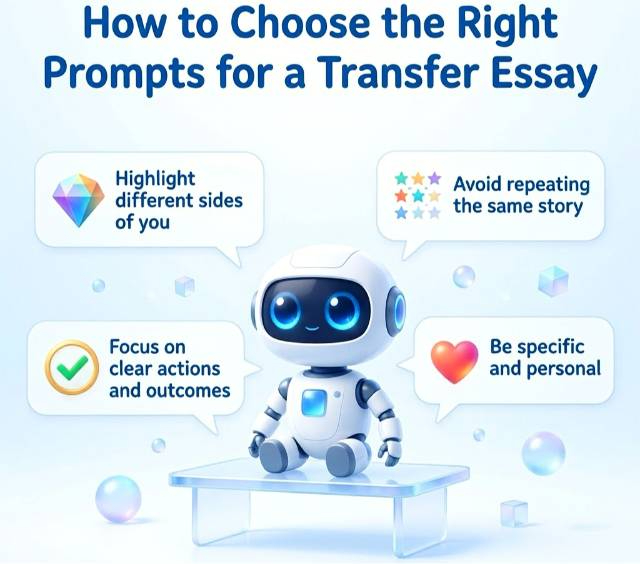
The goal isn't to choose the prompts that sound most impressive. It's to choose the ones that let you tell stories you can't tell anywhere else in the application.
A few rules of thumb:
Cover different ground. If two prompts would lead you to write about the same experience or theme, pick only one. Each essay should reveal something distinct about you.
Play to your strongest material. Don't pick a leadership prompt if your best leadership story is thin. Pick the prompt where you have a real, specific story with a beginning, middle, and outcome.
Use your transfer experience as a feature, not a footnote. Your time at community college probably gave you work history, real responsibilities, and a clearer sense of direction than most 18-year-olds have. That's material. Prompts 4 and 5 in particular often fit transfer students better than freshmen, because you actually have something concrete to write about.
If you're coming from community college specifically, the way you frame your CC path matters as much as the prompt you choose. See our community college transfer essay guide for four specific story types and how to position each one.
Don't pick based on what you think admissions wants. There's no "right" prompt to choose. Admissions officers have read every possible combination. They're looking for authenticity and clarity, not a specific topic.
The best three optional prompts aren't the ones that sound impressive; they're the ones that let you tell stories you can't tell anywhere else in the application.
Writing Your UC Transfer PIQs: What's Different
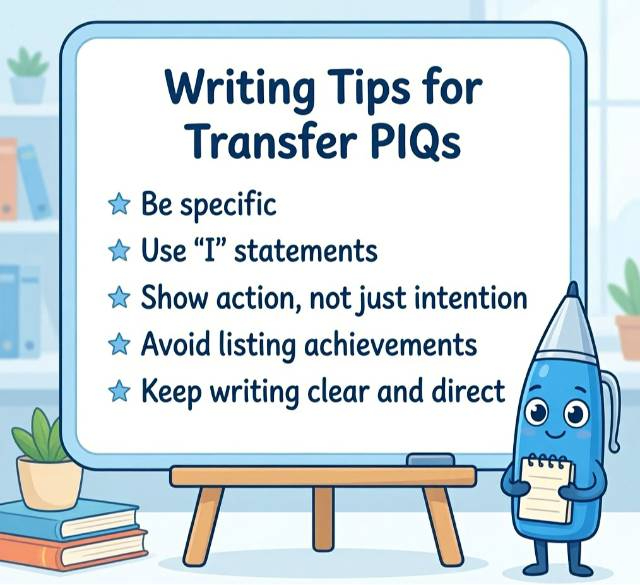
You're not a 17-year-old writing their first real essay. Admissions knows that, and they hold transfer essays to a higher standard: more clarity, more self-awareness, more evidence that you know what you're doing.
A few things that separate a strong transfer essay from a freshman essay:
Your path is the story. Keep the header + 2 sentences max ending at "...resilience, purpose, and the ability to handle real life alongside academics." Cut the rest.
You don't need to apologize for the transfer path. Keep header + 1 sentence: "Admissions isn't looking for regret about the transfer path, they're looking for proof you've made the most of it." Cut the rest.
Maturity reads on the page. Keep header + 1 sentence: "The way you reflect on your experiences signals the kind of student you'll be in upper-division courses: be thoughtful, not just descriptive." Cut the rest.
If you've worked during school, say so. Keep as is, it's already short.
5 Common Mistakes UC Transfer Applicants Make on Their PIQs
- Treating the required question like a resume summary. This isn't a list of your accomplishments. It's an essay about your readiness for upper-division coursework in a specific field. Make it a story, not a transcript.
- Ignoring your community college years. Some transfer students write mostly about high school because that's what other essay guides focus on. But your time at community college, the classes you took, the relationships you built, the person you became, is exactly what admissions wants to hear about.
Those are the mistakes specific to the UC transfer application. For the broader list of what goes wrong across all eight UC prompts vague openings, weak reflections, and misread questions, see the UC essay mistakes to avoid guide. |
You have the structure, the required question unpacked, and a way to pick your three optional prompts. What's left is writing four essays in 350 words each each one doing something the others don't under a deadline that doesn't move. If you'd rather have experienced hands on it, our writers will work from your prompts and your stories and return drafts fast enough to leave room for real revision before November 30.
Need Help With Your Transfer Essay?
We help you craft compelling and authentic transfer essays
- Idea brainstorming support
- Logical essay structure
- Clear and engaging writing
- Professional feedback