What Is an Acceptance Speech
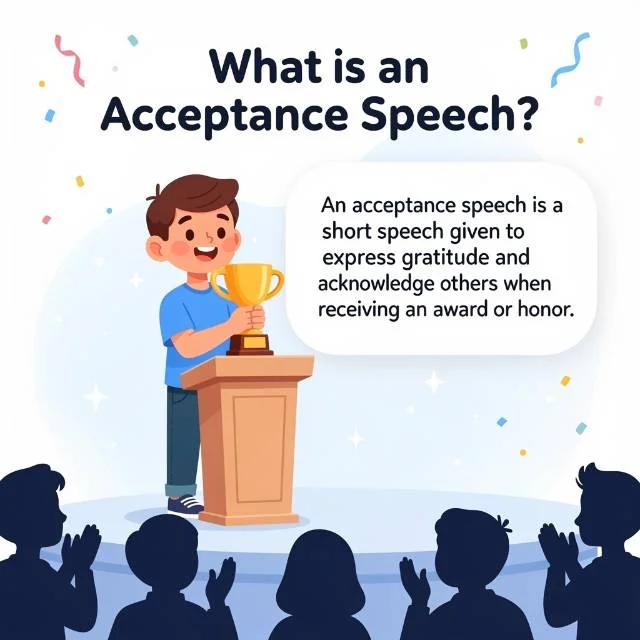
An acceptance speech is the short address you give when you receive an award, a recognition, or a nomination. It’s your chance to thank the people who made it possible, acknowledge what the award means, and leave the audience with something to remember.
These speeches show up across a wide range of events, from school assemblies and scholarship dinners to industry awards, Oscars, and political victory nights. The form stays the same: gratitude, acknowledgement, one personal note, and a clean close. What changes is the tone, the time limit, and who’s in the room.
The goal isn’t to give the best speech of the night. The goal is to sound like yourself, to thank the right people, and to finish while the audience still wants more.
Acceptance speeches are one specific form inside the broader craft of speech writing. If the event actually calls for a different form, the parent guide will help you figure out which fits.
What Makes an Acceptance Speech Memorable: 11 Elements That Work
The eleven elements below appear in almost every acceptance speech that gets remembered and are absent from almost every one that gets forgotten.
- Genuine gratitude. Not performative, not a list you’re powering through. Thanks, that actually sounds like you mean it.
- Specificity about who helped. “Everyone who supported me” is a throwaway line. Two named people with one sentence each about what they did is a speech.
- Brevity. Most great acceptance speeches are under three minutes. Keep the audience wanting more.
- One personal story. Not a memoir. One specific moment that ties to the award.
- Humility without self-deprecation. Acknowledge you earned it. Don’t downplay the work.
- An acknowledgement of the wider group. Team, family, community, whoever’s relevant. Briefly.
- A clear throughline. Your speech should be about one thing, not six.
- A small moment of humour, if it fits. Optional, but it humanises you when it lands.
- Relevance to the room. A school assembly speech sounds different from a Grammy acceptance. Read the event.
- A strong closing line. The last sentence is the one people remember. Make it count.
- A moment about the award or the organisation giving it. One of the strongest speech techniques used by award recipients: spend 15 seconds on the legacy of the award itself, not on you. If the scholarship is named after someone, say a sentence about them. If the award has a history, acknowledge the line of recipients you’re stepping into. This widens the moment from personal to communal and tells the audience you understand what you’re receiving.
How to Write an Acceptance Speech: The 7-Step Method
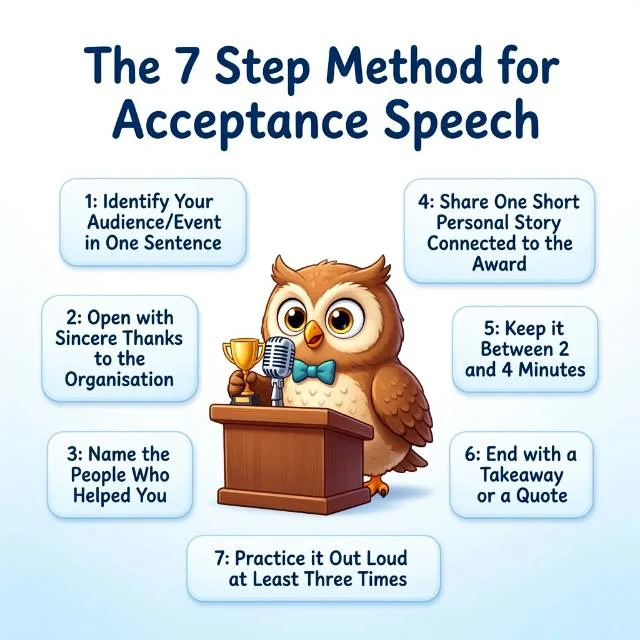
The seven steps below take roughly 30 minutes total and move from identifying your audience to rehearsing a finished draft out loud.
How to Start Writing an Acceptance Speech
Write down: who will be in the room, what the event is, and the tone they’re expecting. A school assembly is warm and brief. A corporate awards dinner is polished and short. A political victory speech is grounded and grateful. You can’t write the speech until you’ve written this line.
Before you draft a single sentence, write a one-line working title for your speech. The audience will never hear it. It’s for you. A working title forces you to decide what the speech is actually about, and every sentence you write after will point back to it.
Examples of working titles that gave executives clarity before drafting:
- “When You Come to a Fork in the Road, Take It”
- “Rejection Is Data, Not a Verdict”
- “The People Who Got Me Here”
- “What This Award Is Really For”
If you can’t title your speech in one line, you don’t know what it’s about yet. Go back to Step 1.
How to Open an Acceptance Speech
Name the award and the body giving it. One sentence is enough. The audience already knows where they are. Don’t spend 90 seconds on the obvious.
How to Thank People in an Acceptance Speech
Pick two or three people. For each one, give a single sentence that tells the audience what that person actually did. “My mum” is a name. “My mum, who drove me to debate practice every Wednesday for four years” is a thank-you. The second version lets the audience meet the person.
How to Use a Personal Story in an Acceptance Speech
One moment. One scene. Not your life story. The best choice is usually the moment you almost gave up, or the moment you realised this thing mattered to you. Thirty seconds of story is enough.
How Long Should an Acceptance Speech Be
Most classroom, event, and professional acceptance speeches should clock in between 2 and 4 minutes. Anything longer needs a reason. Count your words: 150 words per minute is a comfortable speaking pace, so a 3-minute speech is roughly 450 words. Write to that number and resist the urge to pad.
How to End an Acceptance Speech
The close is the line people leave with. You have three options that work:
- A short takeaway drawn from your story (“I’m still bad at accepting help, but I’m getting better”).
- A thank-you that returns to the opening (if you opened with the scholarship body, close by naming them again).
- A quote that does real work, not decoration. If the quote says what you’ve just said in better words, use it. If it’s filler, drop it.
How to Rehearse an Acceptance Speech
Reading the speech silently does nothing. Reading it aloud surfaces every clumsy sentence in the first minute. Stand up, time yourself, and rehearse it three times minimum. By the third pass, the places that slow you down are the sentences that need a rewrite, not the ones that need more practice.
Seven steps in front of you and the blank page still hasn’t moved? That happens, and it’s not a discipline problem. Writing short, heartfelt, structured prose under time pressure is genuinely harder than the steps make it sound. Send us the award, the event, who helped you get there, and how long you have on stage, and our writers can handle your acceptance speech, delivered as a finished draft you can rehearse and adjust.
6 Celebrity Acceptance Speech Examples and What Each One Does Well
The six acceptance speech examples below each demonstrate one specific technique worth borrowing depending on the context of your own award.
| Speaker | Context | Technique to Borrow |
|---|---|---|
| Kamala Harris | First VP-Elect, 2020 | Open by addressing the room, not the audience individually |
| Taylor Swift | 2021 Grammy, Album of the Year | Name collaborators by specific contribution |
| Jelly Roll | 2023 CMT Music Awards | Acknowledge the struggle without self-pity |
| Emma Stone | 2017 Academy Award | Thank nominees with specifics, not platitudes |
| Robert Downey Jr. | Career Recognition Award | Humour early, sincerity second |
| Tim Walz | Gubernatorial Re-election | Close with forward commitment, not just gratitude |
The detailed breakdown of each follows. Skim the table to find the technique that fits your situation, then read the full note.
Kamala Harris, First VP-Elect Speech (November 2020)
How she opens with a direct address (“Good evening. My fellow Americans.”) that anchors the moment before she thanks anyone. In a speech where the stakes are high, grounding the room first is a technique worth borrowing.
Why it works: it widens the acceptance from personal to generational in one sentence. If your award has a lineage (a scholarship named after someone, a tradition you’re stepping into), this structure works.
Taylor Swift, 2021 Grammy for Album of the Year
How she names collaborators by specific contribution, not just title. “Aaron Dessner for bringing me into his world of music” is more memorable than “my producer.”
Why it works: specificity sounds like real gratitude. Generic thank-yous sound like a list.
Jelly Roll, 2023 CMT Music Awards
How he acknowledges the gap between who he was and who he is, without self-pity. “I’ve had a long road to get here, but every moment has been worth it.”
Why it works: if your award came after struggle, naming the struggle briefly is more powerful than hiding it. The audience already knows. Acknowledging it builds trust.
Emma Stone, 2017 Academy Award for Best Actress
How she thanks her fellow nominees sincerely, in a context where that often sounds hollow. “I feel so lucky to be in your company tonight” lands because the line before it is specific (“all just incredible, talented women”).
Why it works: if there are other nominees, finalists, or co-recipients in the room, acknowledging them is polite. Doing it with specifics is what makes the acknowledgement feel true.
Robert Downey Jr., Career Recognition Award
The humour placed early, before the sincere section. Opening on a light note buys him permission to go serious later without it feeling heavy-handed.
Why it works: if your tone is naturally dry or funny, using it in the opening 15 seconds and then shifting to sincerity is a stronger structure than trying to be sincere for the full speech.
Tim Walz, Gubernatorial Re-election Speech (Minnesota)
The shift from thanks to forward-looking commitment in under 60 seconds. “I’m deeply grateful for your trust, and I will work every day to make Minnesota a place where everyone can thrive.”
Why it works: if your award implies an ongoing responsibility (a leadership role, a scholarship with conditions, a community position), closing with what you’ll do next matters more than what you’ve done.
If you want a broader picture of where acceptance speeches sit alongside other occasion-based forms, the guide on types of speeches covers that map.
Short Acceptance Speech Examples (Under 60 Seconds)
A short acceptance speech under 60 seconds uses a three-part structure: thank the organization in one sentence, name one specific person in one sentence, and close with one takeaway.
- Thank + name the award. One sentence.
- Thank one person, specifically. One sentence.
- One takeaway or closing thought. One sentence.
Thank you to the selection committee for the Student Leadership Award. I want to thank my debate coach, Ms. Reyes, who told me in my first year that I was going to be good at this before I had any reason to believe her. What I’ve learned from this programme is that leadership is mostly showing up when it’s inconvenient. Thank you.
Thank you to the leadership team for this recognition. I want to single out my teammate Jordan, who caught three of my biggest mistakes this year and never once made me feel small about any of them. If this award is going to anyone, it’s going to the culture they’ve built on our team. Thank you.
Short speeches feel easier but are actually harder. Every sentence has to carry weight because there are so few of them.
Acceptance Speech Templates for Leadership, Promotion, Election, and Scholarship
Acceptance speeches for leadership roles, promotions, elections, and scholarships each shift the structure away from gratitude and toward commitment or responsibility depending on the context.
Accepting a Leadership Position or Club President Role
The structure shifts from gratitude-heavy to commitment-heavy. You’re not just accepting recognition, you’re accepting responsibility.
Thank you to [the voters / the committee / the team] for trusting me with this role. I want to acknowledge [the outgoing leader / the people who ran alongside me]. My focus for this year is [one or two specific priorities you can actually deliver on]. I’ll need all of you to hold me to it.
Accepting a Promotion or New Professional Role
Corporate audiences expect brevity and a forward look. Skip the extended gratitude. One thank-you, one nod to the team, one sentence about what you’re focused on next.
Thank you. I want to acknowledge [one or two colleagues] who made this possible in ways most of you don’t see. My priority over the next 90 days is [specific focus]. I’m looking forward to getting to work.
Accepting After an Election or Vote
The structure needs to include the people who didn’t vote for you. Acknowledging the loyal opposition is what separates a gracious speech from a triumphant one.
Thank you to everyone who voted for me. I want to also thank [the other candidate / those who supported someone else] for the way this process was run. I take this role seriously, and I intend to represent all of you, not just the ones who picked me. Here’s what you can expect from me in the first month.
Accepting a Scholarship or Academic Award
The donor, the selection committee, and the lineage of the award matter here. If the scholarship is named after someone, acknowledge them.
Thank you to the [committee name] for the [scholarship name]. I’m especially aware tonight of [the person the scholarship is named after, if applicable], whose [specific contribution] made this award possible. This scholarship is going to change what I can do over the next [year / two years / four years]. Here’s what I plan to do with it.
Accepting on Behalf of Someone Else (Absent Honoree, Posthumous, or Team Awards)
When you’re accepting an award for someone who isn’t in the room, the structure shifts in one important way: most of the speech is about them, not about you. Your job is to represent their voice to an audience that came to honour them.
- For an absent living honoree: Thank the committee, explain briefly why the honoree can’t be here (one sentence, no apology), share a short story or quote from them, and close by saying what receiving this means to them. Example: “[Name] asked me to thank the committee directly and to tell you this: she wrote me a note this morning that said one line; ‘Tell them I’m grateful, and tell them I’m still working.’”
- For a posthumous award: The tone is celebratory, not sombre. Focus on what the honoree would have said, what they stood for, and what this award would have meant to them. Audiences expect warmth, not grief. Close with a forward-looking line about how their work continues. Avoid: extended biographical summary, heavy emotion, or making the speech about your relationship to them.
- For a team or group award: Don’t list every team member unless the list is small (under six). Name two or three specific people with specific contributions, then acknowledge the group. “This award belongs to a team of fourteen. Rather than read the list, I want to tell you about three moments that only happened because of them.”
How to Start an Acceptance Speech: 10 Opening Lines That Work
The strongest acceptance speech openings thank the organization directly in the first sentence and avoid filler phrases like ‘wow’ or ‘I wasn’t expecting this.’
- “I am honoured, and I’m going to try to say this without falling apart.”
- “Thank you to the committee. Let me explain what this means to me in under three minutes.”
- “There’s a version of tonight where I didn’t win, and I want to talk about why I’m glad I’m up here instead.”
- “I was told to keep this brief, so I’m going to skip the thanks I rehearsed and say what I actually came to say.”
- “I want to start by naming the person who told me, ten years ago, that I’d never do this.”
- “There are three people in this room without whom I wouldn’t be standing here. I’m going to name them in order.”
- “I have a rule about acceptance speeches: say thank you, mean it, and sit down. Here goes.”
- “I’ve been writing and rewriting this speech all week, and I threw out the last version an hour ago. So this is the real one.”
- “Receiving this award forced me to think about what I actually believe about the work. Let me tell you.”
- “I want to start by reading a note my teacher sent me the day I applied.”
Acceptance Speech Phrases and Templates for Every Section
The phrases below cover every section of a typical acceptance speech including the opening thanks, the named thank-you, the story transition, and the close.
- I want to thank the [committee name] for seeing something in this work that I wasn’t always sure of myself.
- Receiving this from [organisation] means more to me than I’m going to be able to say in the next three minutes, but I’m going to try.
- This award carries a history I’m aware of, and I take it seriously.
- There are three people in this room who know exactly what this moment means. I want to name them.
- I want to say something about [name], which I should have said a long time ago.
- If this award belongs to anyone besides me, it belongs to…
- Let me tell you the moment I almost didn’t get here.
- The reason I’m standing on this stage tonight is a decision I made two years ago.
- I want to tell you about the version of tonight where I didn’t win.
- I don’t know exactly what I’m going to do with this, but I know I’m going to try to deserve it.
- If there’s one thing I’m taking from tonight, it’s this.
- Thank you, again, to everyone who made this possible. I’ll try to make it worth your while.
Quotes for an Acceptance Speech That Actually Earn Their Place
The twelve quotes below work in most acceptance speech contexts because each one expresses a complete idea about effort, gratitude, or persistence in a single sentence.
- “We are what we repeatedly do. Excellence, then, is not an act, but a habit.” — Will Durant, paraphrasing Aristotle
- “It always seems impossible until it’s done.” — Nelson Mandela
- “Fall seven times, stand up eight.” — Japanese proverb
- “The best time to plant a tree was 20 years ago. The second best time is now.” — Chinese proverb
- “Gratitude is not only the greatest of virtues but the parent of all others.” — Cicero
- “The only way out is through.” — Robert Frost
- “Alone we can do so little; together we can do so much.” — Helen Keller
- “Hard choices, easy life. Easy choices, hard life.” — Jerzy Gregorek
- “You do not rise to the level of your goals. You fall to the level of your systems.” — James Clear
- “Don’t let what you cannot do interfere with what you can do.” — John Wooden
- “Success is not final, failure is not fatal. It is the courage to continue that counts.” — Winston Churchill
- “The cave you fear to enter holds the treasure you seek.” — Joseph Campbell
Acceptance Speech Ideas When You’re Stuck on What to Say
When an acceptance speech feels impossible to start, the problem is almost always the same: the speaker does not yet know what the speech is actually about and needs to pick one angle before writing a single sentence.
- What this award represents about the work, not just the outcome.
- The person who believed in you before you believed in yourself.
- The specific moment you almost quit, and what kept you in.
- What you got wrong that led to this.
- Who this award is really for, outside yourself.
- The version of you from 3 years ago, and what they’d say.
- A lesson that surprised you along the way.
- What you owe to the people who didn’t win tonight.
- What you plan to do now that this is done.
- The simple truth you learned that you wish you’d known earlier.
You have the method, six real speeches to learn from, and templates for the specific situations that come up most. What’s left is the part that takes the most time: writing two to four minutes of prose that sounds like you, rehearsing it until it’s smooth, and showing up ready. If the event is close and you’d rather spend that time on delivery than on drafting, you can ask us to write my acceptance speech, and we’ll send a finished draft back inside 24 hours, built to your exact time limit, with the people you want to thank already in place.
10 Tips for Giving an Acceptance Speech People Remember
The ten tips below appear in almost every acceptance speech people remember and are missing from almost every one they forget.
- Open with thanks. Not with “wow.” “Wow” is filler. The audience already knows you’re surprised or moved. Start with the thing.
- Keep it between 2 and 4 minutes. If you’re told to keep it under a minute, do it. Overrunning is a bigger sin than under-running.
- Speak from the heart, not from a page. Use notes, not a script. Eye contact with a few faces in the audience is what makes a speech feel delivered, not read.
- Tell one short story. One specific scene beats three general statements every time.
- Name specific people, not categories. “Ms. Reyes” lands. “All my teachers” evaporates.
- Add a moment of humour if it fits you. If it doesn’t, don’t force it. Humour that feels tacked on is worse than no humour.
- Land the close deliberately. The last sentence is what the audience will repeat to someone in the car on the way home. Write it first, not last.
- Pause on your important lines. A one-second pause before a key sentence makes it hit harder. A pause after gives the audience time to absorb it.
- Practice out loud, at least three times. Silent reading doesn’t reveal clunky sentences. Speaking to them does. The CollegeEssay.org writers who work on acceptance speeches across school and professional contexts consistently find that speakers who rehearse out loud three times deliver speeches that sound natural and speakers who rehearse silently do not.
- Make eye contact with three specific people in the room. Not the whole audience. Three faces. Rotate between them. This is what separates a presentation from a conversation.
If you cry, pause. Take a breath. Say “give me a second.” Audiences are patient in these moments and a short pause reads as genuine, not as failure. Don’t apologise.
If you freeze and forget your next line, glance at your notes and take a sip of water. A 3-to-5-second pause is invisible to the audience. A 20-second panic is not. The sooner you accept the pause, the shorter it gets.
If you get overwhelmed and can’t continue, close early with one clean line. “Thank you, all of you,” delivered with eye contact, is a better ending than struggling through three more paragraphs. A short strong speech beats a long broken one.
None of these are failures. The audience is on your side. You won the award, they want you to succeed on the stage.
Common Acceptance Speech Mistakes to Avoid
The ten mistakes below account for most forgettable acceptance speeches and almost all of them come down to going too long or thanking people in categories instead of by name.
- Forgetting to thank the people who matter most. Run your list past someone who was there. You’ll forget at least one person.
- Going too long. Every minute past the fourth is a minute the audience starts to lose patience. Respect the clock.
- Too much humility. You won the award. Acknowledge that. False modesty reads as disingenuous.
- Reading from a script word-for-word. Notes, not a script. The audience can hear the difference.
- Talking too fast because of nerves. Slow down. Pause more than feels natural. Nerves speed you up, so build that in.
- Quoting three different people. One quote, maximum. More than one and the speech stops being yours.
- Not rehearsing. It always shows. Three rehearsals minimum, out loud, timed.
- Ignoring the audience. A speech written for yourself reads like you’re at a therapy session. Write for the room.
- Overusing jargon or insider language. Unless every person in the room knows the reference, cut it.
- Ending abruptly or with “I guess that’s it.” Plan your close. Write it first if you have to. The final line is the one that sticks.
You’ve seen how an effective acceptance speech is structured and what makes it memorable. If you’d prefer to spend your time rehearsing instead of writing, send us the details of your award, event, desired length, and key thank-yous. Our CollegeEssay.org speech writing team can draft the full speech to your time limit, audience, and tone, usually within 24 hours.
Frequently Asked Questions

-21369.jpg)