3 Types of Speeches According to Purpose
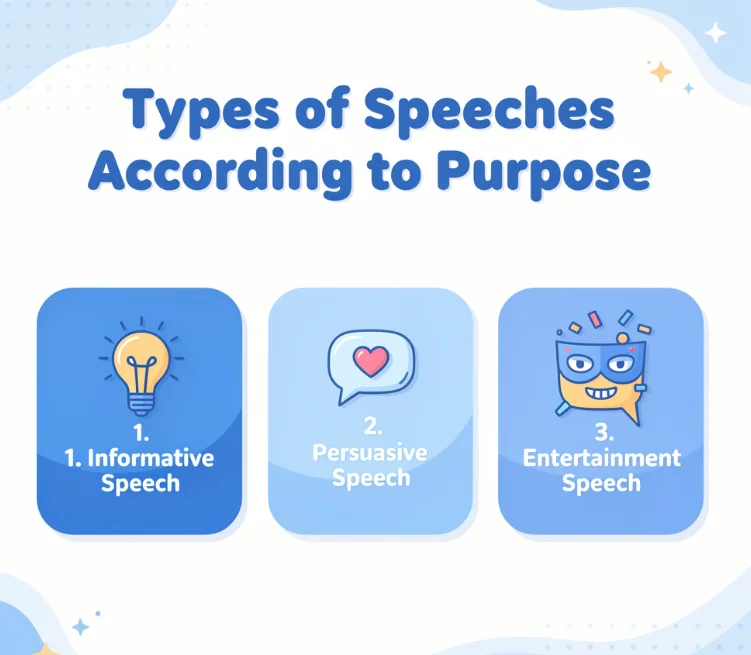
The three types of speech according to purpose are informative, persuasive and entertainment and the purpose type determines the topic, tone, structure and evidence a speaker uses.
Textbooks sometimes list demonstration or demonstrative speech as a fourth purpose type. Most modern communication courses treat demonstration as a sub-type of informative speech rather than a separate category, since its purpose is still to inform, just with physical or visual demonstration. We cover it briefly below and link to a dedicated guide if that’s what you’ve been assigned.
Informative Speech
An informative speech educates the audience on a topic without taking a position or making an argument. The speaker’s job is to take something complex (a process, a concept, an event, a phenomenon) and make it clear, accurate, and memorable. There is no argument being made and no persuasion attempted. The audience should leave knowing something they didn’t know before.
- Explain a specific subject clearly
- Provide useful, accurate information
- Increase the audience’s understanding of a topic
Informative speeches rely on facts, data, and examples rather than emotion. A lecture, a news report, a how-to demonstration, and a research presentation are all informative speeches.
- The history and cultural impact of jazz music
- How vaccines work
- The difference between weather and climate
- The basics of personal finance for first-year college students
If you’ve been assigned an informative speech, our informative speech examples page has full sample speeches.
Persuasive Speech
A persuasive speech is built to change what the audience thinks, feels, or does. You’re taking a position, making an argument, and backing it with evidence that moves the audience toward your conclusion. Campaign speeches, TED talks with a clear thesis, and classroom debates all fall into this category.
- State a clear position on a specific issue
- Support that position with strong evidence
- Address counterarguments directly
- Use persuasive language calibrated to the audience
The line between informative and persuasive is sharper than it looks. An informative speech about climate change presents the data; a persuasive speech about climate change argues for a specific policy response. If your speech has a “therefore you should…” at the end, it’s persuasive.
- Why colleges should make mental health days part of the academic calendar
- The case for a four-day work week
- Why student loan interest rates should be capped at inflation
For full persuasive speech examples, see our persuasive speech examples collection.
Entertainment Speech
An entertainment speech exists to engage and amuse the audience. It’s lighter in tone, often humorous, and usually tied to a specific social setting (weddings, awards banquets, roasts, retirement parties, graduation parties). The speaker is still delivering a message, but the primary contract with the audience is to have a good time.
- Keep the audience engaged and entertained
- Use humor, storytelling, and timing to land moments
- Deliver a light message that fits the occasion
Entertainment speeches are not stand-up comedy. They have structure, a point, and usually an emotional core (gratitude, celebration, affection, nostalgia). The humor serves the message, not the other way around.
- A best-man speech for a college roommate
- A retirement toast for a longtime mentor
- A humorous look at freshman-year mistakes at a graduation dinner
If you also need the broader speech writing guide that covers structure, format, and how to prepare, start there. This page is specifically about classification.
Is a Demonstration Speech a Separate Speech Type or a Form of Informative Speech?
A demonstration speech is a sub-type of informative speech and not a separate purpose category because its goal is still to educate the audience, just through physical or visual demonstration rather than facts and explanation alone.Where Do Motivational and Business Speeches Fit in the Classification?
Motivational speeches are a sub-type of persuasive speech and business speeches such as pitches and keynotes are persuasive or informative by purpose depending on whether they argue for a decision or simply present information.
- Motivational speech. A motivational speech is technically a sub-type of persuasive speech: the purpose is to move the audience toward belief or action, just toward a more personal outcome (pursue a goal, overcome a fear, make a change). If your assignment is a motivational speech, treat it as persuasive with a heavier emotional register and more storytelling. For topic ideas, see our motivational speech topics guide.
- Business and professional speeches. Pitches, keynotes, sales presentations, and TED-style talks are all workplace variants. Most pitches and sales presentations are persuasive by purpose and extemporaneous by delivery. Most keynotes are informative or persuasive and are often delivered manuscript-style when the messaging is tightly controlled, extemporaneously when it isn’t. TED talks are almost always persuasive-extemporaneous with heavy rehearsal.
Other Named Speech Types You May See
These terms come up in textbooks and assignment briefs but aren’t separate purpose categories: they map back to the three main purposes above:
- Pitch speech: Persuasive purpose, short format, usually for business/sales. Maps to persuasive.
- Debate speech: Uses persuasive mechanics but the goal is to justify a position within a formal debate structure, not to convince neutrally. Maps to persuasive.
- Oratorical speech: Formal, ceremonial speaking (graduations, state occasions). Usually maps to entertainment/commemorative or persuasive depending on content.
- Farewell speech: A sub-type of commemorative speech given when someone leaves a role, place, or group. Maps to entertainment/commemorative.
- Explanatory speech: A sub-type of informative speech focused on “how” or “why” something works. Maps to informative.
- Eulogy: A commemorative speech specifically honoring someone who has died.
Still unsure which purpose and delivery combination your assignment calls for? If you've got the classification but the actual writing is the bottleneck, our writers can sort the framing and deliver a speech built to your type, time limit, and audience. Get professional speech help delivered within 24 hours and focus your prep time on rehearsing.
4 Types of Speeches According to Delivery
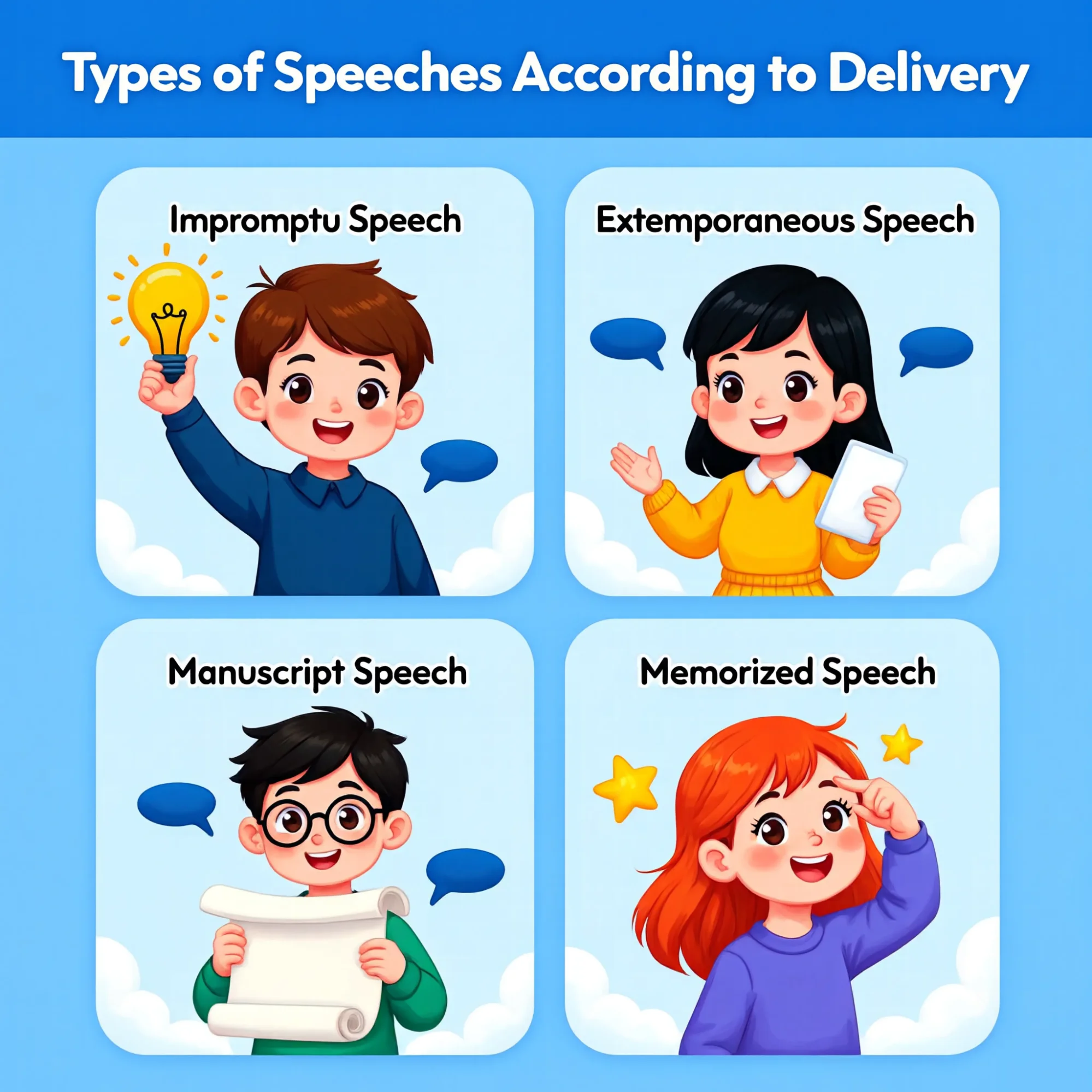
The four types of speech according to delivery are impromptu, extemporaneous, manuscript and memorized and the method used depends on how much preparation time the speaker had and how precisely the wording must be controlled.
Impromptu Speech
Impromptu speeches are delivered without any preparation. You’re called on and you speak. A toast at a dinner that the host springs on you, a question from your professor that you have to answer in front of the class, or a wedding moment where someone hands you the mic are all impromptu situations.
Since you have no prep time, the skill is entirely about structure on the fly. Most experienced speakers use a mental framework (Point-Reason-Example-Point, or Past-Present-Future) to keep themselves coherent for 60 to 90 seconds.
If your class assigns impromptu speaking practice, our impromptu speech topics page has practice prompts you can draw from.
Extemporaneous Speech
Extemporaneous speeches are the most common delivery method in college public speaking classes. You prepare thoroughly (research, outline, key points, evidence) but you don’t write out or memorize the full text. You speak from notes or a brief outline, which keeps the delivery natural and responsive to the audience.
This is the default delivery method for classroom speeches, business presentations, conference talks, and most political speeches outside of formal state occasions. If your professor says “don’t read from a script and don’t memorize it,” they’re asking for an extemporaneous delivery.
Based on orders handled by CollegeEssay.org, extemporaneous is the delivery method specified most often in college speech assignments, which aligns with what most public speaking instructors assign as the default.
If you’re interested in delivering a speech with minimal preparation while maintaining a natural speaking style, explore our complete guide to extemporaneous speech preparation and delivery.
Manuscript Speech
A manuscript speech is written out word for word and read aloud from the full text. This is how inaugural addresses, formal policy announcements, eulogies, and legal statements are delivered. The advantage is precision: every word is deliberate, nothing gets ad-libbed, and the speaker cannot misstate a position under pressure.
The disadvantage is engagement. Reading from a manuscript tends to sound stiff and flatten eye contact. Skilled manuscript speakers practice the delivery specifically to sound like they’re not reading.
- “I Have a Dream” by Martin Luther King Jr.
- “Inaugural Address” by John F. Kennedy
- “The Gettysburg Address” by Abraham Lincoln
Memorized Speech
A memorized speech is delivered from memory without notes or a manuscript. The full text has been learned by heart and rehearsed until the speaker can deliver it fluidly. Acceptance speeches, formal toasts, short ceremonial addresses, and most speech-competition performances are memorized.
The risk is obvious: if you lose your place, there’s no safety net. That’s why memorized delivery is usually reserved for shorter speeches (under 5 to 7 minutes) where the stakes of recall are manageable.
When memorized delivery makes sense: acceptance speeches at awards ceremonies, formal introductions, set pieces at weddings or graduations, competitive speech events.
7 Types of Speeches According to Occasion
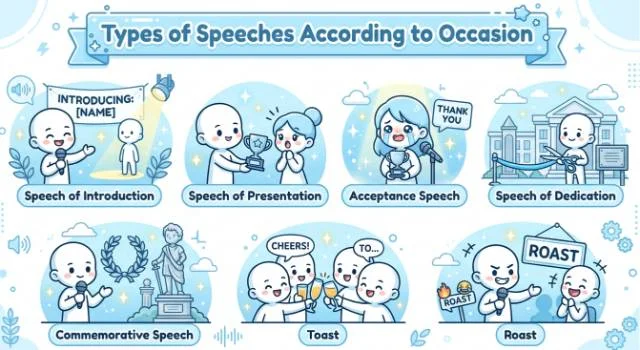
The seven types of speech according to occasion are introduction, presentation, acceptance, dedication, commemorative, toast and roast and each type is governed by unspoken conventions about what the audience expects at that specific event.
Speech of Introduction
A speech of introduction is given by a host to introduce the next speaker. The goal is to warm up the audience, establish the speaker’s credibility, and create a smooth handoff. Good introductions are brief (60 to 90 seconds is usually enough), specific about why this speaker is on this topic right now, and end with the speaker’s name as the applause cue.
Common settings: conferences, lecture series, award ceremonies, panel events.
Speech of Presentation
A presentation speech is given when handing over an award, honor, or recognition. The job is to contextualize the award (why it matters, who gives it), explain why this recipient is receiving it (the specific achievements), and hand it over with warmth. Presentation speeches should spend most of their time on the recipient, not the award.
Common settings: award ceremonies, employee recognition events, graduation ceremonies, hall-of-fame inductions.
Acceptance Speech
An acceptance speech is given by the person receiving an award or honor. It typically has three parts: gratitude to the giver, acknowledgment of the people who helped you get here, and a brief reflection on what the recognition means. Keep it short (2 to 4 minutes for most settings) and keep it specific (name names rather than saying “everyone who supported me”).
For full guidance on structure and examples, see our acceptance speech guide.
Speech of Dedication
Dedication speeches are given to mark the opening of a building, the unveiling of a monument, the launch of an initiative, or any ceremonial first moment for a physical or symbolic thing. The speaker typically describes the significance of what’s being dedicated, names the people who made it possible, and frames what it will mean going forward.
Commemorative Speech
A commemorative speech honors a person, a group, an institution, or an event. It’s less about information and more about shared meaning, which makes it a cousin of the entertainment category in terms of emotional register. Eulogies, memorial day addresses, retirement tributes, and anniversary speeches all fit here.
Full for guidance check commemorative speech structure and examples guide.
Toast
A toast is a very short occasion speech (usually under 2 minutes) given to mark a moment: a wedding, a promotion, a birthday, a retirement, a successful project. Good toasts are specific, warm, and end with a clear call to raise glasses. They’re not the place for deep speeches or long stories.
Roast
A roast is a humorous occasion speech where the speaker lightly (and lovingly) mocks the person being honored. Roasts only work when the relationship between speaker and honoree is close enough that the humor lands as affection, not insult. They’re typically performed at retirement parties, milestone birthdays, and comedy-focused banquets.
How Purpose and Delivery Combine in a Single Speech
Every speech has both a purpose type and a delivery method and the combination is determined by the assignment setting, the formality of the occasion and how tightly the speaker needs to control the wording. CollegeEssay.org’s speech writing team works across all three purpose types and treats the purpose classification as the first thing confirmed from a student’s assignment brief before any drafting begins.
A persuasive speech in a classroom is usually delivered extemporaneously. A persuasive speech in a formal political setting (a State of the Union, a concession speech) is usually delivered from a manuscript. Aristotle’s three classical modes of persuasion — ethos (credibility), pathos (emotion), and logos (logic) — are the foundation of modern persuasive speech structure.
An informative speech in a lecture hall is extemporaneous; an informative speech in a corporate product launch might be memorized or manuscript, depending on how tightly controlled the messaging needs to be.
So when your assignment says “5-minute persuasive speech, no script,” you’re being asked to combine persuasive purpose with extemporaneous delivery. When it says “write and deliver a 3-minute commemorative speech from memory,” you’re combining a commemorative occasion with memorized delivery. Reading both axes of your assignment avoids the most common first-week mistake in public speaking courses (preparing for the wrong delivery method).
- “Write and deliver a 5-minute persuasive speech from notes” = Persuasive purpose + Extemporaneous delivery. No occasion axis.
- “Prepare a 3-minute toast for your best friend’s wedding” = Entertainment purpose + Memorized delivery + Toast occasion.
- “Deliver an acceptance speech at the department awards night” = Entertainment or commemorative purpose + Memorized delivery + Acceptance occasion.
Types of Speech: Full Comparison Table by Purpose, Delivery and Occasion
Use this table when you need to quickly identify what type of speech you’ve been assigned or are watching.
| Type | Main goal | Relies on | Typical setting |
|---|---|---|---|
| Informative | Explain or educate | Facts, data, examples | Lectures, reports, briefings |
| Persuasive | Change belief or action | Argument, evidence, emotion | Debates, campaign speeches, pitches |
| Entertainment | Engage and amuse | Humor, storytelling, timing | Weddings, banquets, celebrations |
| Type | Preparation | Script | Best used when |
|---|---|---|---|
| Impromptu | None | None | Surprise moments, sudden questions |
| Extemporaneous | Thorough | Outline only | Class speeches, presentations |
| Manuscript | Thorough | Full text read aloud | Formal, high-stakes, precise wording required |
| Memorized | Thorough | Full text from memory | Short ceremonial speeches, competitions |
| Type | Length | Job of speaker |
|---|---|---|
| Introduction | 1 to 2 min | Set up the next speaker |
| Presentation | 2 to 4 min | Hand over an award meaningfully |
| Acceptance | 2 to 4 min | Thank and reflect briefly |
| Dedication | 3 to 5 min | Mark the significance of a thing or moment |
| Commemorative | 3 to 7 min | Honor a person, event, or group |
| Toast | Under 2 min | Mark a moment and raise glasses |
| Roast | 3 to 5 min | Honor through humor |
Once you know which type of speech you've been asked to deliver, the real work begins: picking a topic that fits the category, structuring it for your time limit, and writing it so it actually lands with your audience. If you'd rather skip the writing and head straight to rehearsal, you can have someone to write a speech for any occasion, formatted for delivery and back to you within 24 hours.
Which Type of Speech Do I Have? Answer These 3 Questions
To identify which type of speech you have been assigned, answer three questions in order: what the speech should do to the audience, how you are allowed to deliver it and whether it is tied to a specific occasion.
What is the speech supposed to do to the audience?
How are you allowed to deliver it?
Is it tied to a specific event or moment?
Your full speech type is the combination of your answers. Example: “3-minute persuasive speech from memory about why college should be free” = Persuasive (purpose) + Memorized (delivery), no occasion axis.
You now have the full classification: purpose, delivery, occasion — and you can place any speech assignment into the right bucket. The next problem is writing the speech itself so it matches the type you’ve been asked to deliver. An informative speech needs clean structure and credible evidence. A persuasive one needs argument and counter-argument. An impromptu delivery needs a framework you can hold in your head. Tell us the type, the time limit, and your audience, and our speech writing team at CollegeEssay.org will write the full speech, formatted for delivery, sourced where it needs to be, back to you in under 24 hours.
Frequently Asked Questions