What Is a Commemorative Speech?
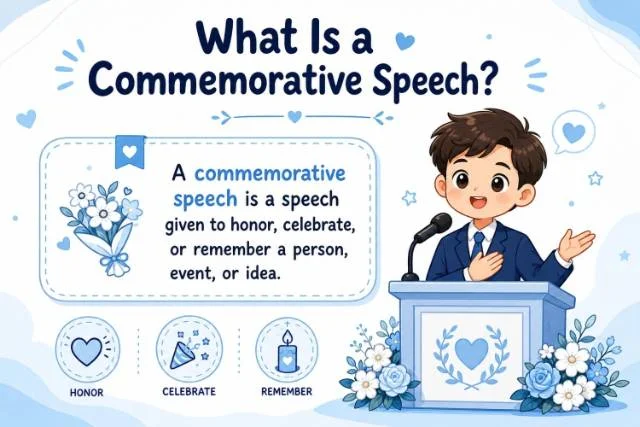
A commemorative speech honors a person, group, event, idea, or institution. Eulogies, retirement tributes, graduation addresses, and award nominations all count. The goal isn’t to inform or persuade. It’s to make the audience feel the weight of what’s being celebrated. Most commemorative speeches run 3 to 7 minutes and follow the same five part shape regardless of type.
- Pick two or three anchor qualities of the subject, each tied to a specific story.
- Open with a concrete dated moment, a question, or a single sentence of tribute.
- Build the body with one section per quality: name it, tell the story, land the point.
- Write the impact paragraph what changed, what the audience carries forward.
- Close with a callback to the opening or a direct address to the subject.
- Aim for 4 minutes when in doubt. Most commemorative speeches are stronger short than long.
Commemorative speeches are one specific form within the broader craft of speech writing. That covers a wide range: a eulogy at a memorial, a toast at a retirement dinner, a graduation address, a nomination for an award, a speech of induction, a tribute to a colleague. What they share is emotional register over factual delivery. A well written commemorative speech is closer to a short personal essay delivered aloud than a report.
If you’re working on a broader speech writing assignment where you’re not yet sure which type fits your occasion, start with the speech writing guide and come back here once you’ve confirmed it’s commemorative.
Types of Commemorative Speeches
The main types of commemorative speeches are eulogies, tribute speeches, speeches of nomination, induction speeches, retirement speeches, graduation addresses, award acceptance speeches, farewell speeches and dedication speeches each serving a different occasion and audience expectation.
| Type | When it’s given | Typical length |
|---|---|---|
| Eulogy | At a memorial or funeral for someone who has died | 3–7 minutes |
| Tribute | For a living person, retirement, milestone birthday, recognition event | 3–5 minutes |
| Speech of nomination | To put someone forward for an award or honor | 2–4 minutes |
| Speech of induction | When someone is being formally inducted into an organization | 3–5 minutes |
| Inauguration speech | To mark the start of a new administration, role, or organization | 5–10 minutes |
| Retirement speech | To honor someone on their retirement | 3–5 minutes |
| Graduation/commencement speech | At the close of a graduation ceremony | 8–15 minutes |
| Award acceptance speech | Given by the recipient of an award | 1–3 minutes |
| Farewell speech | Given by someone leaving a position, group, or community | 3–5 minutes |
| Dedication speech | To mark the dedication of a building, monument, scholarship, or memorial | 3–5 minutes |
| Roast | A humorous tribute, affectionate mockery in a formal setting | 3–7 minutes |
CollegeEssay.org’s writers find that eulogies and retirement tributes are the two occasions that most often arrive without a prepared speaker which is why both types are covered in detail here.
If you’re not sure which category your occasion fits, the shortcut is to ask: what do I want the audience to feel at the end? If it’s pride, grief, gratitude, or inspiration tied to a specific person or moment, you’re in commemorative territory. If you want a broader look at speech categories, the types of speeches guide covers the full map.
Commemorative Speech Outline
A commemorative speech outline follows five parts including an opening that places the audience in a specific moment, a brief background section, two or three body sections each built around one quality and one story, an impact paragraph and a short closing that returns to the opening image.
-
Introduction
- Open with a hook that puts the audience in the room
- Name who or what the speech is for and why you’re the one speaking
- Preview the handful of qualities or moments you’re going to cover
-
The subject’s background
- Only what the audience needs to understand the significance of what comes next
- Not a biography a brief setup
-
Two or three defining moments or qualities
- Pick specific stories or traits that show who the subject really was
- One anecdote per quality concrete, sensory, dated if possible
- Quotes from the subject or about them work well here
-
Impact and legacy
- What changed because of this person or event
- What the audience carries forward
- The single line you want the room to remember
-
Closing
- A callback to the opening
- A final image, a quote, or a direct address to the subject
A filled in outline example
Here’s the same structure filled in for a retirement speech honoring a mentor. You can see how abstract points turn into actual content:
-
Introduction
- Hook: “Thirty one years ago, a first year teacher walked into room 204 and told a nervous kid to sit down and stop apologizing for being there. That kid was me.”
- Who I am: former student, now colleague
- Preview: her classroom, her mentorship, her refusal to retire on schedule
-
Background
- 31 years in the district, three schools, countless students
- The room 204 story set the scene
-
Three defining qualities
- Quality 1: Relentless belief in quiet students anecdote about the debate tournament in ’08
- Quality 2: Brutal, loving honesty the story of the grade she refused to change
- Quality 3: A habit of saying “we’ll figure it out” the new teacher mentorship program she built
-
Impact
- Dozens of her students now teaching in this district
- Her framework for peer review, still used
- The line: “She didn’t just teach English she taught people how to believe a room could be theirs.”
-
Closing
- Callback: “Thirty one years ago, she told a nervous kid to sit down. Today we ask her to stand up one more time.”
- Direct address: “Ms. Delgado thank you.”
Got the outline, but stuck on adapting it to your specific person or event? Tell us who the speech is for, the occasion, and how long you have to speak, get speech writing help. Our writers can give you either a custom outline built around your subject, or the full speech written for you.
How to Start a Commemorative Speech
A commemorative speech should open with either a concrete dated moment, a question the audience is already asking, or a single sentence of tribute followed by a pause.
Four openings that work:
- A concrete, dated moment. “On a Tuesday morning in March 1998, Dad put a wrench in my hand and told me the car would not fix itself.” Specific date, specific object, implied story. The audience is already in the scene.
- A question the audience is silently asking. “How do you honor someone who would have hated being honored?” This names the tension in the room and gives you a thread to pull on for the rest of the speech.
- A single sentence of tribute, then a pause. “Maya Suresh was the best teacher most of you never met.” Say it, let it land, then earn it.
- A moment of gentle humor (for most types, not eulogies for the newly grieving). A well placed joke from or about the subject signals that this will be a human speech, not a funeral for the English language.
How to Write a Commemorative Speech in 5 Steps
Writing a commemorative speech follows five steps starting with choosing anchor qualities, drafting the opening, building one body section per quality, writing the impact paragraph and writing the closing. CollegeEssay.org’s speech writers find that the most common failure in commemorative speech drafts is biographical chronology rather than specific storytelling.
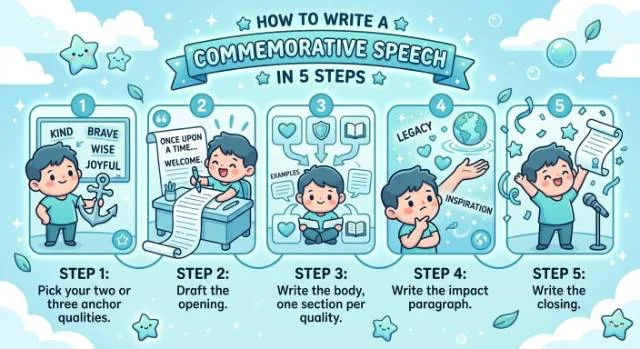
Pick Your Two or Three Anchor Qualities
Choose the two or three qualities that best represent the subject and find a specific story for each one that shows the quality in action rather than stating it directly. Write each story as a paragraph, dated, sensory, and dialogue if you remember any.
If you’re stuck, ask the people closest to the subject: what’s the story about them you always tell? That’s almost always your raw material.
Draft the Opening
Draft the opening using a concrete dated moment, a question the audience is already asking, or a single sentence of tribute and then cut it to no more than four sentences. A commemorative speech opening should be no more than three to four sentences. The audience is still settling for anything longer and you lose them before the speech has started.
Write the Body, One Section per Quality
Write one section for each anchor quality by naming the quality in one sentence then telling the story that proves it in two to four sentences then landing the point in one final sentence. Three sections like this are usually enough. Two is fine for shorter speeches. More than four, and the speech starts to feel like a list.
Write the Impact Paragraph
The impact paragraph names what changed because of the subject and should use concrete details rather than abstract statements.
This is also where a quote often lands well, either from the subject or about them from someone the audience trusts.
Write the Closing
The closing should either return to the image or question from the opening or address the subject directly and the final sentence should be no more than ten words. The direct address works best for tributes, retirements, and awards where the subject is present.
Last sentence: Short. Five to ten words. Something the audience can hold.
Then stop. Do not tack on “in conclusion” or “thank you for listening.” The closing image is the thank you.
You now have everything necessary to write your speech, including a practical outline, a straightforward five-step process, and a complete example. If the speech is due soon, or the subject matters enough that you want a second pair of hands on it, you can get a speech written by CollegeEssay.org. Give us the person, occasion, time limit, and any anecdotes you want woven in, and we deliver a complete, tailored commemorative speech within 24 hours.
Examples of Commemorative Speeches
A Full Length Commemorative Speech Example: 4 Minute Retirement Tribute
The example below is a complete four minute retirement tribute built on the five step process above and it shows how abstract outline points turn into specific dated stories that land with an audience.
Thirty one years ago, a first year teacher walked into room 204 and told a nervous kid to sit down and stop apologising for being there. That kid was me.
I’m Rafael Ortiz. Most of you know me as a colleague in this district. Ms. Delgado knew me first as a fifteen year old who didn’t think he belonged in honours English. I’m here tonight because she’s the reason I do this job.
I’m not going to give you her résumé. You have her résumé. What I want to give you is three things I learned watching her work, in case any of them are useful to the next thirty one years of teachers in this room.
The first is what she did with quiet students. In 2008, our debate team had one student who hadn’t said a complete sentence in class for four months. Ms. Delgado entered her in the regional tournament anyway. The student placed second. When I asked Ms. Delgado how she knew, she said, “I didn’t. I just knew she’d never know unless someone else decided first.” I’ve been borrowing that line ever since.
The second is what she did with grades. In 2014 a parent asked her to change a grade. The parent had pull. The principal asked her to consider it. She wrote back one sentence: “I considered it. The grade stays.” I keep that email printed on my desk. Not because I want to be rude to parents I don’t but because she taught me that the small acts of integrity are the ones nobody applauds and the ones that build a career.
The third is what she did with new teachers. The mentorship programme that runs in this district was hers. She built it the year I started. Forty six new teachers have come through it. I was the first one. I was so nervous on my first day of teaching that I sat in my car for fifteen minutes before going in. She found me there. She said, “We’ll figure it out.” She said that to every new teacher she ever met. The phrase is now embroidered on a sign in the staff room of three different schools. None of them know where it came from.
Here’s what’s changed because of her. Half the teachers in this district either learned from her or learned from someone she taught. The peer review framework she built is still how this district evaluates new hires. The students she taught are now the parents in the conferences I run.
She didn’t just teach English. She taught people how to believe a room could be theirs.
Thirty one years ago, she told a nervous kid to sit down. Tonight, we’re asking her to stand up one more time.
Ms. Delgado thank you.
Notice what this does and doesn’t do. It picks three qualities, each anchored to a specific dated story. It avoids generic praise, biographical chronology, and lists of accomplishments. The closing returns to the opening image and ends in five words. About four minutes at speaking pace.
Reading full examples is the fastest way to internalize the rhythm. The examples below are written versions you can read start to finish, use them as structural references, not templates to copy verbatim.
Commemorative Speech Topics
Strong commemorative speech topics give the speaker direct personal material to draw on and the most effective choices include a teacher who changed how you thought, a grandparent’s most told story, a coach or mentor, a public figure whose work shaped a field and a historical figure whose courage still matters.
- A teacher who changed how you thought about a subject
- A grandparent’s most told story
- A sibling’s unexpected kindness
- A coach, mentor, or first boss
- A friend who helped you through a hard year
- A public figure whose work shaped your field
- A historical figure whose courage still matters
- A cultural or religious tradition your family has kept going
- A place a home, a school, a town and what it meant to you
- An event you lived through that changed your community
Common Mistakes to Avoid in a Commemorative Speech
The most common mistakes in commemorative speeches are getting facts wrong, misjudging the tone of the occasion, using filler adjectives instead of concrete detail and running too long.
- Get the facts right. Names, dates, titles, the order of events. Fact check everything the subject or their family could hear and recognize. Getting a single detail wrong in front of people who know the subject well breaks the whole speech.
- Respect the room, not just the subject. A speech at a retirement dinner is not the same as a speech at a memorial. Read the tone of the room before you write. Humor that lands at a retirement party lands as jarring at a funeral.
- Do not perform grief or admiration you don’t feel. Audiences hear it. If you didn’t know the subject well, say so and then tell them the one thing you did know, specifically. A short, honest speech always beats a long, performed one.
- Cut the filler adjectives. Words like “amazing,” “incredible,” and “phenomenal” do none of the work of actually describing the subject. One concrete detail (“she kept a folder of every thank you note a student ever wrote her”) tells the audience more than ten filler adjectives.
- Time it. Read the draft aloud. If it’s running long, cut, don’t rush. A five minute speech delivered at a natural pace beats a seven minute speech delivered at race pace every time.
With the format, writing process, and examples in hand, you’re ready to create a commemorative speech that truly honors its subject. The hard part is sitting down and actually writing it, especially when the subject matters to you. Send us the details (who the speech is for, the occasion, how long, and any stories you want included), and you can hire someone to write my speech for you, start to finish. Most drafts come back within 24 hours.
Frequently Asked Questions

-21369.jpg)