Types of Debate Formats: Quick Comparison Table
The right debate format depends on your strengths: choose Public Forum or SPAR if you’re new, Policy if you’re strongest at research, Lincoln-Douglas if you reason well philosophically, and Parliamentary if you’re better on your feet than on paper. For most students the choice gets made for them. Based on assignments CollegeEssay.org receives, Public Forum is the format new competitive debaters are most commonly assigned first. The monthly topic rotation and shorter round length make it the standard entry point at most American high schools.
| Format | Time | Team size | Where you’ll see it |
|---|---|---|---|
| Lincoln-Douglas | 40 to 45 min | 1 vs 1 | High school, college |
| Policy (Cross-Examination) | 60 to 70 min | 2 vs 2 | High school, college |
| Public Forum | 30 to 35 min | 2 vs 2 | High school |
| Parliamentary | 45 to 60 min | 2 vs 2 (or more) | College, British style parliaments |
| Congressional | 45 to 60 min | Individual in a group | High school, college (mock legislature) |
| Moderated | Variable | 2 or more | Presidential and televised debates |
| Town Hall | 60 to 90 min | 2 or more + audience | Political campaigns, civic events |
| Spontaneous Argumentation | Under 20 min | 1 vs 1 | College, intro debate classes |
| Cross-Examination (CX) | 60 to 70 min | 2 vs 2 | High school, college (same family as Policy) |
| Team Policy | 60 min | 2 vs 2 | Middle school, high school |
One quick note before you scroll: The words “format,” “type,” and “style” get used interchangeably across debate communities. Some sources will count nine formats, some eleven. The difference is usually that they’re splitting one format into two variants (Cross-Examination and Policy, for example, are functionally the same family) or grouping two distinct formats together. The list above is the working set most students and competitors will run into.
The 10 Most Common Debate Formats
The 10 debate formats covered below range from one-on-one value rounds to full legislative simulations. Each entry includes the time limit, team size, segment breakdown, and where you will encounter it.
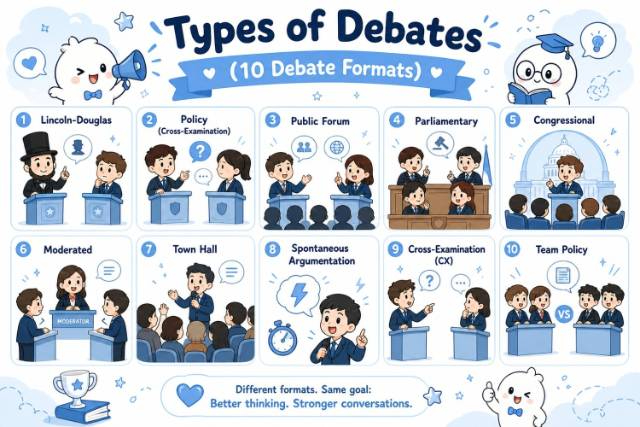
Lincoln-Douglas is the one-on-one, value-based debate format used most often in American high school and college competition. Named after the 1858 Senate debates between Abraham Lincoln and Stephen Douglas, it runs roughly 40 to 45 minutes total.
| Segment | Time |
|---|---|
| Affirmative constructive | 6 min |
| Cross-examination by negative | 3 min |
| Negative constructive | 7 min |
| Cross-examination by affirmative | 3 min |
| First affirmative rebuttal | 4 min |
| Negative rebuttal | 6 min |
| Second affirmative rebuttal | 3 min |
If you’ve been assigned a Lincoln-Douglas round, the writing challenge is mostly about constructing a tight value framework in the constructive speech. Our debate speech writing guide walks through that structure step by step.
Each of these formats has its own structure, timing, and rebuttal pattern, and once you’ve picked yours (or had it picked for you), the harder part is writing a speech that actually fits the format and lands inside the time limit. If that’s where you’re stuck, you can have a debate speech written for the exact format you’ve been assigned. Send us the format, the time limit, and the side you’re arguing, and you’ll have a draft to work from.
Policy Debate is a two-on-two format where teams argue for or against a yearly national policy proposition. It is the most research-heavy format at the school level, with rounds running 60 to 70 minutes and outcomes decided on evidence cards, plan analysis, and disadvantage chains.
The format you’ll see, called “Cross-Examination Debate” (CX) at most American high schools, is essentially Policy Debate with the cross-examination periods built in. They’re treated as one family here.
| Segment | Time |
|---|---|
| First affirmative constructive | 8 min |
| Cross-examination | 3 min |
| First negative constructive | 8 min |
| Cross-examination | 3 min |
| Second affirmative constructive | 8 min |
| Cross-examination | 3 min |
| Second negative constructive | 8 min |
| Cross-examination | 3 min |
| First negative rebuttal | 5 min |
| First affirmative rebuttal | 5 min |
| Second negative rebuttal | 5 min |
| Second affirmative rebuttal | 5 min |
Public Forum was designed to be an audience friendly format, which means topics rotate monthly, draw from current news, and rounds stay tight at 30 to 35 minutes. Two-on-two, with “crossfire” periods replacing traditional cross-examination. A coin toss before the round determines which team takes the affirmative side. If you’re new to competitive debate, Public Forum is usually the format you’ll start in.
| Segment | Time |
|---|---|
| Coin toss | 1 min |
| First speaker (Team A) | 4 min |
| First speaker (Team B) | 4 min |
| Crossfire | 3 min |
| Second speaker (Team A) | 4 min |
| Second speaker (Team B) | 4 min |
| Crossfire | 3 min |
| Summary speakers (each team) | 3 min each |
| Grand crossfire | 3 min |
| Final focus (each team) | 2 min each |
Parliamentary debate is the format where you receive the resolution 15 to 20 minutes before the round starts, which eliminates the research advantage and rewards debaters who can think and argue on their feet.
| Segment | Time |
|---|---|
| Prep time (after motion announced) | 15–20 min |
| Prime Minister constructive (Government) | 7 min |
| Leader of Opposition constructive | 8 min |
| Member of Government constructive | 8 min |
| Member of Opposition constructive | 8 min |
| Opposition rebuttal | 4 min |
| Prime Minister rebuttal | 5 min |
Points of information may be offered to the speaker holding the floor at any time after the first minute and before the last minute of a constructive speech. Speakers may accept or decline.
The structure is looser than Policy or Lincoln-Douglas, with formal “points of information” interruptions allowed during constructive speeches.
Congressional debate is a simulated legislative session where 15 to 20 competitors introduce mock legislation, deliver timed speeches for or against each bill, and vote. The skill being tested is closer to extemporaneous speaking than traditional head-to-head debate.
| Segment | Time |
|---|---|
| Authorship/sponsorship speech | 3 min |
| Cross-examination | 2 min |
| Affirmative and negative speeches | 3 min each |
| Cross-examination after each | 2 min |
| Voting | 1 to 2 min per bill |
Cross-Examination (CX) Debate is functionally identical to Policy Debate. Some communities and tournament packets label it separately, but the structure, timing, and team size are the same.
Team Policy Debate is the middle school and early high school version of Policy Debate. It uses the same two-on-two structure and evidence-driven approach but with shorter speech times and more introductory judging standards.
Spontaneous Argumentation (SPAR) is a 15 to 20 minute debate format where two debaters receive a resolution, take a few minutes to prepare, and argue without any prior research. It is used most often in intro debate classes and as a warm-up at tournaments.
Moderated debate is the format used in televised political exchanges: a neutral moderator controls the floor, sets the questions, and holds participants to fixed time limits, typically two-minute responses with 60 to 90 seconds for rebuttals. Presidential debates, candidate forums, and televised political exchanges all fall under this umbrella.
The structure is variable: networks and event hosts negotiate the format with the participants in advance, including the order of opening statements, the question rounds, and the closing statements. Two minute response windows are standard, with 60 to 90 seconds for rebuttals.
A close cousin of the moderated debate, with one major difference: the audience asks the questions. Moderators walk through a live audience with microphones, citizens pose questions directly to the debaters, and the candidates have a fixed window (typically two minutes) to respond.
Town hall formats are unpredictable by design. They’re popular in American political campaigns and civic engagement events because they force participants to handle questions they couldn’t have prepped for.
You now know the formats you might face. What’s left is the actual writing, and that’s where most students lose the round, not in the research. If you’d rather not spend the night before reverse engineering the rebuttal structure for whichever format you’ve been assigned, we offer debate speech writing for any format, whether that’s Lincoln-Douglas, Policy, Public Forum, Parliamentary, or any other, delivered structured to the format’s time limits and ready to present.
Which Debate Format Should You Use? How to Choose
The right debate format depends on your strengths: choose Public Forum or SPAR if you’re new, Policy if you’re strongest at research, Lincoln-Douglas if you reason well philosophically, and Parliamentary if you’re better on your feet than on paper. Based on assignments CollegeEssay.org receives, Public Forum is the format new competitive debaters are most commonly assigned first. The monthly topic rotation and shorter round length make it the standard entry point at most American high schools.
- Want the shortest path to a first round? Public Forum or Spontaneous Argumentation. Lowest research overhead, friendliest judging, shortest rounds.
- Strongest at research and evidence? Policy. The format rewards depth of preparation more than any other.
- Strongest at philosophical reasoning? Lincoln-Douglas. Win on framework and criterion, not on stats.
- Quick on your feet but bad at long term prep? Parliamentary. The 15 to 20 minutes prep window kills the research advantage.
- Comfortable with public speaking but not competitive debate? Congressional. Closer to extemporaneous speaking than head to head debate.
- Just want to practice? Spontaneous Argumentation. No research, low stakes, fast rounds.
If your teacher hasn’t named a format and you can’t tell from the assignment what they want, default to Public Forum at the high school level or Parliamentary at the college level. Those are the most commonly assigned in their respective settings.
To know how to deliver a strong debate once it’s written, our guide on debate tips covers the stage side.
The Four Types of Debate Arguments
Format dictates how a round runs. Argument type dictates what you’re trying to prove inside that round. Most debates use a mix of all four, but each format has a default. Lincoln-Douglas leans on value arguments, Policy leans on policy arguments, and Public Forum tends to mix fact and persuasion. Knowing which type is dominant in your format helps you pick which sources to look for and which warrants to lean on.
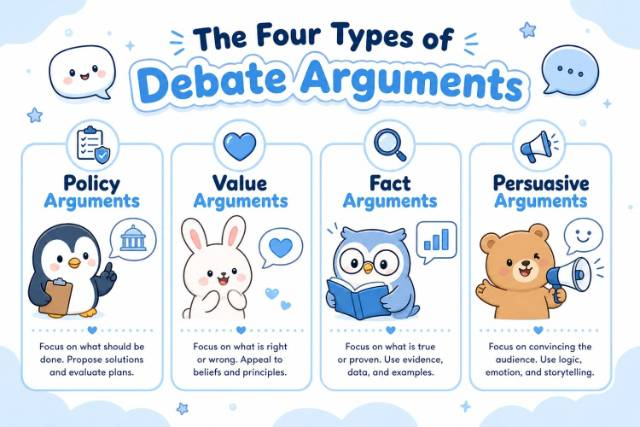
Quick reference for which argument type dominates in each format:
| Format | Primary argument type | Secondary |
|---|---|---|
| Lincoln-Douglas | Value | Fact (under value frameworks) |
| Policy / Cross-Examination | Policy | Fact (as warrants) |
| Public Forum | Mix (fact + persuasive) | Policy on policy resolutions |
| Parliamentary | Mix (depends on motion) | All four show up |
| Congressional | Policy | Persuasive |
| Spontaneous Argumentation | Persuasive | Value or fact depending on prompt |
| Moderated / Town Hall | Persuasive | Policy on candidate forums |
The full breakdown of each argument type follows.
Policy Arguments
A policy argument says “the government, the school, or the institution should do X.” You need to show that there’s a problem, that your proposed solution actually fixes it, and that it doesn’t create worse problems on the way out.
Policy arguments live or die on evidence: statistics, expert testimony, case studies, projections. If you’re in Policy Debate, every speech you give will be built around one.
Value Arguments
Value arguments are about what should be true, not what is true. “Capital punishment is unjust.” “Universal healthcare is a moral right.” These rounds turn on ethical frameworks (utilitarianism, deontology, contractarianism, virtue ethics), the criterion you pick for evaluating the resolution, and whether you can apply your framework consistently when the other side pushes back. Lincoln-Douglas is the home of value debate.
Fact Arguments
Fact arguments concern what is or isn’t true. “Climate change is human-caused.” “The minimum wage reduces employment.” These look easy because they sound binary, but the work is in source quality. Anyone can quote a statistic. Strong fact arguments cite primary research, name the methodology, address counter studies, and explain why your evidence is more reliable than the other side’s.
Persuasive Arguments
Persuasive arguments lean on rhetoric. The audience is the judge, the language matters, and the emotional weight of the case can swing rounds that would have tied on logic alone. Persuasive arguments aren’t a substitute for evidence (any debater leaning entirely on rhetoric will get picked apart by a competent opponent), but they’re how you make evidence land. Storytelling, analogy, and well placed quotation are persuasive tools that work across every format.
You’ve got the formats and the argument types. The next problem is converting that into a speech that fits whichever format you’ve been assigned and lands inside its time limit. Tell us the format, the side you’re arguing, and the resolution or topic, and we can get a speech written for a debate of your specific format, delivered within 24 hours, structured to the timing and rebuttal pattern your judges expect.
Frequently Asked Questions