What Is a Debate Speech?
A debate speech is a structured argument delivered in a competitive format where two sides argue for and against a motion in front of judges.
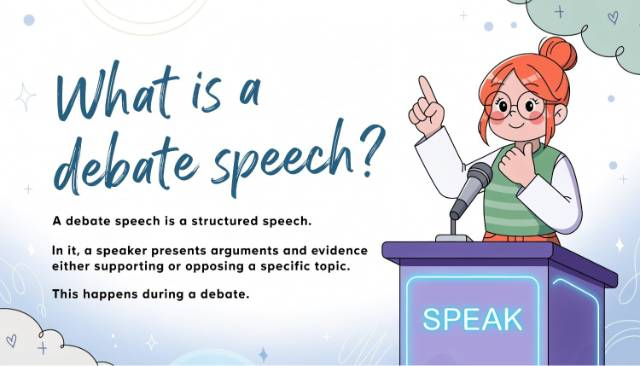
Unlike a persuasive speech, a debate speech is delivered within a fixed time limit, against an opposing team, and scored by judges on argument quality, evidence, and delivery. Each speaker has a defined role: the first speaker builds the case, the second speaker reinforces and extends it, and the rebuttal speaker dismantles the opposition.
The three things that make a debate speech different from other forms of public speaking are the opposition, the structure, and the scoring.
- Every claim needs evidence.
- Every argument needs impact.
- The opening 45 seconds determine whether the judges are listening for the rest of it.
The 5 Step Debate Speech Framework
| Step | Section | Time (5-min speech) |
|---|---|---|
| 1 | Opening: hook + side + roadmap | 40 seconds |
| 2 | Body: 3 arguments × claim/evidence/impact | 150 seconds |
| 3 | Pre-emptive rebuttal | 30 seconds |
| 4 | Closing: restate + recap + memorable line | 25 seconds |
| 5 | Time it, cut it, read it aloud | editing, not delivery |
Before You Write: Three Things to Confirm Before Drafting Your Debate Speech
The three things to confirm before drafting are your time limit, your speaker position, and your side of the motion.
Getting anyone wrong means rewriting the whole speech.
- Your time limit. A 3 minute speech and a 7 minute speech are not the same speech with different padding. They have different argument counts, different evidence depth, and different opening lengths. Get the time limit from your professor or the assignment brief before drafting anything.
- Your speaker position. First speaker, second speaker, and rebuttal speaker each have different jobs. First speakers set up the team’s case. Second speakers reinforce and add new arguments. Rebuttal speakers respond to the opposition. This guide focuses on the first speaker structure because it is the most common assignment and the foundation everything else builds on. CollegeEssay.org’s writers find that students who confirm their speaker position before drafting save significant rewriting time. The first speaker structure and the rebuttal speaker structure are not interchangeable.
Quick reference for how the three speaker roles differ:
| Role | Primary job | Argument count | Rebuttal weight |
|---|---|---|---|
| First speaker | Set up the team’s case, present opening arguments | 3 new arguments | Light (pre-emptive only) |
| Second speaker | Reinforce the case, add new arguments, and respond to the opposition’s first speaker | 1–2 new + reinforcement | Heavy |
| Rebuttal speaker | Attack the opposition’s case, defend the own team, and summarise | 0 new arguments | Entire speech |
Your side. Are you arguing for the motion or against it? "For" speakers usually open the debate. "Against" speakers respond to the opening case. Your side determines whether you're building a positive case or attacking one. Once you've got those three locked in, you can start writing.
If you’re earlier in the process and still figuring out the basics of debate writing in general types of debates, how the format works, and what judges look for our debate writing guide covers the whole picture before you zoom in on the speech itself.
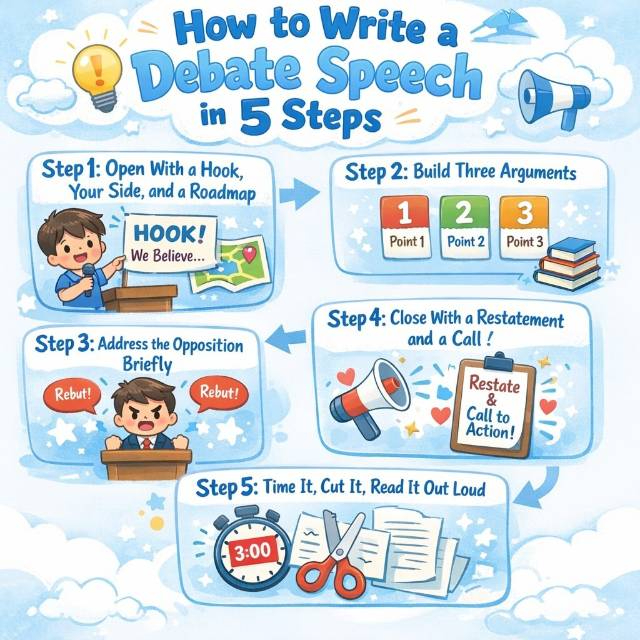
How to Write a Debate Speech in 5 Steps
The first speaker’s version of a debate speech runs five sections in fixed order: opening, three arguments, pre-emptive rebuttal, and closing. The proportions stay the same regardless of your time limit.
How to Open a Debate Speech: Hook, Side Statement, and Roadmap
A debate speech opening must do three things in under 45 seconds:
- Grab attention with a sharp hook a statistic, a short scenario, or a direct question.
- State your motion and your side clearly.
- Preview the three arguments you’re about to make.
That’s it. No long introduction. No definitions. No “today I will talk about.” Judges and audiences switch off in the first 15 seconds if the opening drags.
The three hook types each work for different motions. Quick reference:
| Hook type | Best for | Example |
|---|---|---|
| Statistic | Quantifiable motions (policy, social issues) | “One in three teenagers reports symptoms of clinical anxiety, and the rate has tripled since 2010.” |
| Scenario | Motions about lived experience or moral stakes | “Imagine you are sixteen, and the platform that connects you to your friends is the same platform measuring your insecurities for profit.” |
| Question | Motions where the audience already has a position | “How many of you, in the last hour, have checked a screen without consciously deciding to?” |
Pick the hook type that matches your motion’s centre of gravity. Statistical motions need numbers in the opening. Moral motions need scenes. Belief based motions need questions.
Honourable judges, worthy opponents, and members of the audience, good morning. I stand before you today to [propose / oppose] the motion that [states the motion exactly].
Consider this: [one sentence hook a statistic, a fact, a scenario, or a sharp question relevant to the motion]..propose/oppose
My team will defend this position on three grounds. First, [argument 1, in five words]. Second, [argument 2, in five words]. Third, [argument 3, in five words]. Allow me to take each in turn.
That entire block runs about 40 seconds when delivered. If your time limit is short (under 3 minutes), cut the hook and go straight to motion + roadmap. If your time limit is long, expand the hook into two sentences with one supporting fact.
Build Three Arguments, Each With Claim = Evidence = Impact
Each of the three body arguments follows the same structure:
- Claim one sentence stating what you’re arguing.
- Evidence a fact, statistic, study, expert quote, or real example that supports the claim.
- Impact one or two sentences explaining why this matters and how it strengthens your side of the motion.
That’s roughly 45 to 60 seconds per argument. Three arguments × 50 seconds = 2.5 minutes of body content, which fits a 4–5 minute speech with room for the opening and closing.
Pick your strongest argument first. The first one in your speech is the one judges remember most clearly. Save your second strongest for last (the recency effect), and put your weakest in the middle.
My first argument is that social media is measurably damaging teen mental health. A 2023 study published in JAMA Psychiatry found that adolescents who spent more than three hours a day on social media were twice as likely to report symptoms of depression and anxiety as their peers who used it less. The impact is direct: we are not talking about adults choosing how to spend their leisure time. We are talking about teenagers, whose brains are still developing, being exposed to platforms engineered to maximise time spent at a measurable cost to their wellbeing.
Notice the structure: claim, evidence with a specific source, impact tied back to the motion. Repeat that pattern three times with different angles, and the body of your speech is done. CollegeEssay.org’s debate speech writers apply the claim/evidence/impact structure to every first-speaker brief because it is the format that school and parliamentary debate judges consistently reward.
How to Write a Pre-Emptive Rebuttal in a Debate Speech
A pre-emptive rebuttal takes 30 to 45 seconds and works by naming the opposition’s most likely argument and defusing it before they raise it.
Now, the opposition will likely argue that [their probable counter argument]. But this argument fails for a simple reason: [your response, in one or two sentences].
What makes a pre-emptive rebuttal land or flop:
| Strong rebuttal | Weak rebuttal |
|---|---|
| Names the strongest version of the opposition’s argument | Names a strawman version that’s easy to defeat |
| Defuses with one specific reason (evidence, logic, scope) | Dismisses with a vague counter (“but that’s wrong”) |
| Concedes the partial truth, then explains why it doesn’t change the conclusion | Pretends there is no truth to the opposition’s case |
| One sentence to set up, one or two to dismantle | Three minutes that delay your own arguments |
The strongest version of pre-emptive rebuttal is the steelman: state the opposition’s case better than they will, then defeat that version. Weak rebuttals attack arguments the opposition wasn’t going to make.
This positions you as the speaker who has thought through both sides. It also shrinks the rhetorical space the opposition’s first speaker has to work with, because they now have to either avoid the argument you pre-empted (and look weak) or use it anyway (and seem unoriginal).
How to End a Debate Speech: Restatement and Closing Line
The closing restates your three arguments in five words each, ties them back to the motion, and ends on one short, memorable line.
In summary, we have shown that [argument 1 in five words], that [argument 2 in five words], and that [argument 3 in five words]. For these reasons, the motion that [restates the motion] must [stand / fall].
[The final memorable line is a short, punchy sentence that captures the heart of your case in 10 to 15 words.]
Thank you.
The final memorable line is the part you should write last and rewrite three times. It is what the audience will hear ringing in their ears when the opposition stands up. Make it count.
In summary, we have shown that social media damages teen mental health, that it disrupts sleep and academic performance, and that its harms fall hardest on those least equipped to push back. For these reasons, the motion that social media does more harm than good for teenagers must stand. We are not asking you to ban a technology. We are asking you to be honest about its cost. Thank you.
Time It, Cut It, Read It Out Loud
Once you have a draft, do three things before you call it finished.
- Time it. Read it aloud at speaking pace, not silent reading pace, which is roughly 50% faster. If you’re over your time limit, cut the third argument’s evidence first, then the hook, then trim the closing. Do not cut the roadmap or the impact statements; those are load bearing.
- Cut anything that doesn’t belong. Every sentence in a debate speech should either advance an argument, address the opposition, or hold the structure together. If a sentence does none of those things, delete it.
- Read it aloud properly. Stand up. Read it the way you’ll deliver it. Mark places where you stumble, because those are usually places where the wording is awkward and needs simplifying. Read it three times before the debate.
Got the framework but still staring at a blank doc with the deadline closing in? Send us your topic, your side of the motion, and how long the speech needs to be CollegeEssay.org can write your debate speech from start to finish, with the opening, the three arguments, and the closing already structured.
Debate Speech Outline Template: First Speaker (Fill In and Draft)
This one-page outline covers every section of a first-speaker debate speech in order. Fill in the bracketed parts, and you have a complete first draft.
Opening 40 seconds
Argument 1 50 seconds Strongest
Argument 2 50 seconds Weakest of the three
Argument 3 50 seconds Second strongest
Pre-emptive Rebuttal 30 seconds
Closing 25 seconds
That is the entire structure on one page. Most 4–5 minute first speaker debate speeches can be drafted into this template in 30 to 45 minutes once your research is done.
If you want to see what filled-in versions look like across different debate types and grade levels, the debate examples page has model speeches you can use as references for your own.
You’ve got the structure, the templates, and a fillable outline. The hard part now is the time crunch between drafting, researching evidence, rehearsing, and memorising; most students run out of hours before they run out of work. If you’d rather spend that time on practice and let the writing be off your plate, our professional debate speech writing service delivers a complete, structured speech within 24 hours, with the opening hook, three arguments, pre-emptive rebuttal, and closing already in place.
How Debate Speech Format Changes by Debate Type: Parliamentary, Lincoln-Douglas, and Policy
Parliamentary, Lincoln-Douglas, and policy debate all use the same core speech structure but differ in time limits, speaker counts, and whether you can be interrupted mid-speech with points of information.
For most school debates, parliamentary style with teams of two or three speakers per side is the default, and the structure in this guide maps to that directly.
The full breakdown of different types of debate covers each format’s specific rules; check yours against that guide before finalising your speech, especially if your assignment specifies a format.
How to Deliver a Debate Speech: Pace, Eye Contact, and Voice
The four delivery factors that matter most are:
- Pace. Slower than you think feels right. Most nervous debaters speed up; the audience needs you to slow down.
- Eye contact. Look at the judges, not the floor, and not your notes. Your speech notes should be a single index card with bullet points, not a script.
- Voice variety. Drop your voice for emphasis. Pause before key arguments. Avoid monotone delivery judges fall asleep.
- Hands and stance. Stand still. Use deliberate hand gestures for emphasis, not nervous fidgeting.
A well written speech delivered poorly will lose to a mediocre speech delivered with confidence judges score on impact, not page count.
For the full set of debate specific delivery techniques, handling interruptions, responding to points of information, and recovering when you lose your place, the debate tips guide covers each in detail with practice drills.
A Quick Debate Speech Checklist Before You Submit
Run through this before you call your speech finished:
- Opening states the motion and your side in one clear sentence.
- The three arguments each follow claim = evidence = impact.
- Each piece of evidence has a named source (study, statistic, expert, example).
- The pre-emptive rebuttal addresses one likely opposition argument.
- The closing restates the three arguments and ends on one memorable line.
- Total spoken length matches your time limit (test by reading aloud, not silent reading).
- Every sentence advances an argument, addresses the opposition, or holds the structure.
If all seven checks you’ve got a debate speech worth delivering.
You’ve got the framework. If this is one of several debates you’ve got coming up this term and the writing keeps eating the hours you’d rather spend on practice, you can hire someone to write speech drafts for the rest of the semester same structure as this guide, drafts back inside 24 hours, your time freed up for rehearsal and rebuttal prep.
Frequently Asked Questions