Graduate school scholarships are financial awards for students who have completed a bachelor's degree and are pursuing a master's, PhD, or professional degree. Unlike loans, you don't pay them back. And right now, that matters more than ever. This is why you need a scholarship essay writing service to help you with your essay.
The average master's degree costs around $62,820. A PhD can push well past $100,000. Loans are one option, but they follow you for decades. Graduate school scholarships, from national fellowships to university-specific awards to field-focused programs, can significantly reduce or even eliminate what you owe.
One quick note on terminology: you'll see the words "scholarship" and "fellowship" used interchangeably throughout this article. Technically, fellowships are usually merit-based awards tied to a specific research or study proposal, while scholarships are broader financial awards. In practice, many of the most prestigious programs (NSF, Fulbright, Hertz) are structured as fellowships. The funding and the application process are what matter. Don't let the label trip you up.
This article covers the main types of graduate school scholarships, the most prestigious programs worth knowing, how to find funding that fits your situation, and what actually wins a scholarship application once you've found the right one.
Types of Graduate School Scholarships
Not all graduate school scholarships work the same way. They have different eligibility requirements, application processes, and award amounts. Knowing which type you're applying to shapes everything from how you write your essay to when you submit.
Merit Based Scholarships
Merit scholarships are awarded for academic achievement: your GPA, research record, test scores, or professional accomplishments. They're typically the most competitive because the applicant pool is broad and the criteria are high. Programs like the Rhodes Scholarship, Fulbright Program, National Merit Scholarship, and Hertz Graduate Fellowship all fall into this category.
The application process almost always includes a personal essay or statement, and that's where most strong candidates fall short.
"Merit scholarships reward what you've already done. Your grades, research, and academic record all matter. But winning one almost always comes down to how well you tell your story."
Need Based Scholarships
Need-based awards factor in your financial situation, and they typically require you to complete the FAFSA even if the scholarship itself comes from a private organization. Programs like the Jack Kent Cooke Foundation Graduate Scholarship and the Gates Scholarship use financial need as a primary criterion alongside academic performance.
One thing worth knowing: the Graduate PLUS Loan program is set to end July 1, 2026. That means a key federal borrowing option for grad students disappears, which makes private need-based scholarships not just helpful, but necessary for many students.
"Need-based aid exists for grad students, but most federal loan options are shrinking. Private scholarships are no longer a bonus. They're a necessity." |
Field Specific Scholarships
Field-specific scholarships are tied to your discipline or intended career, and they're funded by professional associations, government agencies, and private foundations. The NSF Graduate Research Fellowship is one of the best-known for STEM students. The AAUW Fellowships support women across virtually any academic field. Google's scholarships target students in computing with disabilities. The Sieble Scholars program focuses on business, computer science, bioengineering, and energy.
These programs typically have smaller applicant pools than big national awards because the eligibility criteria are narrower. "If your field has a professional association, it almost certainly has a scholarship. And those awards have far fewer applicants than the big national ones." That's worth your attention.
Your field's professional association is the fastest way to find these. Check their websites for student awards, and don't overlook whether student membership (which often makes you eligible) is free or low-cost.
Diversity and Inclusion Scholarships
Many organizations fund graduate students from underrepresented backgrounds. The UNCF offers scholarships specifically for African American students. The Point Foundation supports LGBTQ+ students pursuing advanced degrees. NOBCChE programs focus on Black engineers and chemists. These can be merit-based, need-based, or both. They're often less competitive than general national awards because the eligible applicant pool is more targeted.
Location Specific Scholarships
State governments, regional foundations, and local employers all fund graduate-level scholarships, often for students who live or plan to work in that area. These awards fly under the radar. Most students never find them because they don't appear in national databases. Less competition, targeted criteria, and real funding. They're worth spending an afternoon researching by state or region.
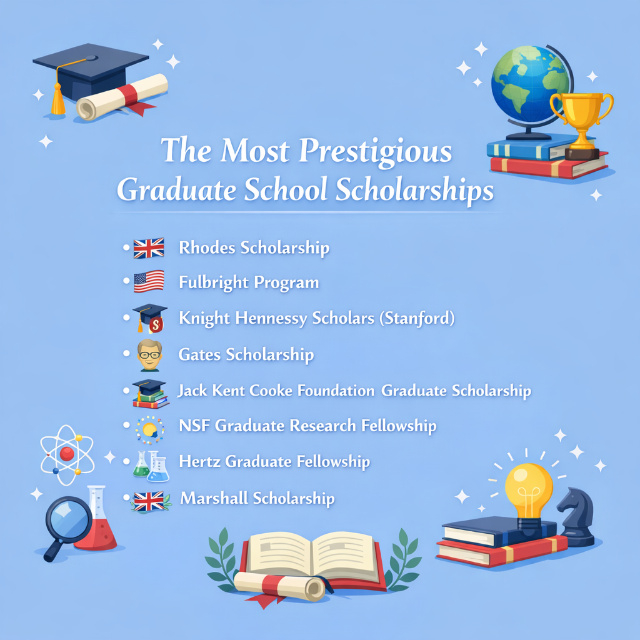
The Most Prestigious Graduate School Scholarships
These are the programs that carry the most recognition, funding, and long-term career impact. They're also the most competitive. Knowing what they offer and when to apply is the first step to deciding which ones are worth your time.
Rhodes Scholarship
One of the most well-known scholarships in the world, the Rhodes funds graduate study at the University of Oxford. It covers all costs, including tuition, fees, and a living stipend. Candidates are selected on academic achievement, leadership, service, and character. The application process is extensive, and a compelling personal essay is central to it.
Application cycle: Opens in spring; U.S. institutional deadlines typically fall in September–October for study beginning the following autumn. |
Fulbright Program
Funded by the U.S. government, the Fulbright supports study, research, or teaching abroad. It's open to students across all disciplines and is highly competitive. The program values clear research objectives and the ability to communicate your goals, which means your essay carries significant weight.
Application cycle: Campus deadlines typically fall in September; the national deadline is in October for grants beginning the following academic year. |
Knight Hennessy Scholars (Stanford)
This program provides up to $70,000 per year for graduate study at Stanford across any discipline. It's focused on leadership and the potential to address complex global challenges. The application is holistic and essay-intensive.
Application cycle: Applications typically open in September and close in October for enrollment the following autumn. |
Gates Scholarship
The Gates provides full funding for outstanding students from underrepresented backgrounds, combining need and merit criteria. It's renewable annually and covers the cost of attendance beyond other financial aid.
Application cycle: Opens in August; deadline is typically in September for the following academic year. |
Jack Kent Cooke Foundation Graduate Scholarship
Designed for high-achieving students with financial need, this program offers up to $50,000 per year. It's one of the more generous need-merit combination awards available to graduate students.
Application cycle: Applications typically open in the autumn and close in late November or early December. |
Ready to Write a Scholarship Essay That Wins?
Our writers specialize in scholarship essays for graduate school applicants.
NSF Graduate Research Fellowship
The NSF GRFP provides a $37,000 annual stipend plus tuition coverage for graduate students in STEM fields. It's one of the most respected fellowships in science and engineering, and it's highly competitive.
Application cycle: Deadlines fall in October, varying by field. You can apply in your senior year of undergrad or in your first two years of graduate school. |
Hertz Graduate Fellowship
For students in applied physical or biological sciences, mathematics, or engineering, the Hertz Fellowship provides a stipend of approximately $34,000 per year. It's selective and focused on the potential to apply science to real-world problems.
Application cycle: Applications open in August and typically close in October. |
Marshall Scholarship
The Marshall funds Americans to pursue graduate study at any UK university, in any subject. Like the Rhodes, it's focused on leadership, academic excellence, and the ability to represent the U.S. abroad through strong communication.
Application cycle: Institutional endorsement deadlines typically fall in late September; the national deadline is in October. |
"Every one of these scholarships requires a compelling personal essay. Your ability to write about yourself clearly and specifically is the deciding factor, not just your GPA."
How to Find Graduate School Scholarships
Most students underestimate how many scholarships they actually qualify for. Not because the awards don't exist, but because they're looking in the wrong places. There are three channels worth working through systematically.
Your university's financial aid office is the first stop, not the last. Many institutional awards, including department fellowships, graduate assistantships, and dean's scholarships, never appear in any external database. They're awarded through the school directly, and the financial aid office (along with your department coordinator) is the only way to find them. Ask specifically about department-level funding, not just university-wide programs. In many cases, completing the FAFSA for graduate students is required to be considered for even merit-based institutional awards. |
National scholarship databases like Scholarships360, Bold.org, and Fastweb let you filter by degree level, field of study, and demographic criteria. These platforms are free to use and pull from large award databases. Check deadlines carefully. Many competitive programs open 6 to 12 months before the academic year starts, and missing a window by a few weeks means waiting another year. |
Your field's professional associations are the most overlooked channel. If you're in STEM, check NSF and your discipline's national body. If you're in healthcare, law, business, or the humanities, each field has associations that fund graduate students. "The most overlooked graduate school scholarships are the ones your department never advertises. Ask your program coordinator directly." A quick email to your department administrator has found more scholarships than most students ever know about. |
How to Win a Graduate School Scholarship
Finding a scholarship you qualify for is only half of it. The other half is the application. And for almost every program on this list, that means a personal essay or statement of purpose.
Most applicants lose competitive scholarships at the essay stage. Not because their credentials aren't strong enough, but because their essay is generic. They describe their background. They list their accomplishments. They explain that they need funding. What scholarship committees are actually looking for is different: they want to see that you understand what this specific scholarship is trying to accomplish, and that your goals align with that mission in a concrete, specific way.
For merit awards, your essay needs to connect your research record to a clear vision for what you'll do with the funding. For need-based awards, the goal is to explain your financial situation with clarity and dignity. Not desperation, not over-explanation. For field-specific and diversity scholarships, the committee wants to know why this award, not just why you.
Most common scholarship essay prompts follow patterns you can prepare for in advance. Knowing those patterns ahead of time lets you tailor your approach rather than scrambling when you see the prompt.
The single highest-leverage thing you can do before submitting any scholarship application is get your essay reviewed by someone who's read successful ones. "Winning a graduate school scholarship almost always comes down to the essay. A great essay isn't just well-written. It's specifically matched to what that scholarship committee is actually looking for."
Your Scholarship Essay Starts Here
CollegeEssay.org has helped countless students get the funding they deserve.
- Professional writers who know what makes a graduate scholarship essay stand out.
- Fully customized to your scholarship, your story, and your program goals.
- Confidential, reliable, and delivered on time. Even on tight deadlines.
- Satisfaction guaranteed with unlimited revisions until you're confident in your essay.
Get started today and give your application the edge it needs.
Order Now