You've got a scholarship application in front of you and a 250-word limit that feels impossible to work with. This page gives you three complete examples, one for a personal background prompt, one for career goals, and one for financial need, along with the structural framework that makes each one work. For a broader look at how scholarship essays work across all lengths and formats, see our scholarship essay writing guide. If you're responding to a "why I deserve this scholarship" prompt specifically, that's covered in a separate guide. For everything else, start here.
250 Word Scholarship Essay Examples (3 Samples + Writing Tips)
Why 250 Word Essays Are Different From Longer Scholarship Essays
At 500 words, you can develop two or three supporting points. At 250, you can develop exactly one.
That's not a limitation, it's the whole game. The students who struggle with this length are the ones who try to pack in everything: their volunteering, their GPA, their career goals, and their family background. The result reads like a résumé with transitions glued between the bullet points.
The students who do this well follow one rule: pick your single best angle and go deep, not wide.
The single-focus rule means choosing one experience, one quality, or one moment and using the entire essay to reveal what it says about you. Everything else gets cut, not because it isn't true or important, but because 250 words can't carry it without collapsing under the weight.
Here's what that looks like in practice:
Scattered approach (fails) | Single-focus approach (works) |
Mentions volunteering, GPA, career goals, and family background | Picks one moment, the hospital waiting room, and stays there |
Each point gets 3–4 sentences, none fully developed | One experience gets 17–20 sentences, fully revealed |
Reads like a résumé with transitions glued in | Reads like a story with a point |
Reviewer remembers nothing specific | Reviewer remembers the coffee cart volunteer |
The biggest mistake at this word count isn't bad writing, it's scattered thinking. You have roughly 17 to 20 sentences. If you spend five of them on point A, four on point B, and three on point C, you haven't made any of them land. You've just listed things.
"A 250-word scholarship essay is not a shorter version of a longer essay. It's a different kind of writing that rewards specificity over breadth." |
The 250 Word Scholarship Essay Structure
Here's how the word count actually breaks down:
Section | Word Count | Purpose |
Introduction | 40–50 words | Hook + thesis |
Body Paragraph 1 | 60–80 words | Core experience or evidence |
Body Paragraph 2 | 60–80 words | Impact or growth |
Conclusion | 40–50 words | Forward-looking close |
This four-paragraph structure is the most reliable framework for this length. Some prompts work better with three paragraphs at roughly 85 words each, especially when the narrative arc is tight enough to need only one body paragraph. Both work. The table above is the safe default.
Notice the introduction is only 40–50 words. That's two to three sentences. There's no room for a slow build or a dramatic scene-setter that takes six lines to get to the point. You need a hook and your main idea in the same breath.
A note on the word limit itself: some scholarships say "250 words" as a hard cap entered into a form field, going to 260 will get your essay cut off. Others say "approximately 250 words," which means 240–265 is fine. Read the instructions carefully. If you're submitting into a text box, stay at or under 250. If you're attaching a document and no hard cap is stated, staying within 10 words either way is safe.
Expert Tip
For scholarship essay format rules like fonts, margins, and spacing, see our formatting guide.
250 Word Scholarship Essay Example #1: About Yourself
This example responds to a classic prompt: Tell us about yourself. The writer chose one specific, defining moment rather than summarizing their background. That's the single-focus strategy in action.
Example:
The summer I turned sixteen, I spent three weeks in a hospital waiting room while my father recovered from open-heart surgery. I didn't read or scroll through my phone. I watched people.
I watched how nurses delivered bad news, the way they crouched down to eye level, spoke slowly, and always left a silence afterward where the family could fall apart. I watched how one patient advocate remembered every family member's name without checking a chart. I watched how a volunteer who brought coffee cart around the floor somehow made everyone feel less alone with four words: Can I sit with you?
I didn't know then that I wanted to work in healthcare. I just knew that what I was watching mattered more than anything I'd learned in a classroom.
I've since completed 200 hours of clinical observation at a pediatric hospital, where I've started to practice what I absorbed in that waiting room, being present, learning names, asking if I can sit. I'm applying for this scholarship so I can study health communication and bring that same quality of presence into a field that too often treats it as secondary to clinical skill.
Some people choose medicine because of science. I chose it because of a coffee cart volunteer who understood that showing up is its own form of care.
Why this works:
- The writer doesn't list achievements. They open with a scene, and the scene does the credential work for them.
- Every sentence connects back to the central point: presence as a form of care.
- The conclusion isn't just a restatement. It adds a forward-looking contrast that earns its place.
- Notice there's no generic opener like "I've always been passionate about helping people." The story shows the passion.
Your turn: Ask yourself what single moment, not a list of experiences, just one, captures the quality you most want this committee to see. That moment is your entire essay.
Expert Tip
For examples across all prompt types and lengths, see our scholarship essay examples guide.
250 Word Scholarship Essay Example #2: Career Goals
This example responds to a career goals prompt. The writer uses one formative experience to anchor a specific career direction, which is exactly what this structure requires.
Example:
I used to think data was just numbers. Then I spent a summer analyzing water quality reports for a small nonprofit in rural Kentucky, and I learned what data actually is: it's the difference between a community knowing its water is safe and not knowing.
The nonprofit had years of test results sitting in spreadsheets that nobody had turned into something usable. My job was to build visualizations that the county health board could actually read and act on. When I presented the final dashboard, the board voted to fund three new filtration projects within sixty days. That was the moment I understood what environmental science with a data literacy component could do.
I'm pursuing a degree in environmental science with a concentration in geospatial data analysis. My goal is to work at the intersection of public health and environmental policy, helping municipalities translate raw environmental data into actionable decisions. Most communities have the data they need to protect their residents. What they lack is the analysis layer that turns it into something a decision-maker can use.
This scholarship would allow me to complete a GIS certificate program in parallel with my degree, a combination I couldn't fund on my own. I'm not choosing this field for the career path. I'm choosing it because I've already seen what it can change.
Why this works:
- The opening subverts a cliché ("data is just numbers") and immediately adds depth.
- The career goal is specific, not vague aspiration. There's a named field, a named concentration, a named certificate program.
- The experience-to-goal arc is tight: one summer, one outcome, one clear trajectory.
- The final sentence closes with purpose, not ambition.
Your turn: What's the one experience that made your career direction feel real rather than theoretical? That's your opening. Everything else, the degree, the goal, the ask, follows from it.
Expert Tip
For a deeper guide to this prompt type, see our career goals scholarship essay article.
250 Word Scholarship Essay Example #3: Financial Need
Financial need essays are tricky at any length. At 250 words, the challenge gets sharper: you have almost no room to explain your situation, and every extra sentence spent on hardship is a sentence not spent on who you are.
The single-focus rule is even more important here. The writer below doesn't try to detail every financial difficulty. They pick one moment that captures the reality, then pivot quickly to purpose.
Example:
My mother works nights at a distribution warehouse so she can be home when my younger siblings get back from school. I've worked weekends at a grocery store since I was fifteen for the same reason, every dollar I bring in is a dollar she doesn't have to. That arrangement has shaped how I think about time, about responsibility, and about what it means to actually want something badly enough to structure your whole life around it.
I want a degree in accounting. Not as a vague plan but as a specific one: I intend to become a CPA and eventually work with small business owners in first-generation immigrant communities, the kind who do everything right and still get blindsided at tax time because no one explained the system to them. I know this community because I grew up in it.
This scholarship would cover my first year of tuition. I've already applied for two others. I'm not asking you to fund a dream, I'm asking you to help close the gap between where I am and where I've been working to get.
My grades, my work history, and this essay are evidence that I use resources well. I'd like the chance to prove that with yours.
Why this works:
- The hardship is concrete but not dramatized. The tone is grounded and dignified.
- The career goal is hyper-specific: CPA, small businesses, immigrant communities. That specificity makes the essay memorable.
- The closing doesn't beg. It makes a case based on evidence, which is exactly the right register for a financial need essay.
- At 250 words, there's no room to wallow. The writer doesn't.
Your turn: Don't try to explain your entire financial situation. Pick the one detail that captures it most honestly, state it plainly, then spend the rest of the essay on who you are and where you're going.
Expert Tip
For a deeper guide to this prompt type, see our financial need scholarship essay article.
You've Got Your Examples. Writing Your Own Is the Hard Part.
You now have three complete models and a clear picture of what makes each one work. The next step, sitting down and writing your own version for your specific prompt and your specific story, is where most students get stuck. If you're working against a deadline or want a draft you can actually submit, we can take it from here. Tell us your prompt, the scholarship name, and anything about yourself that's relevant. Most students get their draft back in under 12 hours.
Common Mistakes in 250 Word Scholarship Essays
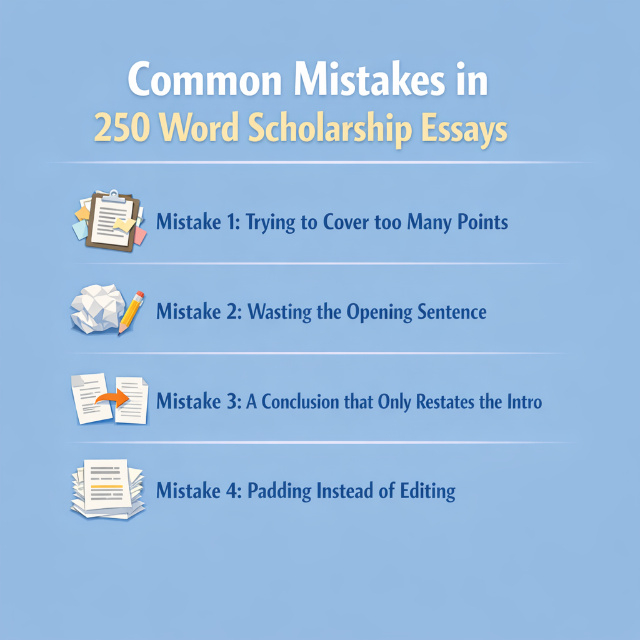
Mistake 1: Trying to Cover too Many Points
This is the single most common error. Students try to mention their GPA, their volunteering, their career goals, and their family story all in 250 words. None of those points get developed enough to land. Pick one. Go deep.
Mistake 2: Wasting the Opening Sentence
"My name is Jordan, and I've always been passionate about environmental science" is a dead start. You've burned 15 words and told the reader nothing they couldn't have guessed. Open with something specific that earns attention.
Expert Tip
See our how to start a scholarship essay guide for openers that actually work.
Mistake 3: A Conclusion that Only Restates the Intro
The conclusion is your last impression. If you just summarize what you already said, you've wasted it. Use the conclusion to pivot forward: what are you going to do with what you've shared? What does it mean for where you're going?
Expert Tip
See our how to end a scholarship essay guide for closings that land.
Mistake 4: Padding Instead of Editing
There's a difference between an essay that's 250 words because you wrote 250 good words, and one that's 250 words because you added filler to hit the count. Scholarship readers can feel the difference. If you're padding, cut back to 220 tight words and see if the essay is actually better. It usually is.
Expert Tip
For a full breakdown of what to avoid across all scholarship essay types, see our scholarship essay mistakes to avoid guide.
You've seen what a strong 250-word scholarship essay looks like. Now you have to write one, for your prompt, your story, and a committee you can't read in advance. If you'd rather hand that off, tell us your prompt, the scholarship you're applying for, and anything about yourself that feels relevant. We'll write the essay. Most students get their draft back in under 12 hours.
Get a Scholarship Essay You're Proud Of
Our writers handle it from scratch, so you can stop second-guessing.
- Custom-written for your prompt, your goals, your voice
- 100% human writers, zero AI, verified on every order
- Essay with satisfaction guarantee
- Rush delivery in as little as 3 hours
Trusted by countless students. No AI. No risk.
Write My 250-word Scholarship EssayFrequently Asked Questions
How long is a 250 word scholarship essay?
Physically, 250 words fits on roughly half a single-spaced page or one double-spaced page. In paragraph terms, expect 3–4 paragraphs. Keep your font at 12pt and margins at standard settings; this mirrors most scholarship submission guidelines. When in doubt, follow any formatting instructions included with the prompt.
What should I include in a 250 word scholarship essay?
Focus on one defining experience, quality, or goal, not a summary of your entire life. Use the structure: hook intro (45 words), two body paragraphs (80 words each), and a forward-looking conclusion (45 words). Every sentence needs to earn its place. If a sentence doesn't develop your central point, cut it.
How do I start a 250 word scholarship essay?
Skip the warm-up sentence. At 250 words, your very first sentence needs to do real work, put the reader somewhere specific, raise a question, or make a claim that earns attention. The hospital waiting room example above opens mid-scene. The data essay opens by subverting a cliché. Both skip the I've always been passionate about... opener entirely. Your first sentence should be the one that makes a reader want to read the second.
Can I use the same 250 word essay for multiple scholarships?
You can reuse the core story, but always adapt the opening and closing to match the specific prompt and scholarship. A generic essay reads like one. A targeted one reads like it was written for that particular committee, because it was.
Is 250 words too short for a scholarship essay?
Not at all. Many scholarships use this limit intentionally. It tests your ability to communicate clearly and concisely, which is exactly what scholarship committees value. The constraint is the point. Treat it as a challenge to be precise, not a problem to work around.
How many paragraphs is a 250 word scholarship essay?
Three to four paragraphs. The most reliable structure is one intro paragraph (40–50 words), two body paragraphs (60–80 words each), and one conclusion (40–50 words). Some writers use three paragraphs for a tighter narrative arc. Either approach works if every paragraph is doing clear, distinct work. For a full guide on structuring scholarship applications, check the Common App personal statement requirements and scholarship application tips from the College Board.
Alexander W. Verified
Author
Alexander W. is a seasoned academic writer with deep expertise in essay structuring and in-depth research. With years of experience helping students navigate the competitive world of scholarship applications, he specializes in breaking down complex prompts into clear, compelling narratives that resonate with award committees.
Specializes in:
Academic Research
Scholarship Essay Writing
College Application Writing
Essay Formatting & Style
Read All Articles by Alexander W.
Keep Reading
Was This Blog Helpful?
On this Page