Your scholarship application is open. The prompt is there. The instructions say 500 words. Here are three complete examples, one for an about yourself prompt, one for career goals, and one for financial hardship, each with a paragraph-by-paragraph breakdown of exactly what makes them work. Read the one closest to your prompt first, then use the structure guide at the bottom to build your own.
If you want to understand the full scholarship essay process before diving in, our scholarship essay writing guide covers everything from structure to tone to common mistakes.
What Does a 500 Word Scholarship Essay Actually Look Like?
Before you read the examples, it helps to understand what 500 words gives you structurally.
At 500 words, you're typically working with 4 to 6 paragraphs, depending on your approach. A standard breakdown looks like this:
Section | Word Count |
Introduction | 75–100 words |
Body Paragraph 1 | 100–120 words |
Body Paragraph 2 | 100–120 words |
Body Paragraph 3 | 100–120 words |
Conclusion | 75–100 words |
The key difference from a 250 word scholarship essay is space.
At 250 words, you can state a point and give one example. At 500 words, you have room to develop a complete story, one that moves through your past, connects it to your present, and points toward your future. |
At 500 words, you have enough room to tell a story, not just state a point. That narrative arc, past to present to future, is what makes a 500-word essay feel complete rather than thin. Every example below uses it. |
500 Word Scholarship Essay Example #1: About Yourself
The "about yourself" prompt is deceptively open-ended. You can write about anything, which is exactly why so many students freeze. The trap is writing a highlights reel of your life. The stronger approach is picking one thread and following it all the way through.
Essay: "The Signal and the Noise"
Growing up in a rural county where the nearest library was forty minutes away, I learned early that information wasn't something you could take for granted. My parents didn't go to college. Our internet was slow and unreliable. While my peers in bigger cities were debating media bias in AP classes, I was piecing together current events from a single local newspaper that printed twice a week.
That gap bothered me. Not just because I felt behind, but because I watched it affect people around me. My neighbors made decisions about their health, their finances, and their local elections based on incomplete information. They weren't uninformed because they didn't care. They were uninformed because quality journalism didn't reach them.
That realization is what sent me to the state university to study communications. In my second year, I joined the campus paper and started covering rural and agricultural communities in our region, the exact communities I grew up in. I've spent weekends driving back to my county to interview farmers about water rights, school board members about budget cuts, and local business owners about the economic pressures they don't see covered anywhere else.
My goal is to build a career in community journalism, specifically in underserved regions. Not the kind of journalism that parachutes in for a disaster and leaves. The sustained, relationship-based reporting that makes communities more informed about their own lives. This scholarship would allow me to finish my degree without the part-time job that currently limits how much reporting I can take on. The more time I have to report, the better I get, and the closer I am to the career I've been working toward since I was a teenager with a slow internet connection, trying to understand the world.
Annotation: What This Essay Does and Why It Works
- Paragraph 1: Opens with a specific, concrete scene rather than a thesis statement. "Rural county, library forty minutes away," the reader can picture it immediately. No "My name is X, and I'm a communications student."
- Paragraph 2: Connects the personal experience to a larger observation. The writer isn't just describing hardship, they're explaining why it matters, which sets up the "why I care" element that scholarship committees want to see.
- Paragraph 3: The present. Shows what the student is actually doing right now, not what they plan to do someday. Specific details (campus paper, agricultural communities, weekend reporting trips) create credibility.
- Paragraph 4: The future, and the scholarship's role in it. This is the paragraph many writers skip or rush. It connects the scholarship directly to a concrete barrier (the part-time job), which is far more persuasive than "this scholarship would mean the world to me."
The best "about yourself" essays don't summarize your resume; they trace one thread from where you started to where you're headed.
500 Word Scholarship Essay Example #2: Career Goals
The next prompt type, career goals, calls for a completely different approach.
Career goals essays fail for one reason almost every time: they're vague. "I want to help people" or "I've always been passionate about medicine" tells a reviewer nothing. The essays that stand out start with a specific moment that made the career feel necessary, not just desirable.
Essay: "What Water Taught Me"
The first time I saw what a failed drainage system looks like from the inside, I was twelve years old. A heavy rainstorm had flooded the street two blocks from our house, a street that had flooded every heavy rain for years. My neighbors sandbagged their doorways like it was routine because, for them, it was. Nobody had fixed the drainage because that neighborhood wasn't a priority.
I've thought about that street ever since. It's a big part of why I'm studying civil engineering at a state polytechnic university, where I'm currently in my junior year with a focus on urban water infrastructure. My coursework covers stormwater management, structural design, and environmental impact assessment. Last summer, I completed an internship with a regional utility district, where I worked alongside engineers assessing aging pipe networks in low-income neighborhoods, communities that see infrastructure failures at higher rates but receive upgrades at lower ones.
The pattern I saw as a kid shows up in the data, and I want to spend my career working to close that gap. My goal is to work in public infrastructure design, specifically in underserved communities, cities, and counties that can't compete with wealthier municipalities for federal funding or private investment. That means doing the kind of engineering that requires both technical skill and an understanding of how infrastructure decisions get made politically.
This scholarship would let me reduce the 20 hours per week I currently spend working to cover living expenses, which would give me time to pursue a graduate certificate in public policy alongside my engineering degree. That combination, technical expertise and policy knowledge, is exactly what the work I want to do requires.
Annotation: What This Essay Does and Why It Works
- Paragraph 1: Opens with a scene, not a statement. The flooded street is specific and visual. The observation that it happened routinely because "that neighborhood wasn't a priority" introduces the core tension without being heavy-handed.
- Paragraph 2: Establishes present credentials without sounding like a resume. "Junior year, civil engineering, internship with a utility district," all relevant, all specific. The internship details about assessing aging infrastructure in low-income neighborhoods directly echo the opening scene.
- Paragraph 3: Names the career goal clearly and explains the reasoning behind it. "Public infrastructure in underserved communities" is more compelling than "I want to be an engineer." The reference to the political dimension of infrastructure shows the writer understands the real complexity of the work.
- Paragraph 4: The scholarship connection is precise: 20 hours per week, graduate certificate in public policy. This isn't "this scholarship would help me focus on school." It's a specific trade-off and a specific plan.
A great career goals essay shows not just where you want to go, but why you're the person who will actually get there.
500 Word Scholarship Essay Example #3: Financial Hardship
Financial hardship essays are hard to write because there's a thin line between explaining your situation and sounding like you're asking for sympathy. The essays that work don't dwell on difficulty; they show what the student has built despite it, and what becomes possible if the barrier is removed.
Essay: "The Math I Do Every Month"
Every month, I do the same math. Rent plus utilities plus groceries plus my portion of my mother's phone bill equals X. My take-home from the diner where I work three nights a week plus the weekend catering shifts equals Y. If Y is greater than X, I register for the upcoming semester. If it's not, I'll figure out what to cut.
This is my third year of doing that math at a public university while pursuing a degree in public health. I've never stopped being enrolled, and I'm proud of that. But the calculation takes a toll that doesn't show up on my transcript. I schedule early morning classes so I can work evenings. I take the minimum course load that still qualifies me for financial aid. I've turned down two unpaid internship offers because I couldn't afford to work without a paycheck.
Those internships mattered. Public health is a field where your experience getting hired is almost as important as your degree. My classmates who could afford to take unpaid positions have built relationships I don't have yet. I'm not behind academically; I'm behind professionally, and that gap costs something.
This scholarship would change the math. Not permanently, but for one year, long enough for me to reduce my hours at the diner and say yes to one of those internship offers. I've already identified a program with the county health department that would place me in community health outreach, the exact work I want to do after graduation. The application is open. I'm qualified. What I can't do right now is afford to take it.
Annotation: What This Essay Does and Why It Works
- Paragraph 1: The monthly math framing does two things immediately. It's specific enough to be vivid, and grounded enough to avoid melodrama. The reader understands the financial reality without being told: "I'm struggling."
- Paragraph 2: Establishes what the student has accomplished despite the constraints. "I've never stopped being enrolled" is a quiet statement of resilience. The paragraph acknowledges trade-offs (course load, internships) without self-pity.
- Paragraph 3: Reframes the cost. This isn't about grades or academic performance; it's about professional experience, which is exactly what scholarship committees understand matters in career-oriented fields. The observation that the gap "costs something" is understated and effective.
- Paragraph 4: The scholarship's role is as specific as it gets. One year. One internship. One program already identified. The final line, "What I can't do right now is afford to take it," is direct without being melodramatic.
The most powerful financial need essays don't ask for sympathy; they show what the student has already done with very little and what more is possible.
You've seen how all three of these essays work: a specific opening, one developed thread, and a scholarship connection that's concrete rather than vague. Writing your own version means applying that structure to your specific story and prompt, which is where most students get stuck. If you're working against a deadline or want a first draft you can actually build from, our scholarship application essay help is available; most students get their draft back within 24 hours.
How to Write a 500 Word Scholarship Essay (Structure Breakdown)
Once you've read the examples, the structure starts to feel natural. Here's how to apply it to your own essay.
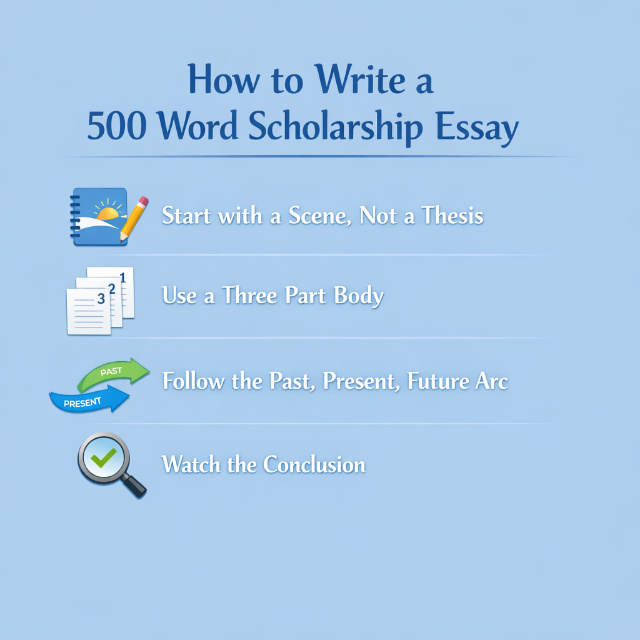
Start with a Scene, Not a Thesis
Your first sentence should put the reader somewhere specific, a moment, a place, a decision. Not "I have always been passionate about medicine." That sentence has appeared in a hundred thousand scholarship essays. A specific scene hasn't.
Here's what a weak opening actually looks like, and why it loses reviewers:
"I have always been passionate about helping others and making a difference in my community. From a young age, I knew that I wanted to pursue a career where I could give back. Receiving this scholarship would allow me to achieve my goals and continue working toward becoming the best version of myself."
This opening could have been written by any applicant, for any scholarship, in any year. There's no scene, no specific experience, no person behind it. A reviewer reading this feels nothing and moves on. Notice how each of the three examples above opens with a specific moment or concrete detail instead. That's the difference between an essay that gets read and one that gets skimmed.
Use a Three Part Body
At 500 words, three body paragraphs work well for most prompts: the experience that shaped your direction, what you're doing about it now, and where you're headed. Each paragraph should move the story forward. If a paragraph doesn't advance the narrative, cut it.
Follow the Past, Present, Future Arc
This is the structure that makes a 500-word essay feel complete.
Past: where you started and what shaped you. Present: what you're doing because of that. Future: where you're going and what the scholarship enables. |
Watch the Conclusion
A lot of 500-word essays waste the ending on a restatement. "In conclusion, I hope you will consider my application" is one of the most common closing lines and one of the least effective. Your last paragraph should look forward, specifically, not summarize what you already said.
What to cut when you're over 500 words:
Cut This | Keep This |
Restating the prompt in your intro | Your actual first memory or scene |
Generic sentences ("I am a hard worker") | Specific evidence of that quality |
Redundant transitions | A new piece of information |
The summary conclusion | A forward-looking final image |
Every paragraph in a 500-word essay should move the story forward; if it doesn't, cut it.
You've got three working examples and the structure behind them. The next step is applying all of it to your specific prompt, your story, and your word count, and that's the part that takes the most time and the most revisions. If you'd rather get a clean first draft to work from, tell us your prompt, your background, and your deadline, and get your essay written with CollegeEssay.org. Most students get their draft back within 24 hours, with time to review and request changes before submission.
Ready to Write a Winning Scholarship Essay?
Work with a professional writer who knows exactly what scholarship committees want.
- Every essay is 100% original: written from scratch for your specific prompt and story.
- Professional writers with track records in scholarship and college essay writing.
- Confidential and secure: your application materials stay private.
- Direct communication with your writer throughout the process.