You've written the draft. Now comes the part that actually matters.
The most common transfer essay mistakes are: sounding like you're running away from your current school, generic "why this school" sections that don't name specific programs or professors, weak or vague closings, negative tone about your current institution, and intro sentences that could apply to any applicant. This article covers each one with before/after examples and a revision checklist.
This article is for students who already have a draft and want to pressure test it. If you're still in the drafting phase, start with our full guide on how to write a transfer essay first, then come back here. We've worked with 50,000+ students on essays exactly like yours and if you'd rather have an expert review yours directly than run through a checklist alone, our expert transfer essay review service does exactly that. What follows is what we see tank applications most often: the transfer essay mistakes that show up again and again, and how to fix them before you submit.
What Is the Biggest Transfer Essay Mistake?
This is the one that trips up the most students. You know why you want to leave. You've been living it. And without meaning to, that frustration bleeds into the essay.
Admissions officers read applications all day. They've learned to spot negativity fast even when it's dressed up in neutral language. A sentence like "My current school doesn't offer the right opportunities for my goals" sounds reasonable, but it's vague and backward-looking. It tells them what's wrong with where you are. It doesn't tell them anything meaningful about where you're going.
Here's what that looks like in practice:
Before (common version): "My current university lacks the research infrastructure I need to pursue my interest in environmental policy. The faculty don't focus on the areas I care most about, and the opportunities just aren't there."
After (corrected version): "Professor [Name]'s work on coastal policy adaptation at [School] is exactly where I want to focus the next two years. Her lab is the reason I'm applying."
One explains a problem. The other explains a destination. Admissions officers want to understand your destination, not your dissatisfaction.
Every sentence about why you're leaving should have a counterpart that explains where you're headed and why that place specifically. For the full framework on how to build that forward-looking narrative from the ground up before you write rather than after, see our why transfer essay guide. |
According to transfer admissions research, students who frame their transfer motivation around academic goals, not institutional dissatisfaction, are consistently viewed more favorably in the review process.
Transfer Essay Intro Mistakes That Kill First Impressions
Your first sentence is the only one that's guaranteed to be read. Make it earn the second.
The most common intro mistakes:
- "I am applying to transfer because..." Starting with your application reason is the essay equivalent of walking into a job interview and immediately talking about your salary expectations. It skips every interesting thing about you.
- The too-broad opener "Education has always been important to me" or "I've always known I wanted to make a difference" tells the reader nothing. Every applicant believes education matters. Start somewhere specific.
- The cliché childhood opener "Ever since I was young, I've been passionate about..." You're a college student now. The story starts here, not in third grade.
- Leading with weakness first Some students open with their GPA drop, their rejected application, or a difficult semester before they've established anything about who they are. That's not vulnerability; it's asking the reader to trust a stranger with bad news before saying hello.
A strong intro drops into a specific moment, realization, or detail that only you could have written. It earns the reader's attention before it asks for anything.
What Makes a Transfer Essay Too Generic?
If you could swap the school name and send this essay to five other colleges, it's not specific enough.
This is one of the hardest mistakes to catch on your own because generic language feels fine when you write it. "Strong faculty in my field," "vibrant campus community," "commitment to undergraduate research" these phrases are true of most universities. They don't tell the admissions office anything about why their school.
Here's the test: Google the phrases you used to describe the school. If they appear in the school's own marketing copy, rewrite them.
What specific actually looks like:
- Naming a professor whose research aligns with yours (and explaining why it matters to your goals)
- Referencing a specific program, lab, initiative, or course not just "the biology department"
- Mentioning something you learned about the school from a visit, a conversation with a current student, or independent research
- Connecting a specific offering to a specific project or goal you already have in progress
The worst version of this mistake is the copy paste "why us" paragraph same structure, different school name plugged in. Admissions offices notice. Some students accidentally leave the wrong school name in. That's an automatic rejection in most cases, but the subtler version a paragraph that could belong to anyone does almost as much damage. |
Transfer Essay: Body Section Mistakes That Weaken Your Case
Every sentence in the body should be doing one of two jobs: explaining who you are or proving why their school is the right fit. |
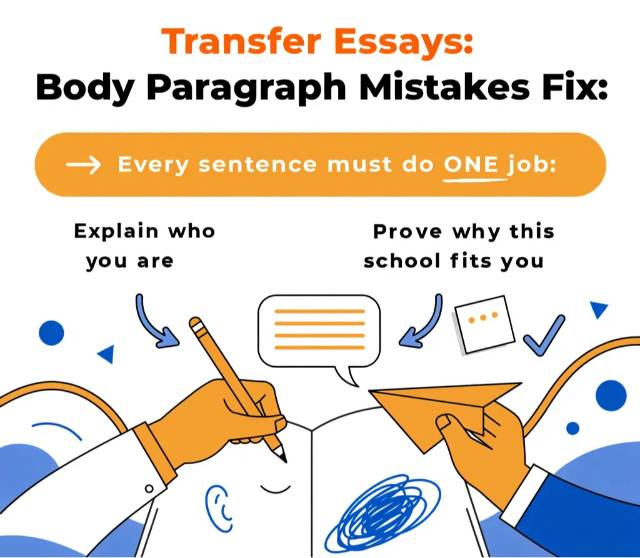
If a sentence doesn't do either, it probably shouldn't be there. Here are the patterns that tend to creep in:
- Trivial reasons for transferring "I want to be closer to home," "the social scene wasn't right for me," "my roommate situation was difficult." These aren't reasons an admissions office can act on. They signal that you haven't thought through the academic case for transferring.
- Too much time in the past You're applying as a college student, not a high school senior. Spending more than a sentence or two on high school achievements, teachers, or motivations buries what actually matters: what you've done since you enrolled.
- Making excuses instead of giving context There's a meaningful difference between "my grades dropped because I struggled with the transition" and "during that semester, I was managing a family illness while adjusting to college-level coursework for the first time." One is an excuse. The other is context that shows self-awareness and resilience.
- Volunteering GPA weakness before establishing who you are. Some transfer applicants open with or lead heavily toward their academic struggles in a low-grade semester, a GPA below their target school's competitive range, before the reader has any reason to trust or invest in them. Addressing an academic inconsistency isn't a mistake; the timing is. Establish your direction, your momentum, and your goals first. Context about a difficult semester belongs in the middle or near the end of the essay, as evidence of resilience, not as the first impression.
- Lists without connections. Naming every club, award, and course you've completed doesn't tell the reader anything unless you connect it to your direction. What did those experiences build toward? Why do they matter for what you're applying to do next?
- Trying to cover too much An unfocused essay that jumps between three or four themes leaves the reader without a clear sense of who you are. One strong thread, followed consistently, beats four weak ones every time.
- Skipping "optional" supplemental essays. Most competitive transfer applications include at least one essay listed as optional. Treat it as required unless your circumstances make it genuinely irrelevant. In a competitive pool, students who skip optional essays are leaving a dimension of themselves unrepresented. Admissions officers who read thousands of applications notice when an optional essay is missing from a borderline file not as a rule violation, but as a missed opportunity. The only time to skip an optional essay is if you genuinely have nothing to add that isn't already covered elsewhere in your application.
If you need help explaining academic struggles in your transfer essay or writing low GPA transfer essay, there's a right and wrong way to address them a brief, forward looking mention is very different from an excuse. |
?
Plan Your Transfer and Common App Essays Strategically
Get a clear plan to manage multiple essays without confusion
The Negative Tone Trap in Transfer Essay (How to Spot It in Your Own Draft)
You can be honest about why you're leaving without being unkind about where you are.
The negative tone trap is one of the most common transfer essay red flags and the hardest to catch in your own writing. You're not saying "I hate this school." You're saying something that sounds reasonable on its face but reads as complaint to someone who doesn't share your frustration.
Scan your draft for these phrases and sentence structures:
- "Unfortunately, my current school..."
- "Despite the fact that..."
- "Although [current school] has been..."
- "My professors don't..."
- "The program lacks..."
- Any sentence that describes your current school's failures rather than your next step's possibilities
The reframe to apply: it's not about them, it's about you. Every sentence that currently says "they don't have X" can be rewritten as "I need X to accomplish Y, which is why [new school]'s [specific thing] matters to me."
Read every sentence that mentions your current school. Ask: could this be read as a complaint? If yes, rewrite it so the focus is on what you learned there or what you need next. You can acknowledge limits without being dismissive. |
Transfer Essay Closing Mistakes That Leave Admissions Officers Cold
Your closing is the last thing the reader carries away. A weak close makes a strong essay feel unfinished.
The most common closing mistakes:
- Vague future ambition "I'm excited to grow, contribute, and make the most of everything [School] has to offer." This says nothing. Every applicant is excited. What are you specifically going to do there?
- Thanking the reader This isn't a cover letter. Ending with "Thank you for considering my application" reads as a job application, not a personal essay. It signals you haven't thought about what the format is.
- Recycling the intro Some students end where they began, repeating the same framing without developing it. That's not full-circle storytelling; it's stalling. A real callback adds something new a realization, a shift in perspective, a specific image.
A related mistake specific to transfer applicants: reusing your original high school Common App personal statement. The essay you submitted as a 17-year-old applicant was written by someone without college experience, for a reader who was extending trust on potential. You now have a transcript, coursework, real academic decisions, and college-level work to draw from. An essay that reads like it was written before you enrolled signals to admissions that you haven't grown enough to write a new one. You can draw on the same experiences, the same formative moments but the framing, the self-awareness, and the context all need to reflect who you are now, not who you were applying as. For the full picture of how transfer personal statements differ from transfer essays, see transfer personal statement vs transfer essay. |
A strong close gives a glimpse of your future self. It shows the reader a specific version of you in this school, in this program, doing the work you've described. Or it circles back to a specific detail from the opening and completes the thought with something the reader didn't expect.
The closing should feel like a door opening, not a summary of everything you already said.
What a weak closing looks like:
"I am excited about the opportunities that [School] offers and I know that with hard work and dedication, I will make the most of my time there. I look forward to contributing to the campus community and growing as a student and as a person. Thank you for considering my application."
Three sentences. Zero specifics. Could end any transfer essay submitted to any school in the country.
What a strong closing looks like:
"By the time I finish Professor [Name]'s lab in my second year, I want to have run at least one independent replication study. That's not an aspiration it's a plan. And it's one I can only execute here."
Three sentences. One specific professor. One specific deliverable. One sentence that signals this student did their research and is thinking about outcomes, not just acceptance.
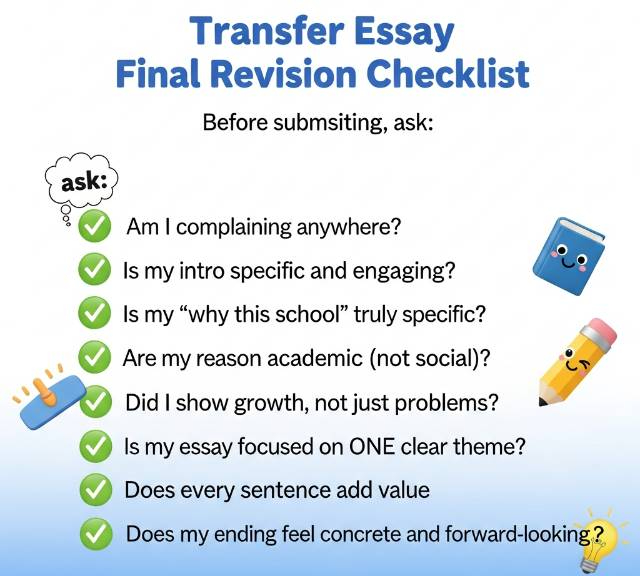
The Transfer Essay Revision Checklist (Run This Before You Submit)
Treating your revision like a checklist isn't mechanical, it's how the best essays get better.
Use this on your draft before you submit. Be honest. If you're unsure on any item, assume the answer is no and revise.
When You Don't Know How to Fix Transfer Essay Mistakes
Some mistakes are easy to fix on your own. A vague opener? You can rewrite that in twenty minutes. A generic "why us" paragraph? Thirty minutes of research and a rewrite gets you there.
The tone problem is harder. When you've been living the frustration of wanting to transfer, it's genuinely difficult to see where it's showing up in your own writing. You need someone who doesn't share your context to read it fresh.
Before you rewrite anything, it helps to see what a strong transfer essay actually looks like by visiting our blog on transfer essay examples that worked. The framing comes before the draft, and getting it right makes the revision much simpler. |
If you've gone through this checklist and you're still not confident, that's a sign the problem runs deeper than a few sentence swaps. Professional editing or writing support isn't giving up; it's using the right tool for the job.
Simplify Your Transfer Essay Writing
Follow a step by step process to complete your essay
- Easy writing framework
- Step by step guidance
- Topic development support
- Editing and revisions