What Makes a Transfer Essay Different from a Freshman Essay
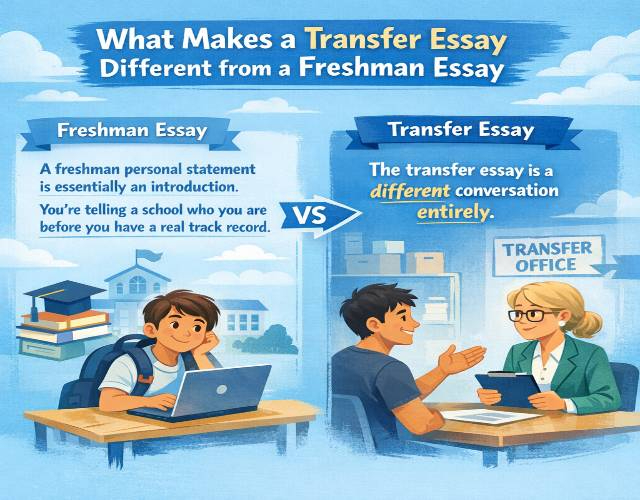
A transfer essay is a written statement explaining why you're leaving your current school and why the school you're applying to is the right next step for your academic goals. It's one of the most important pieces of your application, and it's also the one that trips up the most students.
In transfer essay you're explaining a decision. Unlike the freshman personal statement, a transfer essay explains a decision, and decisions carry weight because they demand honest reasoning.
You also have real college experience now. A GPA. Courses you've taken. Things you've done. That's an asset, and the transfer essay is where you use it.
The "why us" section gets more specific, too. You've lived dorm life, sat in lectures, and felt what it's like when a program doesn't fit. You know what you're looking for in a way a 17-year-old applying out of high school simply doesn't. |
The emotional stakes are also different. You're essentially saying: one place didn't work out. Here's why this next one will. Admissions officers understand that, but they need you to make the case with clarity and honesty.
What Do Transfer Essays Ask? Common Prompts Explained
Most transfer applications use one of a few standard prompt formats. Knowing which one you're dealing with makes the writing significantly easier.
The Common App Transfer Prompt (most common)
The standard Common App transfer prompt asks you to explain your reasons for transferring and the objectives you hope to achieve. The word limit is 250 to 650 words. This is the prompt that the majority of students writing how-to articles are preparing for.
UC Personal Insight Questions
University of California campuses use Personal Insight Questions instead of a traditional transfer essay. You answer 4 out of 8 prompts, at 350 words each. One is required. These are handled differently from the Common App.
School Specific Supplements
Many schools ask for additional short-answer responses on top of the Common App essay. USC, NYU, Cornell, UCLA, and others all have their own variations. These usually run 250 words or less and typically drill down on "why this specific school."
The Coalition App
The Coalition App uses a similar prompt to the Common App, why you're transferring and what you hope to accomplish, but sometimes with slightly different framing depending on the school.
Most transfer prompts are really one question in disguise: "Convince us this is the right decision for the right reasons." |
That's what you're always answering, regardless of how the prompt is worded.
Know you need to transfer, but not sure you can get this essay onto the page? Tell us your school, your situation, and your deadline, and write my transfer essay for you, school-specific, within 24 hours.
Steps to Write a Transfer Essay
Before you write a single word of the essay itself, get honest about why you're leaving.
There are three categories of legitimate transfer reasons. Academic:
- Your current program doesn't offer what you need (a major, a research opportunity, a specific faculty member's work).
- Personal growth: You've outgrown what this school can give you, and you're ready for something bigger or more aligned with your direction.
- Circumstantial: financial changes, family needs, a major life shift.
|
What admissions officers don't respond well to: complaints about a specific professor, vague statements about "not fitting in," or reasons that are purely social. That doesn't mean those experiences weren't real. It means they shouldn't be the centerpiece.
The goal is to find the academic or professional core of your reason, even if personal factors contributed. Instead of "I didn't fit in," try: "I realized I needed a stronger writing program to pursue journalism, and my current school's department doesn't offer it."
The reason you're transferring doesn't have to be dramatic. It has to be honest and forward-looking.
Once you've got clarity on this, the rest of the essay starts to organize itself. For a deep dive into framing this part of the essay, see our full guide on writing the why transfer essay. |
Step 2: How to Start Your Transfer Essay
Don't open with "I am transferring because..." It's flat. It tells the reader what they're about to read instead of making them want to keep reading.
Strong openings for a transfer essay usually take one of three forms. A specific moment that led to the decision. A belief about learning or your field that the rest of the essay will test. A question you've been working toward answering.
Your opening's only job is to make the reader want the next sentence. It's not where you explain your full situation. It's the door into it.
Here's what that difference looks like in practice:
Weak opening: "I decided to transfer because my program doesn't have what I need." Strong opening: "The moment I realized I was in the wrong place was sitting in my 200-person lecture hall, hand up, wondering if anyone would ever call on me." |
The second version creates a scene. It makes the reader feel something before you've explained anything. That's what you're going for.
A strong opening doesn't explain your decision. It makes the reader feel the moment that led to it.
Keep the opening tight. Two to four sentences. You're not summarizing the essay. You're opening a door.
Step 3: Explain Why You're Leaving (Without Sounding Negative)
This is the part most students dread, and it's where the most damage gets done when it goes wrong.
The key is to frame leaving as something you've outgrown, not something that failed you. There's a big difference between "this school wasn't good enough" and "I've grown past what this school can offer me." Admissions officers hear the difference.
A framing that works: acknowledge what you gained, then pivot to what's missing. |
"My current school gave me a strong foundation in the sciences. I've done well academically and I've appreciated the smaller class sizes. But it doesn't have the research lab infrastructure I need to pursue biomedical engineering at the level I'm aiming for."
What you want to avoid: calling out specific professors by name, complaining about administrative issues, or citing campus culture problems. Even if those things are true, they don't serve your application. |
Admissions officers aren't looking for a perfect record. They're looking for students who make considered decisions.
Step 4: Show Why This School Is the Right Next Step
This is your "why us" section, and vagueness is the fastest way to hurt yourself here.
"I love your diverse campus environment," and "your school has a great reputation" are not reasons. Every applicant says some version of those things. They don't tell the admissions office anything about whether you've actually researched them.
What works: specific programs, specific courses, specific faculty members whose research connects to yours, labs, journalism studios, clinical partnerships, writing centers, whatever is relevant to your goals. The more specific, the better. |
Here's an example of the difference:
Generic: "USC has an excellent communications program that would help me reach my journalism goals." Specific: "USC's Annenberg School for Communication has the journalism track and the industry connections I need for broadcast, specifically the Wallis Annenberg Hall MediaCenter, which my current school simply doesn't have." |
The second version shows you've done the work. Schools can tell when you've done your research, and when you've just swapped out the school name.
Connect what you've found in your research directly to the goals you established in Step 1. That connection, between where you've been, what you need, and what this school specifically offers, is the spine of a strong transfer essay.
Step 5: Connect the Dots: Your Past, Present, and Future
This is where good transfer essays become great ones.
At this point, you've explained where you started, why you're leaving, and where you want to go. Step 5 is about making sure those three things feel like a coherent arc, not a list of separate points.
The best transfer essays feel inevitable. Like you couldn't have written them before this moment.
Here's the structure underneath it: brief acknowledgment of where you've been, then a clear statement of where you are, then a compelling case for where you're headed. What makes it work is that each piece sets up the next. Your past isn't just context. It's the reason the present decision makes sense. |
If the essay reads like you're checking boxes (why I left, why I picked this school, here's my future plan), it needs more connective tissue. The reader should feel like they understand not just what you're doing, but why, and why now.
Read the whole thing in one sitting and ask yourself: Does this feel like a story, or does it feel like a form? If it feels like a form, the transitions need work.
Step 6: How to End Your Transfer Essay
Most transfer essay endings fall flat because they do one of two things: they summarize what the reader just read, or they end with something like "I look forward to attending your institution." Both are forgettable.
Your closing line is what the reader takes away when they set the essay down. Make it count. |
A strong ending does one of three things. It callbacks to the opening, returning to the image or moment from the first paragraph and showing what it means now that the reader knows the full story. It offers a forward-looking statement with a specific detail, not generic "I can't wait to grow" language, but something tied to the actual opportunity you described. Or it closes with a line that shows character, something that reveals who you are without explaining it.
Example of a callback ending: If you opened with the image of sitting in a lecture hall with your hand up, you might close with something like: "I'm not looking for a smaller classroom. I'm looking for the right one. And I've done the work to know the difference now." |
Your closing line isn't a goodbye. It's the moment you make the reader feel sure about you.
Keep it tight. One to three sentences. You don't need to restate everything. You need to leave the right impression.
Knowing what makes a strong transfer essay and actually writing one are two different problems. Most students hit the same wall at this point: they understand what the essay needs to do, but getting a draft onto the page that sounds like them, not like a cover letter, is where the hours disappear. Our professional transfer essay writing service delivers a complete, school-specific draft within 24 hours. Give us your reason for transferring, your target school, and your deadline. |
Transfer Essay Tips: 6 Things That Separate Good from Great
1. Specificity beats sincerity. Anyone can say they're passionate. You need to show proof, a specific moment, a specific gap, a specific thing the new school offers that you've actually looked up.
2. Don't write to impress. Write to inform and connect. Admissions officers have read thousands of essays trying to sound impressive. What stands out is a student who's genuinely thought this through.
3. Read it aloud. If you hesitate anywhere, rewrite that part. If it sounds stiff or formal when you hear it, it reads that way too.
4. Get a reader who doesn't know your situation. If they finish and still have questions, your essay raised them, which means you need to answer them. The essay should be self-contained.
5. Revise your opening last. Once you know what the full essay says, you can write a better opening. Most students write the intro first and then don't realize it no longer matches the essay they actually wrote.
6. Don't carry your freshman personal statement over. You've changed since high school. Your college experiences are relevant now. An essay that reads like it was written by a 17-year-old won't serve a transfer applicant.
To Wrap Up!
Writing a strong transfer essay is all about clarity, purpose, and authenticity. The part most students find hardest isn't knowing what the essay needs; it's getting a draft onto the page that sounds like them and not like a form letter. If that's where you are, tell CollegeEssay.org's transfer essay writers your school, your reason for transferring, and your deadline. You'll have a complete, reviewable draft within 24 hours.