You've opened the transfer section of the Common App, and you're looking at a single prompt. It's not the seven options you remember from high school, no "describe a challenge you've overcome," no pick-your-angle flexibility. There's one question, and it has two parts baked into one sentence.
This guide breaks down exactly what the prompt is asking, how to split your 650 words between both parts, and what separates a transfer essay that reads as purposeful from one that reads as a recycled personal statement.
What the Common App Transfer Essay Prompt Actually Says
Here's the exact prompt transfer students see on the Common App:
"Please provide a statement that addresses your reasons for transferring and the objectives you hope to achieve." (250 to 650 words) |
That's it. Some schools display a slight variation focused on your educational path and future goals, but the intent is the same across all Common App institutions.
A few things to know about the mechanics
- This is NOT one of the seven Common App personal statement prompts that high school seniors use. Transfer students have a completely separate prompt. If you've been Googling the Common App prompts and wondering which one fits your situation best, you've been looking at the wrong section.
The prompt has two distinct parts baked into one sentence
- why you're leaving, and where you're going. Most students write too much in the first part and run out of space for the second. That's a mistake, and we'll address it directly in the structure section below.
On length
- the minimum is 250 words, but for any competitive school, you should aim for 550–650. Submitting 300 words signals that you either didn't take it seriously or don't have much to say. Neither impression helps you.
The transfer essay isn't asking who you are, it's asking what you've learned and where you're going next. For a full walkthrough of the transfer process across all platforms and schools, see our transfer essay writing guide.
How the Transfer Essay Differs from Your Freshman Personal Statement
This matters because the most common mistake transfer applicants make is treating the transfer essay like another personal statement. They open with a childhood memory, build to a defining moment, and mention the transfer almost as an afterthought. Admissions readers notice.
Here's how the two essays are genuinely different:
| Freshman Personal Statement | Common App Transfer Essay |
|---|
| Prompts | 7 to choose from | 1 specific prompt |
| Focus | Who you are | Why you're leaving + where you're going |
| College experience | None (just high school) | Must reference your college experience |
| Tone | Reflective, identity-driven | Forward-looking, purposeful |
The biggest structural difference: your transfer essay has to be grounded in your college experience. If your essay could have been written before you ever set foot on a campus, if it's really about a high school moment or a personal trait, it's not a transfer essay. It's a recycled personal statement, and it'll read that way.
Admissions officers reading transfer applications are asking a specific question: "Why isn't this student's current school working for them, and why is our school the answer?" Your essay needs to address that question directly.
The transfer essay isn't about your past. It's about your college chapter, why this chapter isn't working, and what the next one looks like. |
How to Structure Your Common App Transfer Essay (650 Words That Work)
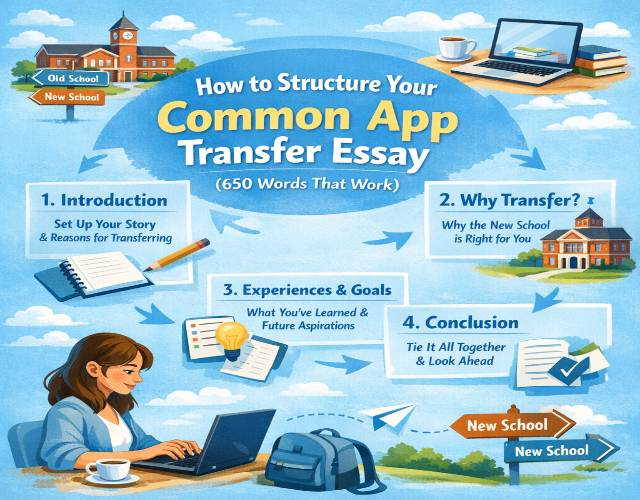
No competitor gives you this, a section by section word budget so you know exactly how to divide your 650 words without one part swallowing the other.
Here's the five-part framework:
| Section | What It Covers | Word Target |
|---|
| Opening Hook | A specific moment, realization, or turning point | 75–100 |
| Why Your Current School Isn't the Right Fit | Honest, forward-looking, not negative | 100–125 |
| What You've Done Despite the Limitations | Show you made the most of it | 75–100 |
| Why the New School Is the Right Fit | Specific programs, opportunities, faculty | 150–175 |
| Closing | Your vision for what comes next | 75–100 |
| Total |
| 600 |
A few notes on how to use this:
The opening hook should be firmly in your college experience. Not a high school memory, not a childhood story, something that happened after you enrolled. A specific conversation, a moment in class, a realization during a project. Ground the reader in your current reality immediately.
The "why I'm leaving" section is where most students over-explain. You don't need a dramatic story. One or two clear paragraphs that name what's missing, not what's wrong with the school, but what's missing for you, is enough. More on tone in the next section.
The "what I've done" section matters more than students realize. It shows you're not just escaping, you've been trying. Mention a class, a project, a professor, or an activity. Something that proves you engaged with your current school before deciding it wasn't right.
The "why this new school" section gets the most words. That allocation is intentional. This is the part admissions readers care about most because it tells them you've done your research and made a deliberate choice. Generic reasons ("great reputation," "strong academics") are not enough. Name a specific program, a specific research lab, a specific opportunity that doesn't exist at your current school.
The closing should be forward-looking. Where are you headed, and how does this transfer get you there? One short paragraph is enough.
Give the most words to where you're going, not where you've been.
If the framework makes sense but you're not sure how your specific situation maps onto it, which section your reason for leaving belongs in, how much of the word budget to give the "why this school" part, whether your opening hook is actually grounded in college experience, tell us your current school, your target school, your reason for transferring, and your intended major. Our Common App transfer essay service will build the structure around your story. Most students have a draft back within 24 hours.
Writing the "Why I'm Leaving" Section Without Sounding Negative for Common App Transfer Essay
This deserves its own section because it's where students worry most.
Here's the reframe: you're not explaining why you hate your school. You're explaining what you need that this school can't provide. Those are very different things, and the way you frame it changes how the essay reads entirely.
Some of the most common transfer reasons, and how to frame each:
The program doesn't exist or lacks depth
- This is the cleanest reason to write about. "The engineering program here doesn't offer the research opportunities I need to pursue my goals in biomedical device design" is specific, honest, and forward-looking. It criticizes nothing; it just names a gap.
Wrong fit for your learning style or environment
- Focus on what you're moving toward. "I've realized I learn best in small seminar settings with close faculty contact" is better than "My school is too big and anonymous."
Financial reasons
- Brief is fine. One sentence acknowledging the practical reality, then pivot immediately to what you're now positioned to pursue academically.
Personal circumstances
- Similar approach, brief context, then pivot. Admissions readers understand that life happens. They don't need the full story, and they don't want it.
What to avoid regardless of your reason
- Naming specific professors or administrators, describing specific incidents, or using any language that reads as bitter or resentful. Even if your experience at your current school has been genuinely bad, the transfer essay is not the place to document it.
The best "why I'm leaving" paragraphs barely mention leaving; they're really about arriving somewhere better.
The School-Specific Problem: One Common App Transfer Essay or Many?
The Common App gives transfer students one essay field for all schools. But the "why this school" section creates a real tension: do you write one essay that works generically, or do you customize it for each school?
Here's how to think about it:
Go Generic When
Your reasons for transferring are program-based in a way that applies to a type of school rather than a specific one. If you're transferring because your major doesn't exist at small liberal arts schools and you need a research university, that reasoning can stay consistent across your list.
Go Tailored When
You're applying to three to five specific schools, and you've done genuine research on each. If you're applying to Northwestern because of the Medill School and to Georgetown because of the Walsh School of Foreign Service, those are different schools for different reasons, and a generic essay will feel hollow for both.
The good news: the Common App technically allows you to edit your personal statement before submitting to each school. You can write a strong base essay, then swap out the "why this school" paragraph for each institution before hitting submit. It takes an extra thirty minutes per school, and it's worth it. |
A generic essay tells every school you'd be happy anywhere. A tailored essay tells one school you've done your homework.
Common App Transfer Essay Examples (Annotated)
Full example essays are long, so here are two annotated excerpts, enough to show the framework working in real prose.
Example 1: 4-Year to 4-Year Transfer (Academic Fit)
Opening hook (80 words): "The turning point came in my sophomore research methods seminar, when I spent three weeks designing a study I'd never be allowed to run. My professor confirmed it: our department doesn't have the IRB infrastructure or faculty bandwidth for undergraduate-led studies. It wasn't a criticism, it was just a fact. I remember sitting with that fact for a long time, because I'd come here specifically to do research." |
What Makes This Work
- Opens in college experience, not before it
- Introduces the reason for transferring through a specific moment
- Identifies a genuine institutional gap (not a personal grievance)
Why this school section (150 words): "Boston University's undergraduate research program is what I couldn't build here. The UROP funding, the direct lab placements, the four credits per semester for original research, these aren't extras at BU, they're built into the undergraduate experience. Professor Kang's behavioral economics lab, specifically, is doing exactly the kind of field-experiment work I want to learn. I've read three of her recent papers. I know what questions she's asking. I want to help answer them." |
What Makes This Work
- Names a specific program (UROP)
- Names a specific professor and specific papers
- Ends with a clear statement of purpose, not a vague hope
Example 2: Community College to 4-Year Transfer (Planned Route)
Opening hook (85 words): "I enrolled at Santa Monica College knowing I'd transfer. That was always the plan: two years to establish my GPA, build my portfolio, and lower the cost of a degree I knew would take me somewhere expensive. What I didn't plan was how much I'd get out of it. My film production courses here are genuinely good, and two of my short films have placed in student festivals. Now I'm ready for what comes next." |
What Makes This Work
- Addresses the "I was always going to leave" dynamic head-on rather than apologizing for it
- Shows engagement with the current institution (festivals, courses)
- Sets up the "why the new school" section naturally
You now have the framework, the word budget, the tone guidance for the hardest section, and two annotated examples. What you need now is a draft. CollegeEssay.org's transfer essay team works specifically on transfer applications. We'll take your situation, your target school, and your reasons for transferring and build the essay around them. Tell us what you've got and we'll tell you what we need.The Key Mistake That Hurts Common App Transfer Essays
The mistake: writing a personal statement instead of a transfer essay.
- It happens because students know the freshman personal statement format and default to it. They open with a childhood memory or a formative experience, build toward a thesis about who they are, and tack on a paragraph about transferring at the end. It's a well-structured essay, just the wrong essay.
The fix is simple but requires honest editing
- Your opening should be grounded in your college experience. Not your pre-college life, not your high school chapter, not who you were before you enrolled. If you remove the final paragraph about transferring, and the rest of the essay still makes sense as a college application essay, rewrite it.
A related mistake
- Vague goals. "I want to challenge myself academically" and "I want to grow as a person" mean nothing to an admissions reader. What do you want to do, specifically? What will you study, specifically? What opportunity at this specific school are you pursuing? The more concrete your answer, the more credible your transfer reason becomes.
If your essay could have been written before you started college, rewrite it.
To Wrap Up!
You've got the structure, the word budget, and the examples. Now comes the writing. If you'd rather spend the next hour doing anything else, tell us your current school, your target school, your major, and your reason for transferring, and we'll get your transfer essay written for you. Most applicants have a complete draft back within 24 hours, with revisions included until it's right.