Writing an essay fast means compressing the normal process into a focused, timed sequence, without skipping the steps that actually matter. The deadline is real. The panic is real. And most "how to write an essay" guides out there weren't designed for someone staring down a clock.
This guide is different. You won't find a list of vague tips here. What you'll get is a timed, step-by-step system, one that tells you exactly what to do and for how long, so you're never stuck wondering what comes next. Run this process, and you'll have a complete, coherent essay, even on a short runway.
If the deadline is too close for any system to help, consider getting custom essay writing help where human writers are available for rush delivery, but try this process first.
Before You Start Writing an Essay: Set Your Time Budget
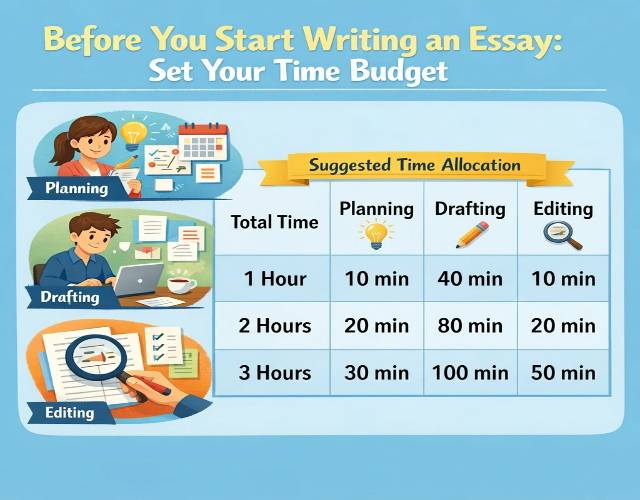
Before you type a single word, spend two minutes setting a time budget. This is the step most students skip, and it's exactly why they run out of time.
Set a timer for each phase. When it goes off, move on, even if that phase doesn't feel finished. Keeping your momentum matters more than perfecting any single part.
One thing students consistently underestimate: the editing phase. Ten minutes sounds like nothing, but that's intentional. Under a real deadline, editing is triage; you're not polishing, you're catching the things that would cost you marks. Trust the time box. It forces you to prioritize what actually matters. |
Steps to Write an Essay Fast
Step 1: Read the Prompt (5 Minutes, Not 30 Seconds)
Most wasted time in fast essay writing comes from one place: misreading the prompt. You get three paragraphs in and realize you're arguing the wrong thing. Now you've burned 20 minutes you didn't have.
Spend five full minutes on the prompt. Underline the instructional words:
- Compare
- Analyze
- Argue
- Describe
- Evaluate
Each one tells you something different about what you're being asked to do. "Compare" means you need two sides. "Analyze" means you're breaking something down into its parts. "Argue" means you're taking a position and defending it. These aren't interchangeable, and mixing them up costs you.
Then write your understanding in one sentence. Something like: "I need to argue whether X is true and support it with two pieces of evidence." If you can't write that sentence, you'll spend hours going in circles. Get clear here first. Everything after this gets faster. |
Pay attention to constraints in the prompt, word count, required sources, formatting rules, and whether a counterargument is expected. Missing a constraint halfway through is one of the most expensive mistakes you can make on a tight deadline. Five minutes of careful reading now prevents an hour of backtracking later.
If your assignment is a specific length, check the relevant guide; our 500 word essay breakdown covers how to scope your argument for shorter pieces. |
Step 2: Build a Fast Outline (Don't Skip This)
Here's the counterintuitive truth about writing fast: spending time on an outline saves more time than it costs.
The reason most students write slowly isn't a lack of skill; it's stopping to think about what comes next. A solid outline eliminates that pause.
Use what's called a flat outline: a simple bulleted list, one idea per bullet. You're not writing full sentences here. You're just deciding what order things go in. Aim for 10 to 15 bullets max, then group related ones into paragraphs.
It looks like this: - Hook/entry point
- Define the problem
- Thesis (your argument in one sentence)
- Body point 1 + supporting evidence
- Body point 2 + supporting evidence
- Body point 3 + supporting evidence
- Counterargument (if required)
- Conclusion, restate + so what?
|
That's your whole essay. Turn each bullet into a paragraph header, and you've got a working structure before you write a word of real content.
The flat outline works because it separates two very different tasks: deciding what to say and actually saying it. Most slow writers try to do both at once. When you draft without an outline, every sentence requires two decisions: what the idea is and how to phrase it. Separate them, and both get faster.
Step 3: Write Your Thesis First
Your thesis is the engine of the whole essay. Every paragraph either supports it or moves toward it. If you don't know what your thesis is, you'll write in circles until something accidentally emerges, and that's expensive when you're on a clock.
Here's how to write a working thesis in under three minutes: take a position, then give two reasons why. Like this: "Social media harms teen mental health because it creates unrealistic comparisons and displaces face-to-face interaction." Notice what that sentence does. It takes a clear side (harms), it's specific enough to argue (teen mental health), and it gives you two body paragraphs built right in, one about comparisons, one about face to face time. That's a thesis that works as a writing tool, not just a topic sentence. |
It doesn't have to be perfect. It has to be directional. Once you've written it, all your body paragraphs have a job: prove that the sentence is true. If a paragraph you're writing doesn't connect back to your thesis, either cut it or adjust it. When you're writing fast, clarity of purpose is everything.
One more thing: write the thesis before the outline, not after. Most students wait until they feel ready. You'll feel ready after you write it.
Step 4: Write the Body First, Intro Last
This is the single biggest speed unlock most students don't know about: don't write the intro first.
The introduction is the hardest part to write cold. You're trying to hook a reader, provide context, and preview an argument you haven't fully worked out yet. It's no wonder students spend 40 minutes on three sentences and hate everything they produce.
Write the body first. Each body paragraph follows the same simple structure:
- Topic sentence: what this paragraph argues
- Evidence: the fact, quote, or example that supports it
- Analysis: why that evidence proves your point
- Transition: one sentence that leads to the next paragraph
|
Once the body is done, you know exactly what happened in the essay. Writing the intro becomes mechanical. You're not guessing at the argument anymore; you're summarizing one you just made.
Step 5: Write the Introduction After the Body Fast
Now that the body is done, your intro is straightforward. You know what you argued. You know how you got there. You just need a clean entry point.
Keep it tight under deadline conditions. Four to five sentences is plenty:
- Hook: one sentence that pulls the reader in (a question, a surprising fact, a direct statement)
- Background: one or two sentences of context
- Thesis: the argument sentence you already wrote in Step 3
- Map: one sentence that tells the reader what's coming
|
Don't over-engineer it. A clear, direct intro beats a clever, half-finished one every time. If you find yourself rewriting the hook four times, move on. You can fix it in the edit pass.
The biggest intro mistake on a deadline is spending too long trying to make it interesting before the essay exists. The body is what makes it worth reading. Write the intro last, keep it clean, and trust that a reader who clicks through to your argument will stick around for a direct hook, even if it's not your most creative sentence.
When Fast Isn't Fast Enough
Sometimes the deadline is too close, even with the best system.
Step 6: Draft Without Editing
Once you're in the drafting phase, keep moving. Don't stop to fix a word. Don't backspace. Don't reread. Just write.
Editing while drafting is the biggest time-killer there is. Every time you stop to polish a sentence, you break your momentum, and rebuilding it costs you more time than the fix was worth. Write ugly first. Fix it after.
A few things that help:
- Turn off spell check if the red underlines distract you
- If you get stuck mid-paragraph, type [FILL IN LATER] and keep going
- Don't delete anything, just write past the bad parts
- Stay in chronological order through your outline; don't jump around
|
Your draft doesn't have to be good. It has to exist. A bad draft you can edit is infinitely better than a perfect paragraph attached to nothing.
The psychology here matters too. Stopping to edit activates your critical brain, the part that judges and second-guesses. Drafting works best when that voice is quiet. Give yourself permission to write badly, and you'll often find the writing isn't as bad as you feared once you go back to read it.
Step 7: Write the Conclusion Fast
The conclusion is not a place for new ideas. Under deadline conditions, especially, keep it simple.
Three to five sentences, structured like this:
- Restate your thesis in new words, don't copy-paste it
- Summarize your key points in one or two sentences
- Close with a "so what", why does this argument matter beyond the page?
|
That's it. You don't need a grand closing statement. You need a clean ending that signals the essay is done, and the argument was made. Anything more than five sentences is probably padding.
A common deadline mistake is trying to introduce a new angle in the conclusion because you realized something while writing the body. Resist that. If it's important, go back and add it to a body paragraph. The conclusion's job is to land the plane, not circle the airport looking for a better runway.
Step 8: Edit Fast, One Pass, Three Priorities
When you're under pressure, you only have time for one edit pass. Use it well by focusing on three things in this order:
Priority 1: Does the argument make sense? Read through once just for structure. Does each body paragraph connect to the thesis? Is there anything that feels out of place or contradicts itself? Fix those first; they're the most damaging issues.
Priority 2: Is every sentence clear? You're not looking for beautiful sentences. You're looking for confusing ones. If you have to read a sentence twice to understand it, rewrite it.
Priority 3: Obvious errors only. Don't proofread every comma. Catch the obvious stuff, misspelled words, wrong names, glaring grammar mistakes. The rest can live.
Reading your essay aloud is the fastest quality check available to you. Your ear catches things your eyes miss. If you stumble over a sentence when reading it aloud, it needs work. This trick alone, one aloud read-through, will catch more issues than three silent passes.
Step 9: When You're Out of Time Entirely to Write an Essay
Sometimes the clock wins. You've done everything right, but the gap between where you are and where you need to be is too big to close on your own.
That's a real situation, and working with a professional essay writing service is a legitimate option.
Here's what matters when you're choosing a service under pressure: make sure it's human-written. AI-generated essays are increasingly detectable, and the risk isn't worth it.
Remember! There's no shame in knowing when to get help. The students who learn that lesson tend to stay a lot saner for the rest of their academic careers.
Tips to Write an Essay Fast
- Use voice-to-text for rough ideas: speak your argument out loud and let your phone transcribe it. Talking is faster than typing for getting ideas out of your head.
- Start with your strongest body point: not the first one chronologically. Momentum comes from confidence. Write what you know best first, then fill in the weaker points.
- Write your conclusion right after your thesis: before the body. It sounds backward, but knowing your ending makes every body paragraph easier to write because you know where you're going.
- Set a "no delete" rule for the first draft: only add, never remove. Deletion is an editing action. Save it for the editing phase.
- Reward yourself in micro-doses: one paragraph done, stand up and stretch. Taking small physical breaks every 20 minutes maintains focus better than powering through until you crash.
To Wrap Up!
Writing an essay fast is all about using a focused strategy that helps you plan, write, and refine your ideas without wasting time. With the right approach, you can meet tight deadlines while still producing clear, well-structured work. And when time runs out, expert help is always an option to ensure your essay is delivered on schedule.
Need Essay Written Tonight?
Our writers work fast so you don't have to.
- Rush delivery available, tell us your deadline
- 100% human writing, no AI, no detection risk
- 50/50 payment terms, pay half upfront, half when happy
- Money back guarantee if you're not satisfied