What Does Essay Format Cover?
The essay format covers three things:
- How the document looks (font, margins, spacing)
- How the content is organized (introduction, body paragraphs, conclusion)
- Which citation style does your course require?
Get the format right, and it disappears into the background. Your writing does the work. Get it wrong, and your professor is hunting for your argument through inconsistent text before they have read a word.
Standard Essay Formatting Rules (Any Style)
Every academic essay uses the same baseline rules regardless of citation style: 12-point font, double spacing, 1-inch margins, and page numbers. These aren’t arbitrary. They exist so your reader can focus on your writing, not your layout.
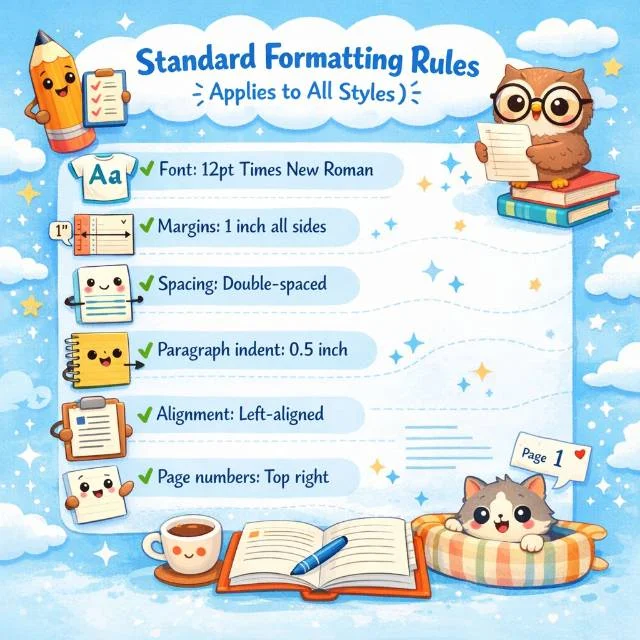
- Font: 12pt Times New Roman (or a comparable readable font like Arial or Calibri, if your professor allows it). Decorative fonts are never appropriate.
- Margins: 1 inch on all sides. This is the standard across all three major citation styles.
- Spacing: Double-space the entire document: body text, block quotes, reference lists, everything.
- Block quotes: Used when a quotation runs longer than 4 lines (MLA) or 40 words (APA). Indent the entire quote 0.5 inches from the left margin, double-spaced, with no quotation marks. The citation goes after the closing punctuation, not before it.
- Paragraph indentation: Indent the first line of each paragraph 0.5 inches (one tab press in most word processors).
- Page numbers: Upper right corner of every page.
- Alignment: Left-aligned. Don’t justify your text. It creates uneven spacing between words and makes your essay harder to read.
How to Format an Essay in Microsoft Word and Google Docs
Microsoft Word and Google Docs both support standard essay formatting through their built-in margin, font, spacing, and header settings. Knowing the rules is one thing; applying them in your word processor is another. Here’s the exact setup for both tools.
- Margins:
Layout → Margins → Normal (1 inch all sides) - Font:
Home → Font → Times New Roman, Size 12 - Spacing:
Home → Line and Paragraph Spacing → 2.0, then “Remove Space After Paragraph” - Page numbers:
Insert → Page Number → Top of Page → Plain Number 3 (right-aligned) - Header (MLA):
Insert → Header →type your last name, then insert page number
- Margins:
File → Page Setup →set all margins to 1 inch - Font:
Format bar at top → Times New Roman, Size 12 - Spacing:
Format → Line & Paragraph Spacing → Double, then “Remove space after paragraph” - Page numbers:
Insert → Page numbers → top right - Header (MLA):
Insert → Headers & Footers → Header →type last name + insert page number
You’ve got the format. If the essay itself is what’s standing between you and submitting, tell us the citation style, page count, and deadline, and get your essay written by an expert who knows the formatting rules cold.
MLA Essay Format
Use MLA for humanities courses, including English, literature, and language. Follow the page setup below.
Modern Language Association
MLA (Modern Language Association) is the standard for English, literature, language, and cultural studies. If you’re writing a paper on a novel or a poem, you’re almost certainly using MLA.
- No separate title page (in most cases)
- First page header (left-aligned): your name, professor’s name, course name, and date. Each on its own line.
- Title: centered, no bold or italics, regular text
- Running header: your last name + page number in the upper right corner (e.g., Smith 1)
In-text citations: MLA uses author + page number in parentheses: (Smith 45). If you mention the author’s name in the sentence, you only need the page number: (45).
Works Cited page: At the end of your essay, on a new page titled “Works Cited” (centered, not bolded). Entries are alphabetized by the author’s last name. CollegeEssay.org’s writing team works with MLA format across English, literature, and humanities assignments at the undergraduate level.
Jane Smith
Professor Rodriguez
ENGL 101
15 April 2026

How Gatsby’s Green Light Symbolizes the American Dream
APA Essay Format
Use APA for social sciences, psychology, education, and health sciences. It requires a separate title page and author-year citations.
American Psychological Association
APA format (American Psychological Association) is the standard for social sciences, psychology, education, and nursing. If your course involves research studies, data, or behavioral science, you’re using APA.
- Separate title page required: paper title (bold, centered, in the upper half of the page), your name, institution, course name and number, instructor name, and due date
- Running head: abbreviated title in ALL CAPS and page number in the upper right. APA 7th edition dropped the Running head label for student papers.
- Abstract (if required): A 150–250 word summary on its own page, labeled “Abstract” (centered, not bold). If the assignment sheet doesn’t mention it, you likely don’t need one.
In-text citations: APA uses author + year: (Smith, 2022). For direct quotes, add the page number: (Smith, 2022, p. 45).
Reference list: At the end, on a new page titled “References” (centered, not bolded). Entries are alphabetized and use a hanging indent.
Headings: APA uses five levels of headings. For most undergraduate essays, you’ll only need Level 1 (centered, bold, title case) and Level 2 (left-aligned, bold, title case). Papers under 5 pages often need no headings at all.
The Relationship Between Sleep and Academic Performance

Jane Smith
University of Michigan
PSYC 202: Research Methods
Professor Rodriguez
April 15, 2026
Chicago Style Essay Format
Use Chicago style for history and some humanities courses. Confirm with your professor whether they want Notes-Bibliography or Author-Date before you start.
Chicago Style
Chicago style is most common in history courses. It comes in two systems, and you need to know which one your professor wants before you begin.
Two systems:
- Notes-Bibliography (NB): Used in the humanities. Citations appear as numbered footnotes at the bottom of each page, with a full bibliography at the end.
- Author-Date: Used in some social sciences. Works similarly to APA, with author + year in-text citations.
- Separate title page: title centered roughly one-third down the page, followed by your name, course name, and date. All centered.
- No running head
- Double-spaced body text, 1-inch margins
- Footnotes (NB system): superscript numbers in the text, with corresponding notes at the bottom of the page
Bibliography: At the end, on a new page titled “Bibliography” (centered). Alphabetized by author’s last name, with a hanging indent.
MLA vs. APA vs. Chicago: Quick Comparison
MLA is used for humanities and literature, APA for social sciences and psychology, and Chicago for history. Here’s how the three styles compare across every major formatting requirement:
| Feature | MLA | APA | Chicago (NB) |
|---|---|---|---|
| Used for | Humanities, literature | Social sciences, psychology | History, arts |
| Title page | No (usually) | Yes | Yes |
| In-text citations | Author + page (Smith 45) | Author + year (Smith, 2022) | Footnote numbers |
| Reference list name | Works Cited | References | Bibliography |
| Page numbers | Last name + number (Smith 1) | Abbreviated title + number | Number only |
| Abstract required? | No | Sometimes | No |
Essay Format Templates by Type (Free Downloads)
Each essay type below has its own format requirements. Download the format guide for your specific assignment before you start.
Essay Format vs. Essay Structure: What Is the Difference?
Every academic essay follows a three-part structure regardless of citation style: an introduction that ends with your thesis, body paragraphs that each develop one supporting point, and a conclusion that wraps up your argument. Format governs how the paper looks. Structure governs what goes in it. Both have to be right.
For a complete breakdown of what goes in each section, see our full guide on how to write an essay.
Common Essay Formatting Mistakes
The five most common essay formatting mistakes are using the wrong citation style, single-spacing, missing page numbers, wrong font size, and leaving out the reference list.
-
1
Wrong citation style for your course. Using MLA for a psychology class is a quick way to lose points on something that has nothing to do with your argument. Always check the assignment sheet first.
-
2
Single-spacing instead of double-spacing. This is the most common error and one of the easiest to miss if you didn’t set your document up before you started writing. Check your spacing settings before you paste anything in.
-
3
Missing header or page numbers. Every style requires page numbers. MLA adds your last name. APA adds an abbreviated title. Chicago just uses the number. None of them are optional.
-
4
Wrong font or font size. 12pt Times New Roman is the standard. If you’re using something else, you’ll need a specific reason and your professor’s approval.
-
5
No Works Cited, Reference list, or Bibliography. Every citation in the text needs a matching entry at the end. Missing this can seriously impact your grade and raise plagiarism concerns.
You’ve got the format rules and the common pitfalls. Applying all of it to an essay you still have to write is a different problem. If you need someone to write my essay. Our writers work in MLA, APA, and Chicago can help turn your ideas into a polished paper.
How to Format an Essay: Pre-Submission Checklist
This checklist covers every formatting requirement across MLA, APA, and Chicago. Run through it before you submit.
- Margins set to 1 inch on all sides
- 12pt Times New Roman (or approved font)
- Entire document double-spaced
- First line of each paragraph indented 0.5 inches
- Header with correct format (last name + page number for MLA; abbreviated title + page number for APA)
- Correct citation style applied throughout (MLA / APA / Chicago)
- Works Cited, References, or Bibliography page included
- Title page requirements followed for your style
- All in-text citations match entries in your reference list
You now have the formatting rules, the citation style breakdown, and the checklist. The last step is the essay itself. Share your prompt, word count, and citation style, and let CollegeEssay.org help you write your essay. The professional team will deliver a paper that’s formatted correctly from the first line.
Frequently Asked Questions