What Is an Essay?
An essay is a piece of writing that develops a central argument through structured paragraphs. It opens with an introduction that states the thesis, supports it through body paragraphs with evidence, and closes with a conclusion that restates what was proved.
How to Write an Essay Step by Step
These seven steps cover every stage of essay writing from the moment you receive an assignment to the final draft you submit.
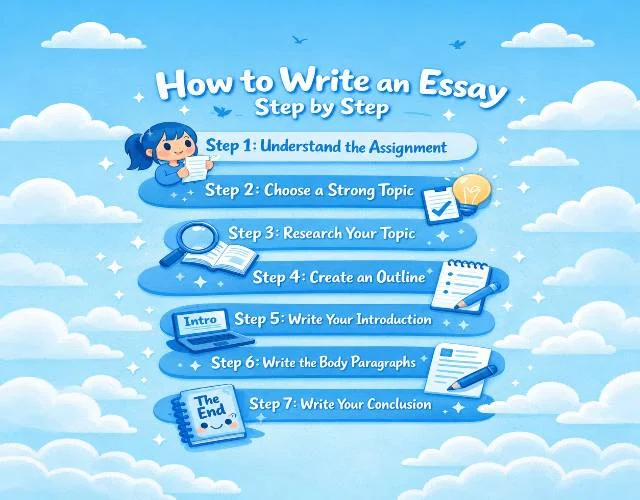
Understand the Assignment
Before you write a single word, read the prompt twice and underline the action word because you are being asked to analyze, argue, describe, or explain, and those are four different tasks.
Also note the word count, due date, and any formatting requirements. A 1,000-word argumentative essay is a very different task from a 500-word narrative. Getting this wrong at the start means rewriting later. Spend five minutes here and save yourself an hour.
Choose a Strong Topic
The fastest way to choose a strong essay topic is to spend 10 minutes writing every idea that comes to mind without editing or deleting anything.
If you get stuck, try mind mapping: put your topic in the center of a page and branch out with related ideas. Or talk it through out loud because explaining your thoughts verbally often unlocks the angle you are looking for.
The approach also varies depending on the type of essay you have been assigned, narrative, argumentative, expository, or descriptive, so confirm that before you commit to a direction.
Research Your Topic
Not every essay needs outside sources, but most do. When researching, stick to credible sources: peer-reviewed articles, government websites, established news outlets, and academic databases. Wikipedia is fine for background, but not for citing.
As you read, take notes and track where each piece of information came from. You will need this for your citations. MLA, APA, and Chicago are the three formats you are most likely to encounter. Your assignment prompt or syllabus will tell you which one to use. Do not mix them.
If you are stuck on a topic entirely, see our list of 250+ essay topics for ideas across every subject.
Create an Outline
Skipping the outline is the single biggest reason writers get stuck mid-essay. An outline gives you a map so you know exactly where you are going before you start writing.
A basic essay outline looks like this:
- Introduction: Hook + background context + thesis statement
- Body Paragraph 1: Topic sentence + evidence + explanation
- Body Paragraph 2: Topic sentence + evidence + explanation
- Body Paragraph 3: Topic sentence + evidence + explanation
- Conclusion: Restate thesis + summarize key points + closing thought
It does not need to be elaborate. Even a rough outline keeps you on track.
CollegeEssay.org’s writers find that students who submit an outline with their assignment details receive a stronger first draft than those who send a prompt alone.
Write Your Introduction
Your essay introduction has three jobs: hook the reader, give them enough context to follow your argument, and state your thesis clearly.
Your first sentence is the hook, and it sets the tone for everything that follows. See hook examples for ready-to-use options across essay types.
Write the Body Paragraphs
Each body paragraph should make exactly one point. Start with a topic sentence that tells the reader what the paragraph is about. Then provide your evidence: a quote, a statistic, or an example. Then explain what that evidence means and how it supports your thesis.
Do not expect the reader to connect the dots. Make the connection explicit. Use transition words to connect your paragraphs without it feeling abrupt.
Write Your Conclusion
Your conclusion should restate your thesis in fresh language and leave the reader with a closing thought rather than simply repeating what the body paragraphs said. Do not introduce new ideas in your conclusion. If it is important enough to mention, it belongs in the body. End with a closing thought that makes the reader feel the essay is complete, not just stopped.
See our full essay conclusion guide for examples of strong and weak endings.
You have got the seven steps. If the assignment is still sitting there unwritten, with the topic not decided and the outline not started, our writers can write my essay for you from whatever stage you are at: topic only, rough outline, or blank page.
How to Format an Essay (MLA, APA, and Chicago)
Standard academic formatting means 12pt Times New Roman, double spacing, 1-inch margins, and a header with your name and page number. Your citation style, whether MLA, APA, or Chicago, will also determine how your works cited or reference page looks.
Formatting is the last thing you should worry about. Get the writing right first. For full formatting rules and style-specific templates, see our essay format guide.
Essay Requirements by Level: High School, College and Graduate School
The mechanics of essay writing stay the same across every level, but what professors expect from those mechanics changes significantly as you progress.
How to Write an Essay in High School
High school essays typically follow a 5-paragraph structure with one introduction, three body paragraphs, and one conclusion. It is a formula, and for good reason. It teaches you to organize an argument before you try anything more complex.
Your teacher is looking for a clear thesis, evidence that supports it, and proper citations. Word counts usually run 500 to 800 words for standard assignments.
The most important thing at this level is staying focused. Pick one clear argument and stick to it. Students who try to make five different points in 500 words end up making none of them convincingly. See our 500-word essay guide for a full walkthrough.
How to Write an Essay in College
College essays require genuine critical analysis, not just reporting. You are not just summarizing what others have said. You are evaluating it, connecting it, and developing your own position.
The thesis needs to be more nuanced. Instead of “Climate change is bad,” a college-level thesis argues that a specific policy approach is more effective than another, and why.
Evidence must come from credible academic sources, cited correctly in MLA, APA, or Chicago depending on your discipline. Word counts typically run 750 to 1,500 words or more.
CollegeEssay.org’s writers handle college essays across all major subjects and word counts and find that the most common issues in student briefs are missing citations, unclear instructions, and academic language that reads as informal.
How to Write a Graduate Level Essay
Graduate school essays require you to critically evaluate existing scholarship rather than summarize it and to develop an original perspective on the debates in your field. A master’s or PhD level essay should demonstrate that you understand those debates and can contribute something new to them.
Habits to unlearn from undergrad: vague thesis statements, surface-level analysis, and over-reliance on direct quotation. At the graduate level, your analysis should take up more space than the quotes supporting it. Word counts vary widely. Essays running 2,000 to 5,000 words or more are common, depending on the assignment and program.
You have got the full process across every level. The next step is turning that process into a finished, submitted essay, which is where most students stall. Our professional essay writing help service takes your assignment details and handles the writing, so the deadline stops being a threat.
Common Essay Writing Mistakes to Avoid
The most common essay writing mistake is starting to write before you know what argument you are making. Here are the six mistakes that show up most often, and how to fix them:
-
1
Weak or missing thesis. Your essay needs a central argument, not just a topic. “This essay is about climate change” is a topic. “Economic incentives are more effective than regulation for reducing industrial emissions” is a thesis. If you cannot state your argument in one sentence, keep thinking.
-
2
No outline. Writers who skip the outline often realize halfway through that they have nothing left to say or too much in the wrong place.
-
3
Ignoring the prompt. Read it again. Then read it once more. Students often write a great essay on the wrong question. Check that your argument actually answers what is being asked.
-
4
Poor transitions. Jumping from one idea to the next without connecting them makes your essay choppy and hard to follow. Each paragraph should flow naturally into the next.
-
5
Burying the thesis. State your argument early, ideally at the end of your introduction.
-
6
Skipping revision. First drafts are always rough. Read your essay out loud before submitting. You will catch awkward sentences, repetitive words, and logic gaps you missed on screen.
Essay Checklist
A complete essay checklist covers nine elements, including your thesis clarity, body paragraph structure, evidence citations, conclusion, and formatting before submission.
| Essay Element | What to Check |
|---|---|
| Title | Does it accurately reflect the content? Is it specific enough to tell a reader exactly what the essay argues? |
| Introduction | Does it hook the reader, provide context, and end with a clear thesis statement? |
| Body Paragraphs | Does each paragraph make exactly one point? Does each have a clear topic sentence, supporting evidence, and an explanation of how that evidence supports the thesis? Are there smooth transitions between paragraphs? |
| Evidence | Are all sources properly cited? Is the evidence relevant and credible? Is there enough of it to support each point? |
| Conclusion | Does it restate the thesis in fresh language? Does it summarize key points without introducing new ideas? Does it end with a closing thought and not just a stop? |
| Audience and Tone | Is the language appropriate for the intended audience? Is the tone consistent throughout? |
| Grammar and Spelling | Are there any grammar errors, awkward sentences, or spelling mistakes? Is the tense consistent? |
| Formatting | Does the formatting match the required style guide (MLA, APA, Chicago)? Are margins, spacing, and font correct? |
| Word Count | Does the essay meet the required length with substantive content throughout and not just padding to hit the word count? |
How to Write an Essay More Efficiently: 8 Practical Tips
The most effective way to write an essay more efficiently is to start early, outline before drafting, and write the body paragraphs before the introduction.
Start early.
The earlier you start, the more time you have to develop your argument and revise. It also gives you the option to step away and come back with fresh eyes.
Keep the question in mind throughout.
Every paragraph you write should be traceable back to the prompt. If it is not, cut it.
Do not write from beginning to end.
Write the body first. Once you know what you have argued, writing the introduction and conclusion is much easier.
Write the introduction and conclusion last.
The body reveals your argument. The introduction and conclusion frame it. You cannot frame something you have not written yet.
Use signpost words.
Words like “however,” “therefore,” “in contrast,” and “as a result” guide the reader through your logic. Use them deliberately, not as filler.
Incorporate evidence carefully.
Cite everything. Explain why each piece of evidence matters and do not assume the connection is obvious.
Edit your first draft extensively.
Read for argument first (does this make sense?), then for structure (does the order work?), then for language (is this clear?). Three passes, three different lenses.
Put the essay aside before your final read.
Even a few hours between finishing and final proofreading helps you catch errors you became blind to during writing.
You now have the full process: the steps, the structure, the format rules, and the most common places essays fall apart. If the essay still needs to be written, then have your essay written by CollegeEssay.org’s writers. They will take the brief, assignment prompt, word count, due date, and deliver a finished draft.
Frequently Asked Questions