What Common App Prompt 6 Is Actually Asking (It's Three Questions, Not One)
Here's something most guides miss: Prompt 6 isn't one question. Read it closely and you'll find three distinct things admissions officers want to know.
Q1: Describe a topic, idea, or concept you find so engaging you lose track of time.
This is the topic itself. But notice that the prompt says "lose track of time", not "find academically important" or "plan to study in college." It's asking about genuine absorption. The kind where you look up and two hours have passed.
Q2: Why does it captivate you?
This is where your personality enters. Not what the topic is, but what it does to you . Why does it hold your attention when other things don't? What question inside you does it keep trying to answer?
Q3: What or who do you turn to when you want to learn more?
Almost everyone skips this one. That's a mistake. This question is where admissions officers see evidence of real curiosity versus performed passion. It's one thing to say you love something. It's another to show you've actively gone somewhere with it.
Most Prompt 6 essays answer Q1 thoroughly, touch Q2, and completely ignore Q3. The ones that stand out treat all three as equally important. The topic is just the lens, in a Prompt 6 essay, you are always the subject.
|
If you're still figuring out which prompt fits your story before committing to Prompt 6, our guide on how to write a Common App essay walks you through the full decision from the beginning. |
Is Common App Prompt 6 Right for You?
The best candidate for this prompt is a student with a genuine intellectual interest that isn't already represented elsewhere in their application, and that second part is what most students miss.
If you're planning to major in biology and you spend half your activities section on science competitions and research, writing a Prompt 6 essay about your love of genetics is wasted real estate. Admissions officers already know. You're not adding anything new.
The strongest Prompt 6 essays often come from "off-field" interests, the future engineer who's spent three years obsessed with medieval cooking techniques, the pre-law student who can't stop reading about mycology, the aspiring business major who somehow knows everything about Ottoman military tactics. These topics aren't on anyone's resume. They reveal something about how a person thinks and what they do with their curiosity when no one is grading them.
Who shouldn't use this prompt? Students who can't point to a specific way they've pursued the topic beyond a classroom. If your interest hasn't taken you anywhere, a book you sought out, a person you contacted, a project you started, you may not have a Prompt 6 essay yet. |
How to Structure Your Common App Prompt 6 Essay
The most important structural principle for this prompt: this is a narrative, not a lecture.
Many students write Prompt 6 as though they're explaining their topic to someone who needs to be educated. That produces essays that are informative and completely forgettable. Admissions officers aren't reading your essay to learn about photosynthesis or Roman aqueducts. They're reading to learn about you.
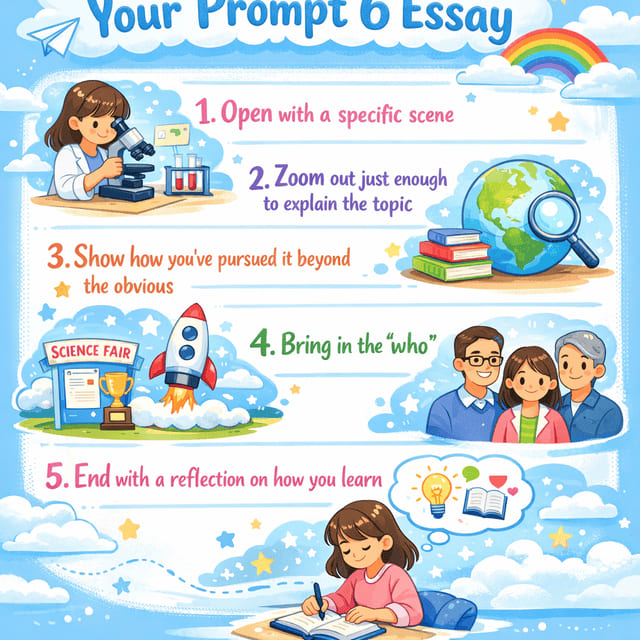
A structure that works:
1. Open with a Specific Scene
Start in a moment. You at your desk at 2 am with twelve tabs open. You reading the same paragraph for the fourth time because something isn't adding up. Ground the reader in the physical reality of your curiosity.
Here's the difference in practice:
Weak: "Throughout history, humans have been drawn to the stars. Astronomy is one of the oldest sciences, and it continues to captivate people today."
Strong: "It was 1am and I was re-reading the same paragraph for the third time, not because I didn't understand it, but because something about the conclusion felt off to me. I couldn't sleep until I figured out why." |
Notice: the second version tells you nothing about the topic yet. It tells you everything about the person.
2. Zoom Out Just Enough to Explain the Topic
One or two sentences about what the topic actually is. Don't lecture. Just give enough context so the next part makes sense.
3. Show How You've Pursued it Beyond the Obvious
This is where you earn credibility. What have you done with this interest? What did you find that surprised you? Where did it take you that you didn't expect?
4. Bring in the "Who"
A specific person, book, community, or resource that deepened your understanding. Name it. Give it a sentence. This answers Q3 and proves your curiosity is active, not passive.
5. End with a Reflection on How You Learn
Not "this topic taught me resilience", that's a different essay. Instead: what does the way you pursue this interest say about how your mind works? What does it reveal about the kind of learner you are?
Common structural mistake: opening with a general statement about the topic. "The ocean covers 71% of the Earth's surface..." or "Throughout human history, music has...", these sentences belong in a textbook. Your essay should start with you.
|
"The strongest Prompt 6 essays feel like following someone down a rabbit hole: specific, curious, and unstoppable."
How to Show Intellectual Curiosity in Your Prompt 6 Essay (With Examples)
Reading about structure only goes so far. Here are three short examples showing what the opening and Q3 answer look like when they're working, with notes on what each one does right.
Example 1, The off-field interest (Medieval cooking)
Opening paragraph:
The recipe called for verjuice, a liquid pressed from unripe grapes that hasn't been commercially produced in most of Europe since the 16th century. I spent three weeks trying to approximate it using grocery-store wine vinegar before I found a specialty importer in Lyon who still made the stuff. The dish I was trying to recreate, a medieval French fricassee from a 1393 household manual, turned out to taste almost exactly like a modern chicken stew. That bothered me more than I expected.
Q3 answer (who they turned to):
When I'd exhausted what I could find in English, I emailed Dr. [name], a food historian at the University of Edinburgh whose paper on medieval spice trade routes I'd found through a citation buried in a footnote. She wrote back in two days with a reading list.
What this does right:
The opening is specific, verjuice, a Lyon importer, a 1393 source. It doesn't announce passion, it demonstrates it. The Q3 answer names a real person, a real institution, and a real action (cold email). It proves the curiosity is active and has a social dimension. Admissions officers are reading this and thinking: this student is going to do interesting things here.
Example 2, The science-adjacent interest (Structural failure)
Opening paragraph:
I've watched the Tacoma Narrows bridge collapse on YouTube probably forty times. Not because the footage is dramatic, though it is, but because the official explanation never fully satisfied me. The standard story is resonance. But the physics of what's actually happening is more complicated than that, and for a long time the engineering community got it wrong in their textbooks. I wanted to understand exactly where the misunderstanding came from and how long it survived before anyone checked.
Q3 answer (who they turned to):
I found a 2000 paper by Billah and Scanlan in the American Journal of Physics that specifically addresses the textbook error and traces how it propagated through engineering education for decades. I printed it and read it three times.
What this does right:
The topic is recognizable (a famous bridge collapse) but the angle is unusual, the student isn't interested in the drama, they're interested in where the explanation broke down. That's an intellectual move, not just a subject preference. The Q3 answer cites a specific paper, specific authors, a specific journal. "I printed it and read it three times" is three words that do more work than an entire paragraph of passion language.
Example 3, The humanities interest (Ottoman military logistics)
Opening paragraph:
Most people, when they think about why empires fall, think about politics or war. I got interested in a different question: how did the Ottoman army eat? Specifically, how did a military force of 100,000 men move through the Balkans in the 15th century without supply lines that would make sense to a modern logistics officer? The answer turned out to involve a system of provisioning so sophisticated that European armies didn't catch up for another two centuries.
Q3 answer (who they turned to):
I'd read everything the school library had, which wasn't much. I found a translated primary source, a 15th-century Ottoman campaign diary, through a university digital archive and started keeping my own glossary of terms I had to look up to understand it.
What this does right:
The opening reframes a familiar subject (why empires fall) into a specific question the student actually wanted answered. It's curious in a way that's legible even to someone who knows nothing about Ottoman history. The Q3 answer shows escalating effort, school library wasn't enough, so they found a primary source through a university archive and built their own reference tool to understand it. That is exactly what admissions officers mean when they talk about intellectual initiative.
The pattern across all three:
The opening doesn't name the topic and then explain why it's interesting. It drops the reader into a specific problem or observation that made the student stop and think. The Q3 answer names something concrete a person, a paper, an archive, a forum, not a vague gesture toward research. If your opening could apply to a different student with a different topic, rewrite it until it couldn't.
The Part Nobody Writes Well: "Who Do You Turn To for Common App Essay Prompt 6?"
Let's spend a minute on Q3 because almost no one handles it well.
When admissions officers ask who or what you turn to when you want to learn more, they're looking for intellectual humility. They want to see that you know you don't know everything. That you seek out people smarter than you about this topic. That your curiosity has a social dimension, it connects you to others.
Strong answers to this question are specific:
- A researcher at a university you emailed cold after reading their paper
- A book that reframed how you understood everything you'd already learned about this topic
- An online forum or community of people who take this interest as seriously as you do
- A mentor, teacher, or family member with deep expertise in this area
Admissions experts consistently highlight this as the most skipped, and most revealing part of the prompt.
|
Weak answers are vague: "I read a lot." "I do research online." "I watch documentaries." These don't show curiosity, they show consumption.
If you genuinely can't name someone or something specific you've turned to, that's important information. It might mean the interest isn't as deep as you think, or it means there's more exploring to do before you write this essay.
| Showing who you learn from proves you don't just consume ideas, you pursue them. |
Common Mistakes to Avoid in Common App Prompt 6
- Writing a topic report. Your essay must have a personal story at its center. If you could remove yourself entirely and the essay still makes sense, rewrite it.
- Picking your intended major. This wastes the opportunity. Use Prompt 6 to show a dimension of you that doesn't appear anywhere else.
- Vague passion language. "I've always been fascinated by..." is one of the weakest opening moves in college essay writing. Show, don't announce.
- Spending all your words on Q1 and Q2, ignoring Q3. The "who do you turn to" part is your proof of authentic curiosity. Don't skip it.
- Picking something too obscure with nothing behind it. The topic doesn't have to be recognizable, but you need to be able to show real depth with it. Obscure topics with surface-level treatment don't impress anyone.
- Generic endings. "This topic has shaped who I am today" tells an admissions officer nothing. End with something specific, a question you're still chasing, a contradiction you haven't resolved, a direction you want to take this.
You now know what Prompt 6 is actually asking, what structure holds an admissions reader's attention, and the five mistakes that kill most of these essays before they start. The hard part that follows is sitting with a topic you care about and turning it into 650 words that sound like you, not like a how-to guide. If you want to work with the CollegeEssay.org common app essay writing team on that draft share your topic, what you've done with it, and your deadline, and they'll write the essay for you.
Common App Prompt 6 vs. Other Prompts; Which Fits You Better?
| Prompt | Best For | Choose When... |
| Prompt 6 | Intellectual curiosity | You have a specific off-field intellectual interest you've genuinely pursued |
| Prompt 7 | Any topic | You have a strong topic but it doesn't fit other prompts, Prompt 7 gives total freedom |
| Prompt 5 | Personal growth | Your story is more about how you changed than what you're curious about |
| Prompt 2 | Overcoming a challenge | Your intellectual pursuit involved a real obstacle or setback |
If you're torn between Prompt 6 and Prompt 7: Prompt 6 gives you structure and a clear Q&A framework to work from. Prompt 7 is more open but requires stronger self-direction. Most students who aren't sure which to use are usually better served by the structure of Prompt 6. "Prompt 6 rewards the student who geeks out about something specific, if that's you, own it."
|
Conclusion:
Prompt 6 is one of the most personal essays in the Common App, and that's exactly why it works when it's done right. You don't need a groundbreaking topic. You need a real one. Pick something you've actually chased, show all three parts of the prompt equal attention, and keep yourself at the center of every paragraph. Do that, and you'll write an essay that most applicants simply won't.
You understand the prompt, the structure, and what makes these essays work. The next step is writing one, a 650-word essay that puts you at the center without reading like a topic summary. If you'd rather not do that alone, you can have your fascination essay written for you, share your topic, your angle on it, and your deadline, and get a complete human-written draft back before you need to submit.