You open the Common App, scroll through the seven essay prompts, and your mind goes completely blank. Nothing jumps out. You've lived 17 years, surely something happened, but right now you can't think of a single thing worth writing about.
That feeling is normal. Most students hit this exact wall.
Common App essay brainstorming is the process of surfacing personal stories, values, and experiences that reveal who you are, before you write a single word. It's not about waiting for inspiration to strike. It's a deliberate process you can follow step by step.
This article gives you a clear three-stage system: four exercises to mine your life for material, a method to shortlist your best candidates, and a four question stress test to confirm your topic before you commit. By the end, you won't just have ideas, you'll have the idea.
Once you do, our guide on how to write a Common App essay picks up exactly where this one leaves off taking your chosen story through structure, drafting, and revision all the way to a finished personal statement.
The essay isn't about finding the most impressive story. It's about finding the most revealing one.
If you'd rather work through the brainstorming process with expert guidance instead of going it alone, Common App essay brainstorming help pairs you with a writer who can draw out the right story, pressure-test your ideas, and make sure you're building on the strongest possible foundation before you write a single word.
Why Brainstorming Feels Hard in Common App Essay (And Why That's Normal)
Most students assume they need something dramatic to write about. A near-death experience. A championship game. A life-changing trip abroad. If you don't have one of those, you think you're out of luck.
You're not. Admissions officers aren't looking for spectacle, they're looking for insight. A small, specific moment that reveals how you think, what you value, or how you've grown will beat a "big" topic with no real reflection every single time.
The real problem isn't that your life is boring. It's that you're too close to your own story to see what's interesting about it. You've lived with yourself for 17 years your most revealing qualities feel ordinary to you precisely because they're yours. |
That's exactly why structured exercises work better than staring at a blank page. They give you a way to look at your life from the outside in. If you want to see what a strong finished essay looks like before you start, browse some common app essay examples to get a feel for the range of topics that actually work.
| You're not boring, you just haven't looked at your life the right way yet. |
Stage 1: Brainstorming Common App Essay: Mine Your Life (Four Exercises)
Don't think about the essay yet. Your only job in this stage is to generate raw material. No filtering, no editing, no deciding. Just dig.
To show how this works in practice, we'll follow one student: Maya, through all four exercises. Maya is a junior who loves photography but doesn't know why it matters to her essay, or if it even should. |
Exercise 1: The Values Inventory
Start by listing 10 or more activities, interests, relationships, or experiences that genuinely matter to you. These can be anything, a sport, a hobby, a job, a friendship, a habit you've had since childhood.
Now, for each item, ask yourself: what does this reveal that I value?
Not what the activity is, but what it says about you. A student who spends hours fixing bikes in their garage isn't just a bike mechanic. They might value resourcefulness, or the satisfaction of making something work with limited tools, or the independence of solving problems alone. Those values are the spine of a strong essay, not the bikes themselves.
This exercise works because the best Common App essays aren't really about the topic. They're about what the topic reveals. When you map your activities to values, you start seeing which experiences point toward something genuinely worth writing about. |
Run through your full list before moving on. You're looking for patterns, values that show up more than once are often the most authentic.
Maya maps photography to three values: control, patience, and seeing things other people walk past. The word "noticing" shows up twice. She puts a circle around it. |
Exercise 2: The Five Words Exercise
Ask three to five people who know you well, a parent, a close friend, a coach, a teacher, to describe you in five words. Don't give them any prompts or context. Just ask.
Then look at what comes back. What patterns appear? Which words show up more than once? Which ones surprised you?
Those repeating words often point directly to the trait worth writing about. Students are frequently surprised by this exercise, the qualities other people see most clearly are often the ones you've stopped noticing in yourself. If three different people independently describe you as "relentless" or "the one who stays calm", that's a signal worth following. |
Maya's words come back: observant, quiet, detail-oriented, careful, present. Three different people used words related to paying attention. That pattern points somewhere. |
Exercise 3: The Small Moments List
Set a timer for ten minutes. Write down 15 to 20 specific, concrete moments from your life. Not categories. Not interests. Actual scenes, things that happened, conversations you remember, decisions you made.
The moments can be tiny. That's the point. You're not looking for your most impressive accomplishment. You're looking for specificity.
Don't write "I love cooking." Write "the night I burned three batches of cookies trying to recreate my grandmother's recipe from memory." Don't write "I've always been competitive." Write "the Saturday morning I replayed the same chess game for four hours because I couldn't accept the loss." |
Write fast and don't edit. Let the list get messy. The goal is volume, you can't see which moments have potential until you have enough of them in front of you.
Here's the difference between a weak list and a strong one.
Weak: "I play soccer. I cook sometimes. I volunteer at a shelter. I like reading." Strong: "The Saturday I stayed an extra hour at the shelter because I couldn't leave a specific dog. The argument I had with my coach that I replayed for a week. The night I made my grandmother's soup from memory and got it wrong three times."
Same student. The second list has scenes, the first has categories. That's what you're aiming for.
When the timer goes off, look back at your list. Which moments made you feel something when you wrote them? Which ones surprised you? Those reactions are useful data.
Maya's list has 18 items. Two of them make her feel something when she reads them back: "the afternoon I spent two hours photographing the same fire hydrant" and "the fight with my mom about whether photography was a real skill." She puts stars next to both. |
Exercise 4: The Contrast Question
Fill in these two prompts in writing:
"Most people see me as _______, but what they don't know is _______." "I used to believe _______, until _______."
These contrast structures often unlock the most interesting essay territory, the gap between the surface and the real story. The person who appears confident but quietly doubts themselves. The student who seemed to have everything figured out until a specific moment changed everything.
Contrast is one of the most powerful structures in personal writing because it creates movement. Something shifts. That shift is usually where the insight lives. |
Don't overthink your answers. Write the first thing that comes to mind, then write a few more. You'll often find the truest answer isn't the first one.
Maya writes: "Most people see me as quiet, but what they don't know is I'm usually the loudest person in the room, I just do it through a lens." That's her first real sentence. She didn't know she had it until she wrote it down. |
Stage 2: Brainstorming Common App Essay: Shortlist Your Candidates
After completing the Stage 1 exercises, you should have somewhere between 10 and 20 potential topics, angles, or moments on paper. Now you need to cut that down to two or three real candidates.
Here's how to filter:
Keep it if:
- It reveals something about you that isn't already on your application
- You could realistically write 650 words about it without the piece feeling thin
- You feel something when you think about it, even mild discomfort or excitement counts
Cut it if:
- Another person (a parent, a coach, a sibling) is more at the center of the story than you are
- The topic itself (the sport, the cause, the event) is more interesting than what it reveals about you
- It's something you think admissions officers want to hear, not something that's genuinely yours
One pattern to look for: the topic where the story is small but the insight is big. A student who writes about the fifteen minutes before every debate round and what that silence taught them about managing anxiety has a stronger essay than one who writes about winning the state championship. The trophy is impressive. The quiet ritual is revealing.
Stage 3: Brainstorming Common App Essay: Stress-Test Your Topic Before You Commit
This is the section most brainstorming guides skip, and it's where most students go wrong. They spend an hour brainstorming, pick a topic that feels okay, and then discover 500 words in that it isn't working.
Before you commit any real writing time, run each of your shortlisted topics through this four-question test.
Maya has two candidates: the fire hydrant afternoon and the fight with her mom. She runs both through the stress-test. |
Question 1: Can you write a scene? If you can't describe one specific moment connected to this topic, it's too abstract to carry 650 words.
A strong essay topic needs a specific moment or scene to anchor it. If you can only write feelings and concepts, "I've always loved science" or "this experience changed my perspective", but no actual scene or event, the topic is probably too abstract.
Try this: write three sentences describing one specific moment connected to this topic. A place. What happened. What you did or said. If you can't do it, the topic likely won't hold up across 650 words. Choose a different one. |
Question 2: Does it reveal a value or trait? If the honest answer is "it shows I work hard," that's usually too generic, half the applicant pool could say the same.
Ask yourself: what does this story say about who I am?
If the honest answer is "it shows I work hard" or "it shows I care about others", that's usually too generic. Half the applicants in the pool could say the same thing. The best topics reveal something distinct. Something specific to how you see the world or how you move through it.
That doesn't mean your trait needs to be unusual. It means the expression of it in your story needs to feel like it could only come from you.
Question 3: Would this surprise your principal? If the essay is essentially a narrative version of your transcript, it's probably not doing new work for your application.
Imagine the person who knows your academic record, your grades, your extracurriculars, but has never had a real conversation with you. Would this essay teach them something genuinely new?
If yes, that's a strong signal. If no, if the essay is essentially a narrative version of your transcript, it might be too close to what your application already shows. Admissions officers want the piece of you that doesn't fit in a data field.
Question 4: Can you write this honestly? Essays that feel guarded rarely work, and the slight discomfort of a topic is often a sign you're onto something real.
Are you comfortable being this specific, this personal, this direct? Essays that feel guarded rarely work. When a writer is holding back, readers can feel it.
Here's the counterintuitive part: if a topic makes you slightly uncomfortable to share with a stranger, if it feels a little exposed, that's often a sign you're onto something real. Not every strong essay is vulnerable, but most are honest in a way that took something to write. |
Here's the counterintuitive part: if a topic makes you slightly uncomfortable to share with a stranger, if it feels a little exposed, that's often a sign you're onto something real. Not every strong essay is vulnerable, but most are honest in a way that took something to write.
If three out of four questions get a yes, commit to that topic.
The right topic isn't the most impressive one. It's the one only you could write.
The fight with her mom passes three out of four. The fire hydrant afternoon passes all four, she can write a specific scene, it reveals her noticing instinct, it would surprise anyone who only knows her grades, and she's slightly nervous to share it. She commits to that one. |
Let a Pro Write It, Our writers have helped students tell their story.
How Long Should Common App Essay Brainstorming Take?
Plan for one to two weeks before you start drafting. That's not because the exercises are time-consuming, they aren't. It's because your best ideas often come between sessions, when you're not actively trying to think about the essay.
That said, don't let brainstorming become a way to avoid writing. Analysis paralysis is real, and the essay doesn't write itself.
Here's a practical timeline:
- Days 1–2: Complete all four Stage 1 exercises
- Days 3–4: Shortlist to two or three candidates
- Days 5–7: Run the stress-test on each, then commit to one
Once you've committed, go write. You'll refine the topic as you draft, and that's fine. Starting is more important than starting perfectly.
Common App Essay Brainstorming Mistakes to Avoid
Waiting for the perfect topic to appear on its own. It won't. Good topics don't announce themselves, they're found through the exercises above.
- Thinking the essay through in your head instead of writing it down. This is how students talk themselves out of every idea before giving any of them a real chance. Get it on paper. You can't evaluate what you can't see.
- Picking a topic because you think it's what admissions officers want. They've read every "I learned leadership from my team" essay. What they haven't read is yours, the specific, weird, honest version of a moment only you experienced.
- Spending too long brainstorming and never committing. Brainstorming is the beginning of the work, not the work itself. At some point you have to pick a topic and write.
- Centering the story on someone else. Your coach who believed in you, your grandmother who taught you resilience, your sibling who struggled and inspired you, these are supporting characters, not topics. You are the subject of this essay.
- Picking a topic that's really a list. "Three things I've learned from volunteering" is not a topic. It's an outline. Strong essays usually have one moment, one thread, one thing they're actually about.
What to Do With Your Common App Topic Once You Have It, after Brainstorming
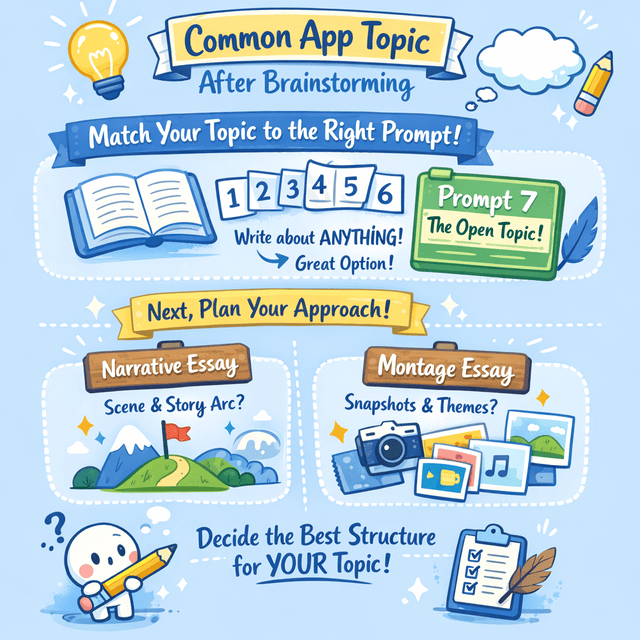
Once you've committed to a topic, the next step is matching it to the right prompt. Read through all seven prompts with your topic in mind and find the one that fits most naturally.
If none of them feel like a natural fit, that's what Prompt 7, the open topic is for. According to Common App's official prompts page, Prompt 7 lets you write on any topic of your choice. It's used more than most students realize.
From there, think about structure. Will this be a narrative essay with a clear scene and arc? Or a montage that weaves together several related moments? Both work, the choice depends on your topic and how you want to tell it.
You've got this. Brainstorming isn't the hard part of the Common App essay, it just feels that way before you start. Work through the four exercises, cut your list down honestly, and run your top pick through the stress-test. You'll come out the other side with a topic you actually believe in.
That's the foundation everything else is built on. The writing gets a lot easier from here.
Turn Your Topic Into a Real Essay Skip the blank page.
Our human writers take your story and write a college essay that sounds exactly like you.
- Zero AI, verified by Originality.ai + Turnitin on every order
- Free revisions
- 3-hour rush order available
- Writers who know what admissions officers actually want to read