Most admissions officers spend somewhere between three and seven minutes reading your Common App essay. That's not a lot of time to make an impression. And if your essay trips one of the patterns they've seen hundreds of times before, they've mentally moved on before they finish the first paragraph.
A Common App essay mistake is any pattern, topic, or structural choice that signals to admissions officers you haven't done the reflective work they're looking for. The good news: every mistake on this list is fixable. The bad news: most students don't know they're making them.
This guide breaks the most common mistakes into four categories, content, tone and voice, structure, and process, so you can self-diagnose your draft fast. If you're still in the early stages and want to understand how a strong essay is built before worrying about what can go wrong, start with our guide on how to write a Common App essay first it gives you the foundation this checklist assumes you have.
If you've already got a draft and you'd rather have an expert tell you exactly what's working and what isn't, get expert essay review from writers who know these patterns cold, and can tell you in plain terms what needs to change before you submit.
What's the Clichéd Topic Problem in Common App Essay Mistakes?
The most common common app essay mistakes to avoid start with topic selection. Here are the topics admissions officers see so often they could write them themselves:
- The mission trip where you "realized how lucky you are"
- The sports injury comeback ("I learned that failure makes you stronger")
- A grandparent's passing, written as a tribute rather than a reflection
- The immigration story told from a distance, without specific personal detail
- Any essay opening with "I am passionate about..."
The problem with a clichéd topic isn't the topic itself, it's that most students tell it the same way. A mission trip essay can work. A sports injury essay can work. What can't work is a generic version of either.
The fix: Run your topic through the differentiator test. Ask yourself: "Would 100 other applicants write this exact story, in this exact way, with these exact takeaways?" If the answer is yes, you need a narrower angle or a different story. You don't need to abandon your topic; you need to find what only you can say about it. |
The Resume Essay Mistake; in Common App Essay
A resume essay is exactly what it sounds like: you've taken your activities list and turned it into narrative. "I've been playing violin since I was six. By junior year, I was concert master. My dedication to music taught me discipline and perseverance." It sounds impressive. Admissions officers find it exhausting.
Your essay is the only place in the application where admissions officers can hear you think. They already have your activity list. They know you play violin. What they don't know is how you process things, what you notice that others don't, or what kind of person you are when no one's watching. That's what the essay is for.
The fix: Look at every paragraph and ask: "Does this show something my activity list doesn't?" If it's just restating what they already have, cut it or reframe it. Describe a specific moment, a surprising realization, a question you can't stop thinking about. Show the inner life, not the highlight reel. |
One more thing: if you've already written about a major activity in your supplemental essays for a school, try not to double down on it in your Common App essay. Spread the picture.
The Problem/Solution Ratio Mistake to Avoid in Common App Essay
This is one of the most common bad common app essay topics patterns, and it's subtle enough that most students miss it in their own writing. It goes like this: you spend the first 600 words describing how hard something was, how much you struggled, how much it hurt, and then you spend two paragraphs at the end talking about what you learned from it.
Admissions officers aren't grading your hardship. They're reading for how you moved through it. |
The size of the challenge isn't what impresses them. What impresses them is self-awareness, resilience, and genuine reflection. If 80% of your essay is about the problem and 20% is about growth, you've written a description, not an essay.
The fix: Flip the ratio. Spend the first 20–25% establishing context and the weight of the situation. Then spend the remaining 75% on what you did, what you thought, how you changed, and what you carry forward. The obstacle is the setup. You are the story.
|
Here's what the wrong version looks like:
My junior year, I tore my ACL two weeks before regionals. I'd trained for three years for that moment. The surgery was brutal. Recovery took eight months. I missed the entire season, watched my team from the stands, and questioned whether I even wanted to keep playing. Every physical therapy session felt like starting over. Some days I didn't think I'd make it back.
Here's what the fixed version looks like:
The eight months after my ACL surgery taught me something I couldn't have learned on the field: I'm more useful as a student of the game than I ever was as a player. Sidelined, I started breaking down film for my teammates. By the time I returned, my coach told me I saw the game differently than anyone else on the roster. The injury didn't make me resilient. It made me pay attention.
The wrong version uses 80% of its words on the problem. The fixed version opens with the realization and spends its words on what changed. Same story. Completely different essay.
✍️
Still Not Sure Your Essay Is Working?
Our human writers review and write essays free from every mistake on this list.
Tone and Voice Mistakes in Common App Essay
These are the mistakes that make admissions officers feel like they're reading a cover letter instead of meeting a person.
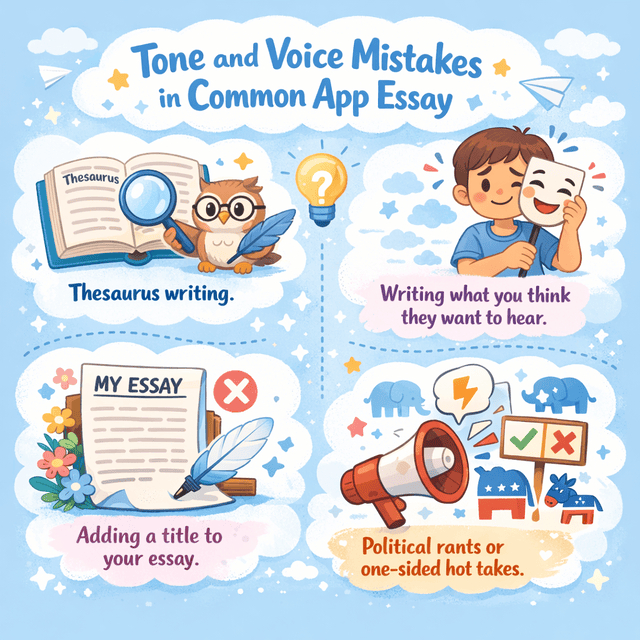
- Thesaurus writing. You've swapped out normal words for impressive-sounding synonyms, and now every sentence sounds stiff. "Commenced" instead of "started." "Endeavored" instead of "tried." If you wouldn't say it out loud to someone you just met, it probably doesn't belong in your essay.
- Writing what you think they want to hear. "I want to attend [University] because of its rigorous academic environment and diverse student body." This tells admissions officers nothing real about you. Write what's actually true, even if it feels less impressive. Authenticity reads.
- Adding a title to your essay. This is a specific, surprisingly common red flag. Common App essay prompts don't ask for a title, and adding one often signals that the student is trying to compensate for something the essay itself isn't doing. Let the writing do the work.
- Political rants or one-sided hot takes. An essay isn't the right venue for an unqualified argument about a political issue. You can have strong views and let them show, but the goal is to reveal your thinking process, not deliver a verdict.
The tone you're going for is a thoughtful, self-aware version of yourself, writing to someone you respect but aren't trying to impress. Honest. Specific. A little vulnerable. |
Structural Mistakes in Common App Essay
Structure mistakes often sink essays that have genuinely good content. Here's what to watch for.
The "tell me about yourself" intro. Opening with "I am a student who loves learning and wants to make a difference" is the written equivalent of a shrug. Start in a scene. Put the reader somewhere specific. The first sentence should make them want to read the second one.
|
Starting with a dictionary definition or a famous quote. "Webster's Dictionary defines leadership as..." was already a cliché in 2005. Starting with a Brené Brown quote or a line from Gandhi signals you're writing around your story rather than from inside it.
|
Too much dialogue, not enough reflection. Dialogue can work as a scene-setting device. But if your essay reads like a script, he said, she said, back and forth, there's not enough of you in it. Admissions officers want your interpretation of events, not a transcript.
|
The summary conclusion. "In conclusion, this experience taught me to persevere and never give up." You've just spent 600 words showing them what you learned, don't summarize it back to them in generic terms. End somewhere that opens a door, not one that closes it.
|
Trying to cover too much. The best Common App essays zoom in, not out. You don't need to tell the story of your whole life, or every dimension of who you are. Pick one moment, one realization, one specific thread, and follow it all the way through. Narrow and deep beats wide and shallow every time.
|
Going significantly under the word limit is its own red flag. The Common App gives you up to 650 words, if you're submitting 400, admissions officers notice. It signals you either don't have much to say or didn't invest the time. You don't need to hit 650 exactly, but anything under 550 should prompt you to ask whether you've actually gone deep enough.
Process Mistakes That Hurt the Final Draft of Common App Essay
Some common app essay red flags aren't in the writing itself, they're in how the writing happened.
- Waiting too long to start. Rushed essays show. Not just in typos, but in the quality of reflection. The best essays go through several drafts, sometimes over weeks. You need distance from your own writing to see what's working and what isn't.
- Letting parents or counselors rewrite it until your voice is gone. Feedback is useful. A rewrite is not. If an adult reads your draft and "fixes" your sentences into something more polished, the result often sounds like a 45-year-old wrote it. Admissions officers read thousands of essays. They can tell. The voice needs to be yours.
- Not reading it aloud. This is the fastest way to catch what sounds unnatural. If you stumble over a sentence while reading it out loud, an admissions officer will stumble over it too. Read the whole thing, out loud, to yourself or someone else.
- The copy-paste error. Submitting an essay that says "Harvard" when you're applying to Northwestern is a real thing that happens every year. If you've tailored parts of your essay for another school's supplement, double-check every sentence before you submit.
- The AI-written essay risk in 2026. Admissions officers are increasingly trained to spot AI writing patterns, the generic structure, the suspiciously balanced arguments, the over-smooth transitions. Beyond detection risk, if your essay was written by a tool, it doesn't represent you. The most expensive mistake you can make with your Common App essay is not starting early enough to fix it yourself.
Common App Portal Mistakes (That Have Nothing to Do With Your Writing)
The mistakes above are about the essay itself. This category is different, these are submission errors that happen in the gap between your finished draft and the portal. They are completely avoidable and surprisingly common.
- Mistake: Pasting from Word or Google Docs without using plain paste:
When you copy your essay from a word processor and paste it directly into the Common App text box using Ctrl+V or Cmd+V, hidden formatting often comes with it. The result can be unexpected line breaks, odd character rendering, or spacing that looks fine in the editing view but breaks in the Preview.
Fix: always use plain paste, Ctrl+Shift+V on Windows, Cmd+Shift+V on Mac, then re-apply any italics you need using the portal's toolbar.
- Mistake: Trusting your word processor's word count over the portal's:
Google Docs and Microsoft Word count words differently from the Common App portal, particularly for hyphenated words and special characters. If your draft is sitting at exactly 649 words in Google Docs, check the portal counter after pasting, you may be over 650 and unable to submit. The portal counter in the bottom right of the text box is the authoritative count.
- Mistake: Adding blank lines between paragraphs in your draft.
The Common App portal automatically adds spacing between paragraphs. If you have added a blank line between paragraphs in your word processor and then paste the essay in, the portal doubles it, producing a visual gap that reads as a formatting error rather than a stylistic choice. Remove all blank lines between paragraphs before pasting. One hard return at the end of each paragraph is enough.
- Mistake: Not clicking Preview before submitting.
The editing view inside the Common App text box does not show you what the admissions officer sees. The Preview button, in the upper right of the Writing section, shows the rendered version. Most formatting problems that survive the paste are invisible in the editing view and immediately obvious in Preview. Use it every time before you submit.
- Mistake: Writing directly in the Common App text box.
The portal text box has no version history, no autosave you can rely on, and no undo beyond the current session. If something goes wrong, a browser crash, an accidental clear, a session timeout, your work is gone. Always write and finalize your essay in Google Docs or Word first, then paste in.
- Mistake: Not checking which prompt you selected in the portal.
Students occasionally paste a finished essay into the portal without confirming the prompt dropdown matches the essay they wrote. The portal saves your prompt selection automatically, but if you switched between prompts during drafting, double-check that the dropdown shows the prompt your essay actually answers before you submit.
Prompt by Prompt Mistakes: The One Error That Sinks Each Common App Prompt
Every Common App prompt has one mistake that shows up consistently in weak essays written for that prompt. If you have already chosen your prompt, find it below.
Prompt 1: Background, Identity, Interest, or Talent
The mistake: Writing a catalogue of identities instead of a story. "I am Filipino-American, a first-gen student, and a competitive debater" is an introduction, not an essay. Prompt 1 requires showing one specific experience or moment that makes the identity real, not listing every dimension of who you are.
The fix: Choose one scene, object, or ritual that carries the identity. Let the reader arrive at the label through the scene, not before it.
Prompt 2: Challenge, Setback, or Failure
The mistake: Spending 70–80% of the essay describing how hard the challenge was and only 20–30% on what you learned and how you changed. Admissions officers are not grading the difficulty. They are reading for self awareness and growth. A massive obstacle with shallow reflection is weaker than a small obstacle with genuine insight.
The fix: After your first draft, calculate your problem-to-reflection ratio. If more than half the words are about what happened, cut from the problem section until the insight section is clearly dominant.
Prompt 3: Questioning a Belief or Idea
The mistake: Writing a manifesto. Students sometimes choose Prompt 3 to prove a point rather than to show how they think. Essays that arrive at a confident new belief, "and that is why I now believe X", miss what the prompt is asking for. The outcome is supposed to be genuine intellectual engagement, not a verdict.
The fix: End on complexity, not certainty. Show what you now understand that you didn't before, including what you're still not sure about
Prompt 4: Gratitude
The mistake: Writing a tribute to the person rather than an essay about yourself. Prompt 4 essays frequently end with the subject of gratitude as the hero of the story. The admissions reader is supposed to finish the essay understanding you better, not the person you are grateful to.
The fix: Read your last paragraph. If the grammatical subject of your final sentence is the other person, rewrite it so the subject is you.
Prompt 5: Accomplishment, Event, or Realization
The mistake: Announcing the growth instead of demonstrating it. "This experience taught me that I am more resilient than I thought" is the most common Prompt 5 sentence, and the weakest. Stated growth is invisible. Demonstrated growth is what the reader remembers.
The fix: Find the sentence in your essay that tells the reader what you learned. Delete it. Replace it with a specific action or image that shows the same thing without stating it.
Prompt 6: Intellectual Curiosity
The mistake: Naming a broad interest instead of showing a specific obsession. "I have always been passionate about astrophysics" is not a Prompt 6 essay. The prompt asks about the experience of genuine curiosity, what you were reading at 1am, the question you couldn't let go of, the rabbit hole you went down without anyone asking you to.
The fix: Start not with the topic but with the moment the curiosity became uncontrollable. The first line should be inside that moment, not a description of your general interest.
Prompt 7: Topic of Your Choice
The mistake: Using Prompt 7 as the easy option rather than the right option. Students sometimes choose Prompt 7 because it feels like the fewest constraints, then write a generic essay that could have been written for any prompt, or for no prompt at all. Prompt 7 without a clear reason for not using one of the other six prompts often produces the weakest essays on the list.
The fix: Before committing to Prompt 7, run your topic through Prompts 1–6 and ask honestly whether one of them fits. If the answer is genuinely no, if your story requires the freedom Prompt 7 gives, then it is the right choice. If the answer is "Prompt 5 kind of fits but Prompt 7 feels easier," go with Prompt 5.
A Quick Self Diagnosis Checklist to Avoid Mistakes in Common App Essay
Run your current draft through these five questions right now:
- Does my topic show up on any cliché topic lists? If yes, that's not a dealbreaker, but ask yourself whether your execution is distinctly different from how most people write this story.
- Does this essay show something my activity list doesn't? If your essay just retells your extracurriculars in paragraph form, it's not pulling its weight.
- Is more than half of the essay about growth, response, or reflection, not the problem itself? If the obstacle takes up most of the word count, rebalance.
- Does it sound like me, or like a template? Read it cold, ideally after a day away from it. If it sounds like a generic college essay, it probably reads like one.
- Have I read this aloud in the last 24 hours? If not, do it before you submit.
If you can't answer yes to all five, your essay has at least one of the mistakes above. The good news is you're catching it before you submit. See common app essay examples that worked to see what the opposite of these mistakes looks like in practice. |
Ready to Submit an Essay That Works?
College Essay writes personal statements that sound like you, and get results.
- Authentic voice, not generic templates
- Human writers who know what AOs want to see
- Every essay passes Originality.ai and Turnitin before delivery
- Free revisions