If you've been staring at a blank document wondering what an environmental science essay is even supposed to look like, you're not alone. Most students can describe what they need to write, they just can't picture it. That's where examples help. Not as something to copy, but as a model you can study and learn from.
This article covers four types of environmental science essays: argumentative, analytical, research paper, and reflective essay. For each one, you'll get a real example excerpt and a breakdown of what makes it work, structurally and argumentatively. There's also a before/after comparison of an introduction so you can see exactly what separates a strong opening from a weak one. And if you want to see a finished product before diving into the examples, check out our how to write an environmental science essay guide, it covers the full process from research to final draft.
An environmental science essay is a piece of academic writing that examines environmental issues, such as climate change, pollution, or biodiversity loss through a scientific and analytical lens. A strong example has three things in common: a thesis that makes a claim rather than just stating a topic, evidence tied to named sources, and a conclusion that returns to what the opening promised.
What to Look for in a Good Environmental Science Essay
Before you read the examples, it helps to know what you're looking for. Otherwise you'll read them and think "okay, that seems fine" without actually learning anything you can use.
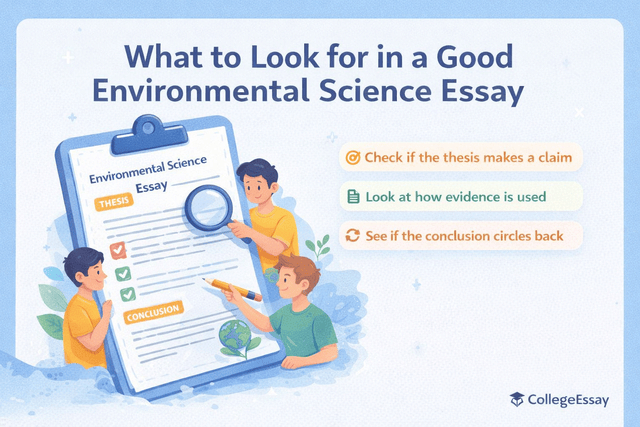
There are three things worth paying attention to in any strong environmental science essay.
- First, look at the thesis, does it make a claim, or does it just identify a topic?
- Second, look at how evidence is used, is it specific (named sources, actual statistics) or vague?
- Third, check the conclusion, does it circle back to what the opening promised, or does it just trail off?
The difference between a good environmental science essay and a weak one usually comes down to whether the thesis makes a claim, not just a topic statement.
That's really it. Keep those three things in mind as you read the examples below.
Environmental Science Argumentative Essay Example
An argumentative essay takes a position and defends it with evidence. It doesn't just explain an issue, it argues that something is true, necessary, or effective, and uses sources to back that up.
Example Excerpt, Topic:
Single-Use Plastic Bans as an Effective Policy for Reducing Ocean Pollution
Introduction
Single-use plastic bans represent one of the most direct and scalable policy interventions available to governments seeking to reduce marine plastic pollution. Despite industry opposition and concerns about consumer inconvenience, the evidence consistently supports their effectiveness. In countries where comprehensive bans have been implemented, including Rwanda, which has maintained a near-total ban since 2008, researchers have documented measurable reductions in plastic waste in waterways and coastal zones (Mutha et al., 2021). This essay argues that single-use plastic bans, when paired with accessible alternatives and strong enforcement mechanisms, are an effective and necessary tool in combating ocean pollution.
Body Paragraph
The scale of the ocean plastic crisis demands policy solutions that target waste at the source rather than managing it downstream. According to estimates from the Ocean Conservancy (2020), plastic bags, straws, and food containers consistently rank among the top ten items collected during annual coastal cleanups, all single use items that could be eliminated through targeted legislation. Critics argue that bans shift the environmental burden onto alternative materials such as paper or reusable cotton, which carry their own production costs. However, lifecycle analyses consistently show that reusable alternatives achieve net environmental benefits when used more than a handful of times, a low bar for most consumers. At this point, framing bans as economically or environmentally burdensome looks more like industry messaging than anything the scientific record actually supports.
Conclusion
The case for single use plastic bans is not built on idealism, it's built on documented outcomes in countries and jurisdictions that have implemented them. When paired with accessible, affordable alternatives and meaningful enforcement, these policies reduce the volume of plastic entering marine ecosystems. The question is not whether bans work, but whether governments will act on the evidence that already exists.
What Makes This Work Thesis: The introduction doesn't just say "plastic pollution is a problem." It makes a specific, arguable claim, that bans work when implemented with enforcement and accessible alternatives. That's something a reader can agree or disagree with, which is exactly what an argumentative thesis needs to do. Evidence: The body paragraph names specific sources (Ocean Conservancy, 2020) and cites a concrete example (Rwanda's 2008 ban). Vague references to "studies" or "experts" weaken arguments; named, dated sources strengthen them. Counterargument: The essay doesn't ignore the opposition, it acknowledges the criticism about alternative materials and then addresses it directly. That's what separates a developed argument from a one-sided assertion. Conclusion: The final paragraph doesn't introduce new ideas. It returns to the opening claim and reframes it, "not idealism, documented outcomes", which closes the loop on the argument cleanly.
|
Environmental Science Analytical Essay Example
An analytical essay examines how or why something happens. It doesn't argue a side, it breaks down a phenomenon by analyzing its causes, mechanisms, or effects. The goal is clarity and insight, not persuasion.
Example Excerpt, Topic:
How Urban Heat Islands Intensify Local Air Pollution
Introduction
Urban heat islands, metropolitan areas that experience significantly higher temperatures than the surrounding rural landscape, do not just create discomfort for residents. They actively intensify local air pollution through a series of interconnected atmospheric and chemical processes. This essay analyzes the mechanisms through which elevated urban temperatures increase ground level ozone concentrations, reduce the natural dispersal of pollutants, and compound the health burdens already disproportionately carried by lower-income urban communities.
Body Paragraph
The relationship between heat and ozone formation is chemical and direct. Ground level ozone, a key component of urban smog, forms when nitrogen oxides and volatile organic compounds react in the presence of heat and sunlight. The higher the ambient temperature, the faster and more extensively this reaction occurs. In cities already characterized by dense vehicle traffic and industrial emissions, the heat island effect functions as an accelerant, producing ozone levels that frequently exceed EPA health standards during summer months. The EPA's own monitoring data from cities including Houston, Atlanta, and Los Angeles documents a consistent pattern: ozone exceedance events cluster on the hottest days of the year, not merely on the most polluted.
Conclusion
Urban heat islands don't generate air pollution independently, they amplify what's already there.They raise temperatures, slow wind circulation, and speed up the chemical reactions between existing emissions, which means pollution builds up faster and takes longer to clear. Understanding this mechanism matters not just for environmental science, but for urban planning decisions about green space, building materials, and infrastructure that directly shape the thermal character of cities.
What Makes This Work Focus: This essay doesn't take a stance, it analyzes a process. Every paragraph is organized around a mechanism (heat accelerates ozone formation, heat slows dispersal) rather than an argument to win. That's the right mode for analytical writing. Specificity: The causes and effects are named precisely. It's not "pollution gets worse when it's hot", it's a named chemical process (nitrogen oxides + VOCs + heat = ozone) with a specific consequence (ozone exceedance events). That level of specificity is what distinguishes analysis from description. Structure: Each paragraph handles one analytical point and moves the explanation forward. There's no repetition or padding, the essay earns its word count. Tone: Academic, but readable. The sentence "they create conditions in which pollution accumulates faster and disperses more slowly" is technically accurate without being jargon-heavy. That's the target register for most undergraduate environmental science essays.
|
?
We'll Write It. You Submit It.
Our human writers handle environmental science essays at every level, any deadline.
Environmental Science Research Paper Example
A research paper presents findings from existing literature and synthesizes evidence around a focused research question. Unlike an argumentative essay, the goal isn't to persuade, it's to consolidate, evaluate, and interpret what the evidence says.
Example Excerpt, Topic:
The Impact of Agricultural Runoff on Freshwater Biodiversity in Midwestern US Ecosystems
Abstract
Agricultural runoff, the flow of water carrying fertilizers, pesticides, and sediment from farmland into adjacent waterways, represents one of the leading contributors to freshwater biodiversity loss in the Midwestern United States. This paper reviews existing literature on the effects of nitrogen and phosphorus loading on aquatic species composition, drawing primarily on studies conducted in the Mississippi River basin between 2005 and 2022. Findings indicate that elevated nutrient concentrations consistently correlate with reduced macroinvertebrate diversity, increased algal bloom frequency, and the displacement of sensitive species in favor of pollution-tolerant taxa. The paper concludes that current EPA standards for agricultural water quality are not sufficient to stop ongoing biodiversity loss, and recommends a review of nitrogen thresholds in the agricultural zones most affected.
Introduction
The Midwest produces a disproportionate share of the United States' corn, soy, and livestock, and the waterways that run through it bear the consequences. Decades of research have documented the role of agricultural runoff in degrading freshwater ecosystems, yet biodiversity loss in these systems continues to accelerate. This paper focuses specifically on the mechanisms through which nutrient runoff, particularly nitrogen and phosphorus from synthetic fertilizers disrupts aquatic species composition in rivers, streams, and wetlands across the Mississippi River basin. The research question driving this review is: at what concentrations do nitrogen and phosphorus loading events begin to produce measurable, lasting changes in macroinvertebrate community structure?
Findings Paragraph
Studies examining macroinvertebrate communities in runoff-impacted waterways consistently document a shift from diverse, sensitive assemblages toward communities dominated by pollution-tolerant taxa. Cuffney et al. (2010), analyzing 2,111 sites across the continental US, found that agricultural intensity, measured by percentage of catchment in cropland, was the single strongest predictor of reduced biological integrity scores. Similar patterns were documented by Dodds et al. (2009) in Kansas streams, where nitrogen concentrations above 1.5 mg/L correlated with a 40% reduction in sensitive species richness. These findings suggest a threshold effect: below certain nutrient levels, ecosystems maintain resilience; above them, community composition shifts in ways that are difficult to reverse.
What Makes This Work Research question: The paper doesn't just say "agricultural runoff is bad." It identifies a specific, answerable question, at what concentrations does nutrient loading change macroinvertebrate community structure? A good research paper question is focused enough to actually be answered by reviewing the available literature. Sources: Every claim is supported by named, dated, peer-reviewed studies. "Cuffney et al. (2010)" and "Dodds et al. (2009)" are specific, not just "researchers have found." That's the citation standard your paper needs to meet. Abstract: The abstract covers the paper's scope, methods, findings, and recommendation in approximately 120 words. It summarizes the whole paper, not just the topic. If someone reads only the abstract, they should understand what the paper found and why it matters. Synthesis: The findings paragraph doesn't summarize one study, then another, then another. It identifies a pattern across multiple studies, the threshold effect, and uses the individual studies as evidence for that broader finding. That's synthesis, which is the core skill a research paper is testing.
|
Environmental Science Reflective Essay Example
A reflective essay asks you to connect course concepts to personal experience or observation. Unlike the other types, the argument isn't built from external sources, it's built from your own thinking, with course material used to frame and support it.
Example Excerpt, Topic:
What a Local River Cleanup Taught Me About Systemic Environmental Failure
Introduction
I spent three hours last April pulling plastic bottles and fast food packaging from the banks of a creek that runs behind my neighborhood. By the end, our group had collected six large bags of waste, and within a week, I'd watched the same stretch of bank accumulate new litter. That experience didn't just frustrate me. It made me question whether individual cleanup efforts, however well-intentioned, can meaningfully address pollution that is fundamentally systemic in origin. This essay reflects on what that afternoon revealed about the gap between individual environmental action and the structural conditions that make that action insufficient.
Body Paragraph
The cleanup felt productive in the moment, and the data suggests small-scale interventions do have measurable short-term effects on local water quality. But the litter returned quickly, which pointed to something the cleanup couldn't fix: the creek's pollution isn't a behavior problem. It's a proximity problem. The surrounding neighborhood has no public waste bins within a quarter mile of the creek path. Littering, in that context, isn't carelessness, it's the predictable outcome of inadequate infrastructure. Our course reading on environmental justice (Bullard, 2000) framed this more precisely than I could at the time: low-income communities disproportionately bear environmental burdens that are structural, not incidental.
Conclusion
I still think the cleanup was worth doing. But I no longer think of it as environmental action in any serious sense. What it gave me was a ground-level view of how systemic failures look from the bottom, a creek that gets cleaned and immediately gets dirty again, in a neighborhood that was never designed to stay clean. That's a different kind of knowledge than what I get from reading studies, and it's one I plan to carry into how I think about policy arguments going forward.
What Makes This Work Personal anchor: The essay opens with a specific, concrete experience — not a general statement about caring for the environment. That specificity is what makes reflective writing credible. Course material integrated, not bolted on: The Bullard (2000) reference doesn't appear as a citation dropped in to meet a requirement. It's introduced at the moment the personal experience runs out of explanatory power, which is exactly how course material should function in a reflective essay. Honest conclusion: The closing doesn't resolve the tension neatly. It sits with the complexity, "still worth doing, but not environmental action in any serious sense", which is more intellectually honest than a tidy takeaway, and more in line with what reflective writing is actually asking for.
|
Example Introduction: Environmental Science Essay
The introduction is where most environmental science essays fall apart. You're trying to establish the problem, signal your argument, and scope the essay, all before the reader has any reason to trust you. That's a lot to do in three or four sentences. Here's what the difference looks like in practice.
Version A: Weak Introduction
The environment is something that affects everyone on Earth. There are many environmental problems today, including pollution, climate change, and deforestation. Scientists have been studying these issues for many years. This essay will discuss some of the ways that human activity impacts the natural world and what can be done about it.
Version B: Strong Introduction
Every year, approximately 8 million metric tons of plastic enter the world's oceans, the equivalent of dumping a garbage truck's worth of waste into the sea every minute (Jambeck et al., 2015). Despite growing public awareness of marine pollution, plastic production continues to rise, and the systems designed to manage it remain structurally inadequate. This essay argues that without binding international agreements that cap plastic production at the manufacturing level, waste management infrastructure alone cannot prevent ongoing ocean contamination, and that the evidence from existing recycling frameworks demonstrates why.
What Version B Does That Version A Doesn't Specific evidence in the first sentence. Version B opens with a named statistic and source. Version A opens with a claim so broad ("the environment affects everyone") that it communicates nothing. Specificity signals competence from the first line. |
- A scoped argument, not a topic description. Version B tells the reader exactly what the essay will argue, binding production caps are necessary because waste management is structurally insufficient. Version A announces a topic that could describe ten thousand different essays. A strong intro commits to a position.
- A signposted scope. Version B tells the reader what evidence will be used and what it will demonstrate. The reader knows what to expect from this essay before the body begins. Version A ends on a vague gesture toward "what can be done", which doesn't prepare the reader for anything specific.
Common Patterns Across Strong Environmental Science Essays
After reading through four different essay types and a before/after intro comparison, a few things should stand out.
Every strong environmental science essay treats the environment as a system, with inputs, processes, and consequences, rather than a backdrop. The argumentative essay didn't just say plastic is bad; it tracked the mechanism (production: waste: ocean accumulation) and the policy gap. The analytical essay traced a specific causal chain (heat: chemical acceleration: ozone). The research paper identified a threshold effect across multiple studies. The refelctive essay highlights the experience and opinion of the writer. In each case, the writing reflects an understanding that environmental problems are systemic, not isolated.
Every strong environmental science essay you'll see does one thing, it treats the environment as a system with causes and consequences, not just a topic to describe. |
Two other patterns show up consistently: the thesis takes a position or poses a specific question (never just announces a topic), and the conclusion returns to the opening frame rather than introducing new material. These aren't stylistic preferences, they're what your marker is looking for when they assess whether your essay has a clear argument and a coherent structure.
Conclusion:
You've now seen what three different types of environmental science essays actually look like, not just described, but shown and broken down. You know what a strong argumentative thesis does differently from a weak one, what analytical writing focuses on instead of argument, and what separates a research paper's abstract from a vague topic statement. You've also seen, side by side, what a strong intro does that a weak one doesn't.
If you're still deciding on a topic, the environmental science essay topics article is the natural next step. If the deadline is getting close and you'd rather have it handled properly than rush something through, the option below is there.
Short on Time? We've Got You.
Tell us your topic, essay type, and deadline. We'll handle the rest.
- Every essay is written by a human, zero AI content.
- Rush delivery available from 3 hours.
- Used by students since 2010
- Free revisions