Writing an environmental science essay sounds straightforward until you're staring at your assignment and realising you have no idea where to start. The topic feels enormous, climate change, biodiversity loss, pollution, and the standard essay advice you've used before doesn't quite fit.
An environmental science essay is a structured academic paper that argues, analyses, or investigates an environmental issue using scientific evidence. To write one well, you need to know your essay type, build a focused thesis, use credible scientific sources, and follow a structure built for scientific argument, not just the generic five-paragraph format most students default to.
This guide gives you the discipline specific framework. Not generic writing tips, the actual steps that separate a solid environmental science essay from a forgettable one. Still confused and need the essay done right? Get environmental science essay help from experts.
What Is an Environmental Science Essay?
An environmental science essay is an academic paper that uses scientific evidence to argue, analyse, or investigate a specific environmental issue.
That definition matters because it immediately tells you something: evidence is the backbone. This isn't a reflective piece or a personal opinion column. Every claim you make needs scientific support.
But before you start writing anything, you need to know which type of environmental science essay you're writing. The three main types are genuinely different, and getting this wrong from the start will throw off your entire approach.
Argumentative: You take a clear position on an environmental issue and defend it with evidence. Your essay has a side. Think: "Offshore wind development causes net ecological harm to marine ecosystems, that's a claim you'd defend. |
Analytical: You examine a topic from multiple angles, causes, effects, implications, without necessarily taking a strong stance. You're dissecting something, not arguing for a verdict. |
Research-based: Closer to a report structure, with a literature review, methodology, and findings. Common in upper-level undergraduate and postgraduate courses. |
"Your essay type determines your structure, your thesis, and even how you present your evidence, get this wrong from the start and no amount of good writing will save it."
Check your assignment brief. It will usually tell you which type you're expected to write, either directly or through the marking rubric.
To see what a well-structured environmental science essay looks like in practice, check out our environmental science essay examples, each one is annotated so you can see exactly what's working. |
Environmental Science Essay; How to Choose Your Angle
The most common mistake environmental science students make isn't bad writing, it's picking a topic that's too broad to argue.
"Climate change" is not an essay topic. "The impact of deforestation" is not an essay topic. These are areas of study. Your essay needs a specific, arguable angle within that area.
A useful narrowing framework: Who + What + So What.
- Who is affected or involved? (A specific community, ecosystem, policy area, species)
- What is happening or being examined? (A specific cause, effect, policy, or trend)
- So what does it matter? (The implication that makes this worth investigating)
"The effect of urban heat islands on low-income neighbourhoods in Phoenix" is a topic. "Whether single use plastic bans reduce ocean microplastic accumulation" is a topic. These are specific enough to build a real argument around.
You'll typically pick from categories like pollution and contamination, climate policy, biodiversity and conservation, energy systems, or land use and deforestation but the narrower your angle, the stronger your essay.
How to Structure an Environmental Science Essay
This is where most students lose marks. Not because they don't have evidence, but because they either don't know how to arrange it or they borrow a generic structure that doesn't fit scientific argumentation. Here's what actually works.
Introduction
Hook: A striking statistic, a research finding that challenges assumptions, or a contested policy question. Something that creates genuine intellectual tension.
Context: Two or three sentences that frame the issue. Why does this matter? What's the current state of the debate?
Thesis: Your specific position or the precise question you're investigating. One clear sentence.
Roadmap: A brief statement of what the essay will cover and in what order.
Don't spend half your word count on background. Get to your thesis quickly. |
Body Paragraphs
Each body paragraph is one argument, one piece of evidence examined in depth. The PEEL structure works well for environmental science essays:
- Point: State your sub-argument clearly at the start of the paragraph
- Evidence: Introduce and quote or paraphrase your source
- Explanation: Tell the reader what this evidence actually proves — don't assume they'll connect the dots
- Link: Tie it back to your thesis
Most undergraduate essays need three to five body paragraphs. If you're writing an argumentative essay, include at least one counterargument paragraph, acknowledge the opposing view, then explain why your position is better supported by the evidence.
In environmental science essays, the body paragraph is where most students lose marks, not because they lack evidence, but because they present data without explaining what it proves.
Conclusion
Three things, in order:
- Restate your thesis: not word for word, but rephrased to reflect what you've now demonstrated
- Summarise your key arguments briefly: two or three sentences
- Broader implications: what does this mean for policy, for the field, for future research?
Don't introduce new evidence in your conclusion. This is a common mistake and markers notice it immediately. |
Annotated Outline
Here's a template you can adapt before you start drafting:
H1: [Your Essay Title]
Introduction (~150 words) ? Hook: [striking statistic or contested question] ?
Context: [2–3 sentences on the issue] ? Thesis: [your specific argument or investigation] ? Roadmap: [what this essay covers]
Body Para 1 (~200 words) ? Point: [first supporting argument] ? Evidence: [specific study, data, source with citation] ? Explanation: [what this evidence proves] ? Link: [connect back to thesis]
Body Para 2 (~200 words) [same structure]
Body Para 3 (~200 words) [same structure]
[Optional: Counterargument paragraph]
Conclusion (~150 words) ? Restate thesis (rephrased) ? Summarise key arguments ? Broader implications
Fill this in before you write a single sentence of prose. It takes fifteen minutes and saves you hours.
Writing a Strong Environmental Science Essay Introduction
Students often spend too long on their introductions trying to get them perfect before they know exactly what their essay argues. Write a rough version, get through the body, then come back and sharpen it.
That said, the intro has to do specific things, here's how to nail each one.
The hook: In environmental science, the most effective hooks are:
- A specific statistic from a credible source ("According to the IPCC, global surface temperatures have increased by approximately 1.1°C since pre-industrial levels")
- A research finding that contradicts common assumptions
- A policy question that's actively debated
Avoid the sweeping opener ("Since the dawn of time, humans have affected the environment"). It signals to your marker that you don't have a specific argument yet.
The thesis: This is the single most important sentence in your essay. It needs to be specific and arguable, meaning someone with knowledge of the field could reasonably disagree with it.
"Pollution is a serious problem" is not a thesis. That's an observation.
"Microplastic contamination in freshwater ecosystems poses a greater long term ecological risk than previously modelled by the EPA's 2019 assessment", that's a thesis. It's specific, it's arguable, and it tells the reader exactly what your essay will demonstrate.
Thesis transformation; three examples:
Argumentative essay Weak: "Climate change is having a negative effect on biodiversity." Strong: "Accelerated glacier retreat in the Hindu Kush since 2000 has disproportionately reduced freshwater availability for downstream agricultural communities in northern Pakistan." Why it works: specific region, specific timeframe, specific consequence, arguable claim. |
Analytical essay Weak: "This essay will examine the effects of plastic pollution on marine ecosystems." Strong: "This essay analyses how microplastic accumulation in the North Pacific Gyre affects zooplankton reproductive rates and what this means for food chain stability." Why it works: specific mechanism, specific location, specific implication, not just a topic statement.
|
Research-based essay Weak: "Deforestation is a major environmental problem." Strong: "This study investigates whether community-managed forest reserves in the Brazilian Amazon produce measurably different deforestation rates compared to government-managed reserves between 2010 and 2022." Why it works: specific comparison, specific geography, specific timeframe, measurable outcome.
|
For an argumentative essay, your thesis takes a clear position. For an analytical essay, your thesis states what you'll examine and through what lens.
"A thesis like 'pollution is a serious problem' isn't a thesis, it's an observation. Your thesis needs to make a claim that someone could actually disagree with."
Common intro mistakes to avoid: burying your thesis in paragraph three, spending too much space on historical background, and writing a roadmap that lists your H2 headings verbatim rather than summarising your argument.
Finding and Using Scientific Sources for Environmental Science Essay
This is where environmental science essays differ most from essays in the humanities, and where students most often undermine otherwise solid work.
What counts as credible in environmental science:
- Peer-reviewed journals: Environmental Science & Technology, Nature, Science, Ecology, Global Environmental Change
- Government databases: EPA (epa.gov), NOAA, IPCC reports (ipcc.ch)
- Academic databases: Google Scholar, JSTOR, PubMed
- Institutional reports from universities and recognised research bodies
What doesn't count as a primary source:
- Wikipedia
- News articles (useful for context, not as evidence for scientific claims)
- Advocacy group websites unless they're citing peer-reviewed research
- Blog posts, even from well-known writers in the field
When you integrate evidence, don't quote-dump. Introduce the source, present the data or finding, then explain what it proves in the context of your argument. One strong, well-explained source beats three weak ones with no explanation.
Most environmental science courses use APA format.
For journal articles, that means: Author, A. A. (Year). Title of article. Journal Name, Volume(Issue), page range. If you're citing an IPCC report, treat it as an institutional author.
When in doubt, your assignment brief or department style guide is the authority, not what you find on random citation websites.
The contested data problem is something no generic writing guide will tell you about: environmental science is a field where some data is actively disputed, climate statistics, species population counts, pollution impact modelling. When you're working with contested data, acknowledge the limitations of the source, cite the methodology, and explain why the consensus source is more credible than the dissenting one. Your marker will respect this far more than pretending the debate doesn't exist.
Not all sources are equal in environmental science, an EPA report and a think-tank blog are not the same thing, and your marker will know the difference. |
We'll Write It for you! Our writers specialise in environmental science essays
What Are the Most Common Environmental Science Essay Mistakes?
These are the patterns that come up again and again, and they're all avoidable.
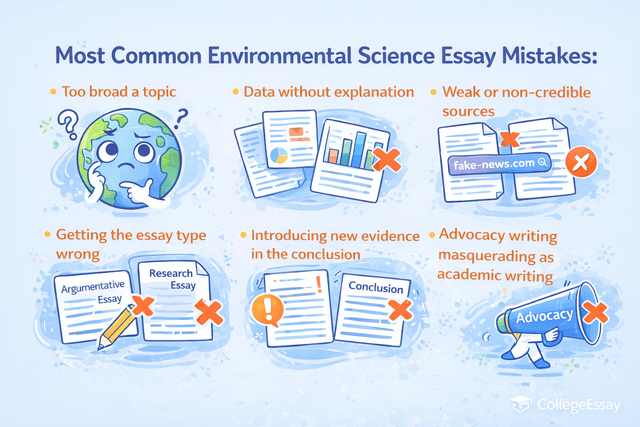
- Too broad a topic. If your essay can't fit a specific thesis into one sentence, your topic is too wide. Narrow it before you write anything.
- Data without explanation. Listing statistics is not argumentation. You must explain what the data proves in relation to your specific claim. "Studies show X" followed by your next point is a failing pattern.
- Weak or non-credible sources. Using news articles as primary evidence, citing advocacy websites without verifying their source data, or relying on studies more than ten years old (unless they're foundational) will cost you marks.
- Getting the essay type wrong. Writing an analytical essay when the brief asked for argumentative or vice versa is a structural mistake that affects every section. Check before you start.
- Introducing new evidence in the conclusion. The conclusion synthesises what you've argued. It doesn't extend it. If you have more evidence, add another body paragraph.
- Advocacy writing masquerading as academic writing. Saying "we must protect the environment" is advocacy. Saying "deforestation in the Amazon reduced regional rainfall by X% between Y and Z" is evidence. Know the difference.
How Do You Get Better Grades on an Environmental Science Essay?
- Read your rubric before you write, not after. The rubric tells you exactly what your marker is looking for. It's the most underused document in every essay assignment.
- Complete the annotated outline above before drafting. It forces you to check whether your arguments actually support your thesis before you've invested hours in prose.
- Write the body before the introduction. You'll write a far stronger intro once you know exactly what your essay argues.
- Check every source before you cite it. Is it peer reviewed? Is it recent? Is it from a credible institution? If you can't answer yes to at least two of these, find a better source.
- One argument per body paragraph. Don't crowd multiple points into one paragraph you'll develop none of them properly.
- Get distance before you edit. Leave the draft for at least a few hours before you review it. You'll catch more errors and weak reasoning with fresh eyes.
- Read your conclusion first to check your essay actually proves what you claimed it would. If your conclusion feels disconnected from your introduction, your argument has probably drifted during drafting.
Final Thoughts
Writing an environmental science essay gets a lot easier once you stop treating it like a generic assignment and start treating it like what it actually is a discipline-specific piece of academic writing with its own rules.
Know your essay type before you write a single word. Narrow your topic until you have a specific, arguable thesis. Build your structure around scientific argumentation, not the five-paragraph format you learned in high school. Use credible sources and, this is the part most guides skip, explain what your evidence actually proves.
The students who struggle with these essays aren't struggling because they lack knowledge of environmental science. They're struggling because no one told them the rules are different here. Now you know them.
Let a Specialist Write Your Essay
100% human-written environmental science essays, delivered on your timeline.
- Writers with environmental science academic backgrounds
- Human writers only, zero AI in your paper
- Proper citations
- Free Revisions