Your professor assigned a philosophy essay and gave you a topic as broad as "write about ethics" or nothing at all. You need something specific enough to argue, manageable enough to research, and interesting enough that you can actually write 1,500 words about it without losing the will to live.
This page has 100+ options organised by category, difficulty, and essay type, plus a short guide on how to narrow whatever you pick into a thesis your professor will actually respect.
Philosophy Essay Topics by Category
Each topic below includes a difficulty rating (Beginner / Intermediate / Advanced) and an essay type tag (Argumentative / Comparative / Analytical / Reflective).
Not sure which category to browse first? Start here:
If your assignment is… | Best categories to start with |
Argumentative essay | Ethics, Free Will, Philosophy of Religion |
Comparative essay | Free Will (compatibilism debates), Political Philosophy (Rawls vs. Nozick), Mind & Identity |
Analytical essay | Epistemology, Mind & Consciousness, Philosophy of Religion |
Reflective essay | Ethics (personal moral questions), Free Will (responsibility), Personal Identity |
Find your topic in 10 seconds:
I want to write about… | I'm a… | Go to |
Right and wrong, moral decisions | Beginner | Ethics |
Responsibility, choice, fate | Beginner–Intermediate | Free Will |
Justice, government, rights | Intermediate | Political Philosophy |
God, faith, religion | Beginner–Intermediate | Philosophy of Religion |
Mind, identity, consciousness | Intermediate | Mind & Identity |
Knowledge, certainty, skepticism | Advanced | Epistemology |
If you need a want a step bystep walkthrough and understanding of philosophy essay, the full guide on how to write a philosophy essay covers everything from thesis to conclusion. |
Ethics and Moral Philosophy Topics
Ethics is the most beginner-friendly category. You already have intuitions about right and wrong, now you just need to interrogate them. These topics work well for most intro philosophy courses.
Beginner / Argumentative
- Is it ever morally right to lie? (Beginner / Argumentative)
- Are animals entitled to the same moral consideration as humans? (Beginner / Argumentative)
- Do wealthy individuals have a moral obligation to give to charity? (Beginner / Argumentative)
- Is euthanasia morally permissible? (Beginner / Argumentative)
- Should we judge historical figures by today's moral standards? (Beginner / Analytical)
- Is capital punishment ever morally justified? (Beginner / Argumentative)
- Does moral luck undermine our judgments of praise and blame? (Beginner / Analytical)
- Can an act be wrong even if no one is harmed? (Beginner / Argumentative)
Intermediate / Mixed Types
- Is there a moral obligation to help those in poverty? (Intermediate / Argumentative)
- Does the trolley problem reveal the limits of utilitarian ethics? (Intermediate / Analytical)
- Is it ever ethical to break the law for a moral reason? (Intermediate / Argumentative)
- Can moral progress be made without objective moral truths? (Intermediate / Analytical)
- Is virtue ethics more useful than consequentialism for everyday moral decisions? (Intermediate / Comparative)
- Does the ends-justify-the-means reasoning have any legitimate place in ethics? (Intermediate / Argumentative)
- How should we weigh individual rights against collective welfare? (Intermediate / Analytical)
- Is cultural relativism a defensible moral position? (Intermediate / Argumentative)
Advanced
- Can moral relativism and universal human rights coexist? (Advanced / Argumentative)
- Does moral realism require a theistic foundation? (Advanced / Analytical)
- Is there a coherent non-consequentialist foundation for global ethics? (Advanced / Argumentative)
- Can we be morally obligated to do something we believe is wrong? (Advanced / Analytical)
Worked narrowing example for this category: Broad: "Is lying wrong?" Narrowed: "Kant's categorical imperative fails to account for cases where lying is necessary to prevent serious harm, and this reveals a fundamental flaw in deontological ethics." |
Free Will and Determinism Topics
This category is endlessly interesting to write about because the stakes feel personal. It's also rich with positions, hard determinism, libertarian free will, compatibilism, which makes it easy to build a comparative or argumentative essay.
Beginner / Argumentative
- Do humans have genuine free will, or is every choice determined? (Beginner / Argumentative)
- If our choices are shaped by genetics and upbringing, can we be truly responsible for them? (Beginner / Analytical)
- Does punishment make sense in a fully deterministic world? (Beginner / Argumentative)
Intermediate / Mixed Types
- Does compatibilism successfully resolve the free will debate? (Intermediate / Analytical)
- Can someone be held morally responsible if their actions were caused by factors outside their control? (Intermediate / Argumentative)
- Is the feeling of deliberating over a decision evidence that free will exists? (Intermediate / Analytical)
- Does the existence of addiction challenge or support the compatibilist account of free will? (Intermediate / Analytical)
- Is Frankfurt's concept of second-order desires a convincing account of autonomous action? (Intermediate / Analytical)
- Does Strawson's argument from basic desert succeed against compatibilism? (Intermediate / Comparative)
- Is soft determinism just hard determinism with better PR? (Intermediate / Argumentative)
Advanced
- Is hard determinism compatible with a meaningful life? (Advanced / Argumentative)
- How does neuroscience challenge or support the concept of free will? (Advanced / Analytical)
- Does quantum indeterminacy rescue libertarian free will from physical determinism? (Advanced / Argumentative)
- Is Galen Strawson's Basic Argument for the impossibility of moral responsibility sound? (Advanced / Analytical)
- Can agent causation theories of free will avoid the randomness objection? (Advanced / Argumentative)
Mind, Consciousness, and Personal Identity Topics
This category gets at some of the weirdest, most interesting questions in philosophy. What makes you you? Can machines think? Is your mind just your brain? For a deeper look at the debates around consciousness and identity, the Stanford Encyclopedia of Philosophy has thorough overviews of most of the major positions.
Beginner
- What makes you the same person you were ten years ago? (Beginner / Analytical)
- Is the mind separate from the brain? (Beginner / Argumentative)
Intermediate / Mixed Types
- Can artificial intelligence ever be conscious? (Intermediate / Argumentative)
- Does personal identity require psychological or physical continuity? (Intermediate / Comparative)
- Is there anything it is like to be a bat — and what does that tell us about consciousness? (Intermediate / Analytical)
- Does the Ship of Theseus problem reveal something important about personal identity? (Intermediate / Analytical)
- Is the mind-body problem genuinely unsolvable, or just currently unsolved? (Intermediate / Argumentative)
- Can a functionalist account of mind explain subjective experience? (Intermediate / Argumentative)
- Is self-deception possible, and what does it reveal about the structure of the mind? (Intermediate / Analytical)
- Does Parfit's account of personal identity undermine the rationality of self-interest? (Intermediate / Analytical)
Advanced
- Is the Chinese Room argument a successful refutation of strong AI? (Advanced / Analytical)
- Can physicalism fully account for the qualia of conscious experience? (Advanced / Argumentative)
- Is the conceivability of philosophical zombies a sound argument against physicalism? (Advanced / Argumentative)
- Does eliminative materialism make sense of everyday mental talk? (Advanced / Analytical)
- Is there a coherent account of personal identity that survives cases of fission? (Advanced / Analytical)
Political Philosophy Topics
Good for students in politics, sociology, or social science crossover courses, and for anyone who wants to argue about justice, government, and rights with philosophical rigor.
Beginner / Argumentative
- Is civil disobedience ever morally justified? (Beginner / Argumentative)
- Do citizens have a duty to obey laws they believe are unjust? (Beginner / Argumentative)
- Is democracy the best form of government, or just the least bad? (Beginner / Argumentative)
- Should freedom of speech have any limits? (Beginner / Argumentative)
Intermediate / Mixed Types
- Does social contract theory provide a valid foundation for government authority? (Intermediate / Analytical)
- Which theory of justice is more defensible, Rawls or Nozick? (Intermediate / Comparative)
- Is there a right to revolution against unjust governments? (Intermediate / Argumentative)
- Does cosmopolitanism require open borders? (Intermediate / Argumentative)
- Can affirmative action be justified on Rawlsian grounds? (Intermediate / Argumentative)
- Is there a meaningful distinction between negative and positive liberty? (Intermediate / Comparative)
- Can a state be legitimate if its founding involved historical injustice? (Intermediate / Analytical)
Advanced
- Can a liberal democracy justify restrictions on free speech? (Advanced / Argumentative)
- Is global distributive justice a coherent moral demand? (Advanced / Argumentative)
- Does republican political philosophy offer a better account of freedom than liberalism? (Advanced / Comparative)
- Can deliberative democracy overcome the problem of persistent reasonable disagreement? (Advanced / Analytical)
Still going back and forth? If you've got a topic in mind but aren't sure you can turn it into a full essay, or if you just want this handled, you can tell us to write my philosophy essay for you. Tell us the topic, your word count, and your deadline, and we'll take it from there.
Philosophy of Religion Topics
A strong category for courses touching on metaphysics, theology, or worldview. The debates are old but the arguments are surprisingly technical.
Beginner
- Does the existence of evil disprove the existence of an all-powerful, all-good God? (Beginner / Argumentative)
- Can religious belief be rational? (Beginner / Argumentative)
- Is atheism a religion in its own right? (Beginner / Argumentative)
- Does science make religious belief unnecessary? (Beginner / Argumentative)
Intermediate / Mixed Types
- Is the cosmological argument a convincing proof for God's existence? (Intermediate / Analytical)
- Can faith and reason coexist without contradiction? (Intermediate / Argumentative)
- Is religious experience a reliable basis for belief in God? (Intermediate / Argumentative)
- Is Pascal's Wager a sound argument for religious belief? (Intermediate / Analytical)
- Does Hick's soul-making theodicy successfully respond to the problem of evil? (Intermediate / Analytical)
- Is divine command theory a defensible account of moral obligation? (Intermediate / Argumentative)
- Is the fine-tuning argument for God's existence stronger than critics admit? (Intermediate / Argumentative)
Advanced
- Does the ontological argument succeed in proving God's existence? (Advanced / Analytical)
- Is religious pluralism philosophically coherent? (Advanced / Argumentative)
- Can a perfectly good God permit gratuitous suffering? (Advanced / Argumentative)
- Does reformed epistemology provide an adequate response to the problem of religious diversity? (Advanced / Analytical)
Epistemology Topics (Theory of Knowledge)
The most abstract category, flag this as Intermediate to Advanced territory before you commit. That said, questions about what we can know and how we know it tend to produce genuinely interesting essays once you get into them. For a primer on Cartesian skepticism and its critics, the Stanford Encyclopedia has a solid overview worth bookmarking.
Beginner
- Is it possible to have certain knowledge of anything? (Beginner / Analytical)
Intermediate / Mixed Types
- Does Descartes' method of doubt succeed in establishing a foundation for knowledge? (Intermediate / Analytical)
- Does skepticism make knowledge impossible, or just difficult? (Intermediate / Argumentative)
- Can testimony count as a genuine source of knowledge? (Intermediate / Analytical)
- Is perception a reliable basis for knowledge about the external world? (Intermediate / Argumentative)
Advanced
- Can empiricism adequately account for mathematical knowledge? (Advanced / Argumentative)
- Is justified true belief sufficient for knowledge? (Advanced / Analytical)
- Does contextualism about knowledge standards resolve skeptical paradoxes? (Advanced / Analytical)
- Is internalism or externalism about epistemic justification more defensible? (Advanced / Comparative)
- Does Quine's naturalized epistemology avoid the problems it inherits from traditional epistemology? (Advanced / Analytical)
- Can we have knowledge of the future? (Intermediate / Argumentative)
- Is social epistemology a genuine improvement on individualist accounts of knowledge? (Advanced / Analytical)
If you want to see what a strong philosophy essay looks like before you start writing, check out these annotated philosophy essay examples, they show the structure and argument in action. |
How to Choose a Philosophy Essay Topic That Actually Works
Before you scan the list below, it helps to know what you're looking for. Not every topic that sounds interesting is actually writable, at least not for a college essay.
Here are three things to check before you commit:
- Is it arguable? A philosophy essay needs a thesis you can defend, not just describe. "Is lying wrong?" is arguable, you can take a position and back it up. "What is lying?" is just a definition. If your topic only has one reasonable answer, it's not a philosophy topic, it's a dictionary entry.
- Is it specific enough? "Free will" is a subject. "Does having a determined past remove your moral responsibility for your actions?" is a topic. The more specific you are upfront, the easier it is to write a focused, compelling essay. A vague topic leads to a vague thesis, and professors notice.
- Can you find evidence? You don't need to have read every philosopher ever, but you should be able to name two or three thinkers or positions you could draw on. If you genuinely have no idea who has written about your topic, it may be too obscure for a college assignment. Stick with areas where you know there's a real debate.
The litmus test: if your topic can be stated as a yes/no question and most people would shrug and say "depends," you're probably in good territory. |
How to Narrow a Broad Philosophy Topic Into a Focused Thesis
This is the step most students skip, and it's why so many philosophy essays end up as vague summaries instead of real arguments.
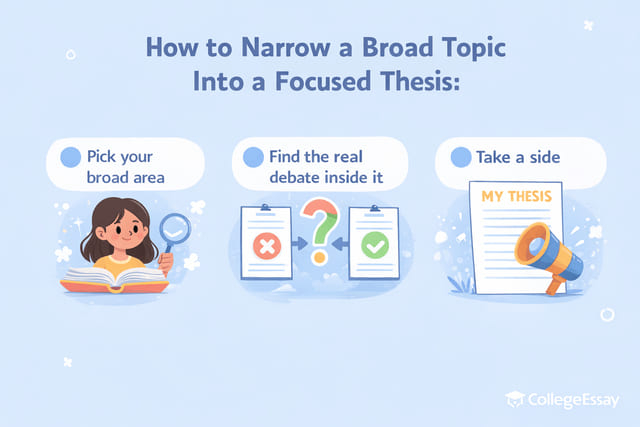
Here's how the narrowing move works:
Broad Topic | Narrowed Thesis |
Free will | Compatibilism fails to resolve the conflict between determinism and moral responsibility |
Ethics and lying | Kant's absolute prohibition on lying is incompatible with obligations to protect others from harm |
The existence of God | The problem of evil provides stronger grounds for atheism than traditional theodicies can overcome |
Notice what each narrowed version does: it names a specific debate, takes a clear position, and invites disagreement. That's what makes it arguable.
The three step narrowing move:
- Pick your broad area (free will, ethics, God)
- Find the real debate inside it (compatibilism vs. hard determinism; Kant vs. consequentialists; problem of evil vs. theodicy)
- Take a side (don't just describe the debate, argue one position is stronger)
Once you've landed on a position, the next challenge is structuring the argument itself, how to build a claim, engage with objections, and reach a conclusion that holds. The guide on how to write a philosophy argument walks through that step by step. |
A good philosophy thesis doesn't summarize both sides equally. It commits to something. That's what your essay is there to defend.
The rule: if you can't state your thesis as a claim someone could genuinely disagree with, narrow it further. |
You've got your topic, and if you've used the narrowing guide above, you've probably got the shape of a thesis too. Writing the actual essay is where most students hit a wall: structuring the argument, engaging with the right philosophers, getting the analysis tight enough. If that's where you are, we can handle the philosophy paper writing from here, you provide the topic, word count, and deadline, and our writers deliver a complete, properly argued philosophy essay.
Quick Tips for Picking the Right Topic for Your Assignment
A few practical pointers before you commit:
- If you're new to philosophy, stick to ethics or free will. You'll have more to say because you already have intuitions you can interrogate. Epistemology and philosophy of mind are great eventually, but they're harder to get a foothold on in a short essay.
- If it's an argumentative essay, pick a topic where you genuinely land on one side. You can't write a convincing argument if you secretly think "both sides have a point." Find the topic where your gut reaction is strong, then figure out why.
- Match scope to length. For a 5-page essay, go as narrow as possible. For a 10-page or longer essay, you have room to engage with more than one objection. The biggest mistake is picking a topic too big for the word count you have.
- When in doubt, email your professor. Send them your narrowed thesis, one sentence, and ask if it's a viable angle. Most professors are happy to confirm before you've written 2,000 words in the wrong direction.
Conclusion
You've got the topics. You know how to evaluate them, how to narrow them, and how to match them to your assignment type. The only thing left is picking one and committing.
You've got 100+ topics, a framework for narrowing them, and a clear sense of what makes a philosophy thesis actually arguable. The only thing left is writing the essay itself. If you'd rather hand that part off, our philosophy essay writing service pairs you with a writer who has a philosophy background, give them your topic, your word count, and your deadline, and you'll have a complete draft back within 24 hours.