Your professor wants a philosophy argument. Not an opinion. Not a summary of what Kant said.
An actual argument: a claim, the reasons behind it, and engagement with the strongest objection against it.
Here is how to build one from scratch.
Your professor wants a philosophy argument. Not an opinion. Not a summary of what Kant said.
An actual argument: a claim, the reasons behind it, and engagement with the strongest objection against it.
Here is how to build one from scratch.
A philosophy argument is not a debate performance and it is not a persuasive essay in the traditional sense. It is a structured attempt to establish that a claim is true using reasons and logic, then to defend that claim against the most powerful challenge you can find.
Three components make up every sound philosophy argument:
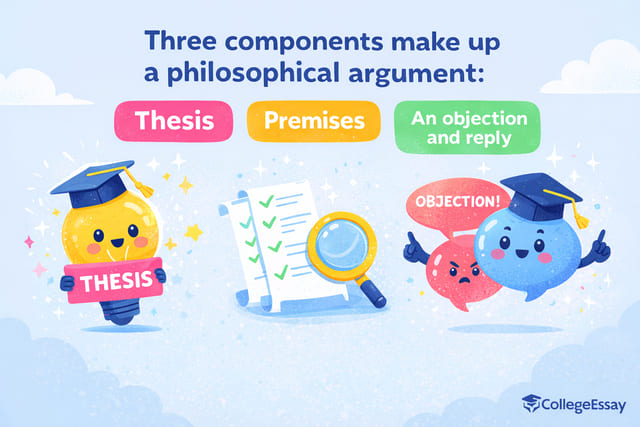
One clear, contestable claim. Not "philosophers disagree about free will", that is an observation.
A thesis takes a side: "Free will is incompatible with determinism because an agent cannot be the ultimate source of their actions in a deterministic universe."
The logical steps that lead from accepted starting points to your thesis. Each premise should be something a reasonable person could accept, and the chain should move in one direction, toward your conclusion.
The part most students skip. You identify the strongest counterargument someone could make against your thesis, state it charitably (better than your opponent would), and then show why it fails or why your position survives it.
That three-part structure is what separates a philosophy argument from an opinion piece.
For an understanding on philosophy essay tone, structure our guide, how to write philosophy essay covers the full essay framework. |
The most common mistake in a philosophy argument is starting too broad. "Is morality objective?" is a dissertation topic. "Is free will compatible with determinism?" is still too large for most undergrad assignments. You need to narrow until you have a claim small enough to actually defend in the space you have.
Good narrowing technique: take the broad question and add one constraint.
Broad claim | Narrowed thesis |
Free will and determinism are incompatible | Hard incompatibilism fails because it mischaracterizes what "control" requires for moral responsibility |
Lying is morally wrong | Kant's categorical prohibition on lying fails in cases involving murderers at the door because the Formula of Humanity permits agent-relative constraints |
Consciousness cannot be reduced to physical states | The knowledge argument shows that phenomenal properties are not captured by any complete physical description |
Notice that each narrowed thesis is still contestable, a reasonable person could disagree. That is the minimum requirement. If your thesis is "cruelty for its own sake is wrong," no one will disagree and you have nothing to argue.
If you are still finding your topic, philosophy essay topics has 100+ arguable claims sorted by branch and difficulty. |
Before drafting a single sentence, map the logic of your argument on paper. Philosophers call this reconstructing an argument in standard form. You list each premise as a numbered statement, and your conclusion follows explicitly from them.
Example: a compatibilist argument:
P1: Moral responsibility requires only that an agent acts in accordance with their own desires and reasoning. P2: Determinism does not prevent agents from acting in accordance with their own desires and reasoning. C: Therefore, determinism does not undermine moral responsibility. |
This mapping exercise does two things. First, it forces you to notice gaps, if P1 jumps to C without P2 doing real work, you have a missing premise. Second, it tells you exactly where your objector will attack. In the example above, a libertarian will attack P1: they will argue that acting in accordance with your desires is not enough if those desires were themselves causally determined. That is where your reply needs to go.
Map your argument this way before you open a document. It will save you from writing 800 words before discovering your logic has a hole in it.
Each premise in your argument needs to be either self-evident, supported by argument, or supported by citation of a philosophical position. "P1 is true because it seems obvious" is not philosophy, it is assumption.
For each premise, ask yourself:
Could a reasonable person deny this? If yes, you need to either argue for it or qualify it. If a premise is deniable without argument, your whole argument rests on an unearned assumption. |
Is this doing real logical work? Some premises are redundant, they restate the conclusion in slightly different language. This is called begging the question and it is the most common logical error in undergraduate philosophy papers. Check that each premise is genuinely independent of your conclusion. |
Is this too strong? Overstated premises are easy to attack. "All agents always act only from self-interest" is almost certainly false, and an opponent will demolish it instantly. "Many agents in competitive contexts prioritize self-interest over altruism" is defensible. Prefer qualified claims unless you have a watertight argument for the strong version. |
Philosophy moves through the body of your essay at the level of premises, not at the level of "in this paragraph I will discuss free will." Each body section should be advancing, supporting, or qualifying one premise.
Students instinctively find the easiest objection to answer. This is exactly wrong.
Philosophy professors are trained to notice when you have set up a strawman, an objection so weakly stated that rebutting it proves nothing. Defeating a bad version of the counterargument does not strengthen your thesis. It signals that you either do not understand the debate or you are avoiding the hard part.
The principle here is called the principle of charity: state the opposing view in its strongest possible form. A useful test is to ask: would a defender of this view recognize their position in my summary of it? If your objection section would make a Kantian wince because you have misrepresented the categorical imperative, you have failed this step.
How to find the strongest objection:
Look at the premise your opponent will most want to deny. In the compatibilism example above, the strongest objection targets P1, the claim about what moral responsibility requires. A libertarian will argue that you need more than acting on your desires; you need the ability to have had different desires, which determinism denies. That is a serious challenge and it is the one you need to address.
Once you have stated the objection, answer it directly. You have three legitimate moves:
Still working through how to frame your objection section, or not sure whether your reply actually holds up? CollegeEssay.org's philosophy argument writing specialists can review your argument structure or build one from your notes, you send the thesis and the premises you have, they identify where the logic breaks and what the strongest reply is.
The Introduction
Your introduction has one job: put your thesis in front of the reader with enough context to understand what is at stake. It should be short, three to five sentences for most undergrad papers.
Open with the philosophical problem, not background history. "Philosophers have debated free will for centuries" is not a philosophical problem, it is throat-clearing. "Whether agents can be morally responsible in a deterministic universe depends entirely on what responsibility actually requires" is a problem.
State your thesis explicitly, usually at the end of the introduction. Do not make the reader infer what you are arguing.
The Body
Follow your argument map. Each major premise gets its own section. Within each section: state the premise, explain what it means, argue for it or show why it is reasonable to accept, and pre-empt obvious misreadings.
Transition between sections by signposting the logical movement: "Having established that moral responsibility requires only that an agent acts from their own desires, I now turn to the second premise, that determinism does not prevent this."
The Objection Section
This should sit in the second half of the paper, after your positive argument is complete. Label it clearly, most philosophy professors appreciate transparency here: "The strongest objection to this view is..."
State the objection. Then reply. Do not pepper-spray three weak objections. One serious objection, fully engaged with, is worth more than five shallow ones.
The Conclusion
Restate your thesis in light of what you have argued, not as a verbatim repetition. Identify what your argument has shown and what its limits are. A good conclusion acknowledges what remains open, this signals philosophical maturity, not weakness.
Avoid new arguments in the conclusion. If you find yourself making a fresh point, move it to the body or cut it.
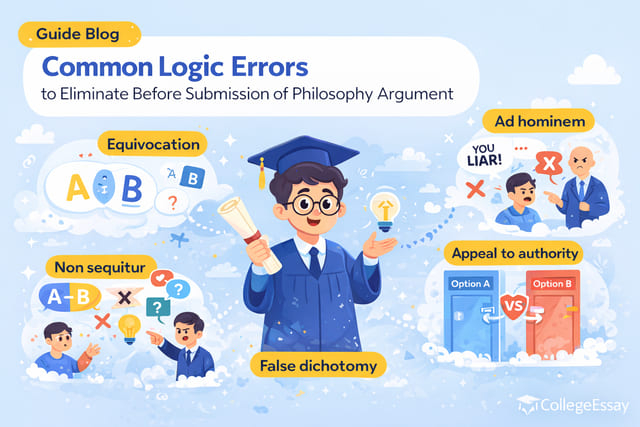
Run through this list before submitting. Professors catch all five.
Philosophy prizes clarity above everything else. Not elegance, not flourish, not showing your vocabulary; clarity. If a sentence can be read two ways, rewrite it until it can only be read one way.
Some practical rules:
You have the structure, and the logic. The hard part now is sitting with the objection until you find a reply that actually holds. That is the work philosophy requires, and it does not get easier with more time, only with more focus. If the deadline is closer than the clarity is, have your philosophy argument written for you by a subject specialist, share your thesis, your assigned reading, and the word count, and get a complete, structured argument back within 24 hours.
Before submitting, run through this:
If all seven are yes, you have a philosophy argument. If any is no, that is where to spend the next hour.
You have your argument structure. Writing it into a polished, properly formatted philosophy paper is the next step, and the one most students underestimate. If you would rather not spend the next three hours turning your logic map into flowing academic prose, our writers work specifically on philosophy. Tell us your thesis, your word count, and your deadline, and we will handle the custom philosophy paper writing, complete paper, your argument, ready to submit.
A philosophy essay is the full paper, introduction, body, conclusion, formatting. A philosophy argument is the logical core inside it: a thesis, the premises that support it, and a reply to the strongest objection against it. You can have a well-formatted essay with a weak argument, and that is what most professors are actually penalizing when they say your paper lacks depth. Get the argument right first; the essay is the container for it. to have see philosophy essays that work, explore our guide on philosophy essay examples.
It depends on the assignment, but argument length is not word count, it is premise count. Most undergraduate philosophy arguments rest on two to three premises. Each premise needs to be stated, explained, and either defended or shown to be reasonable. In a 1,000-word paper, that leaves roughly 200–250 words per premise plus space for your objection and reply. Do not pad. A tight two-premise argument is stronger than a sprawling four-premise argument where two premises are doing no real work.
Look at whichever premise a reasonable opponent would most want to deny, usually the one that does the most work in getting you to your conclusion. State that premise clearly, then ask: what would someone who rejects my conclusion have to say about this premise? That is your objection. If you are struggling, read the secondary literature on your topic and find the actual counterargument philosophers use, do not invent a weaker version of it.
Yes, and in many cases you should. Philosophy is one of the few academic disciplines where I argue that... is not only acceptable but preferred. It signals that you are making a claim and taking responsibility for it, rather than hiding behind passive constructions. The caveat is that first person does not license informality, I think maybe X is true is weaker than I argue that X because... Use it to state your thesis and your moves, not to hedge them.
It usually means one of three things: your premises are not argued for (you asserted them without support), your conclusion does not follow strictly from your premises (non sequitur), or your objection section engaged with a weak version of the counterargument rather than the strongest one. Read the paper looking only at your premises, could a smart skeptic deny any of them without argument? If yes, that is where the rigor is missing.
Professor Gabriel Sullivan Verified
Professor Gabriel Sullivan is a distinguished philosopher focusing on the intersections of philosophy of science, philosophy of biology, and philosophy of mind. His research contributions and dedication to scholarship have been widely acknowledged.
Specializes in:
Keep Reading
Was This Blog Helpful?
On this Page
We Value Your Feedback
Help us improve your experience by sharing your thoughts and suggestions.

Thank You for Your Feedback!
We're thrilled you had a great experience. Your input helps us keep improving!


Essay Services
Academic Papers
Admissions
Company
Legal & Policies