You've been assigned a biology essay, you have total freedom to pick your topic, and somehow that's made everything harder. A blank page, a vague assignment, and a deadline that's closer than you'd like it's a frustrating spot to be in.
This list gives you 65+ biology essay topics organized by essay type and difficulty. A biology essay topic is the specific angle you take on a biological subject, narrow enough to argue or explain in full, broad enough to find sources. The best biology essay topics aren't just interesting; they're specific enough that you can actually finish the essay. Students who need expert support beyond topic selection can explore our biology essay writing service for professional help.
Whether you're writing an argumentative essay, a descriptive piece, a compare and contrast analysis, or a cause and effect essay, you'll find a usable topic below, plus guidance on how to narrow it down before you start writing. Once you've got your topic, our guide on how to write a biology essay walks you through the full process, structure, sourcing, and getting from outline to finished draft.
How to Pick a Biology Essay Topic (That Actually Works)
Before you scroll through the list, take sixty seconds to think about these four things. They'll save you a lot of headaches later.
Match the Topic to Your Essay Type
An argumentative topic needs a defensible claim. A descriptive topic needs a clear process or concept to explain. A compare-and-contrast topic needs two things worth comparing that reveal something meaningful when placed side by side. A cause-and-effect topic needs an identifiable trigger and downstream impact. Grabbing a topic without knowing your essay type is how students end up rewriting their introduction three times.
Match the Topic to Your Word Count
A topic like "the human immune system" is a textbook chapter, not a 750-word essay. If you're writing under 1,000 words, you need a tight, specific angle. If you have 2,500+ words to fill, you can go broader but only slightly.
Make Sure You Can Find Sources
Some topics sound fascinating but have very little peer-reviewed research behind them. If you can't find at least 3–5 credible sources in a ten-minute search on Google Scholar or PubMed, pick a different topic.
Narrow Before You Write
This is the step most students skip, and it's why they get stuck halfway through. We'll cover how to do it properly in the next section below.
Biology Essay Topics to Avoid (And Why)
Before getting into the lists, here are five topic traps that consistently produce weak essays. If your topic falls into one of these categories, narrow it or swap it before you write a single word.
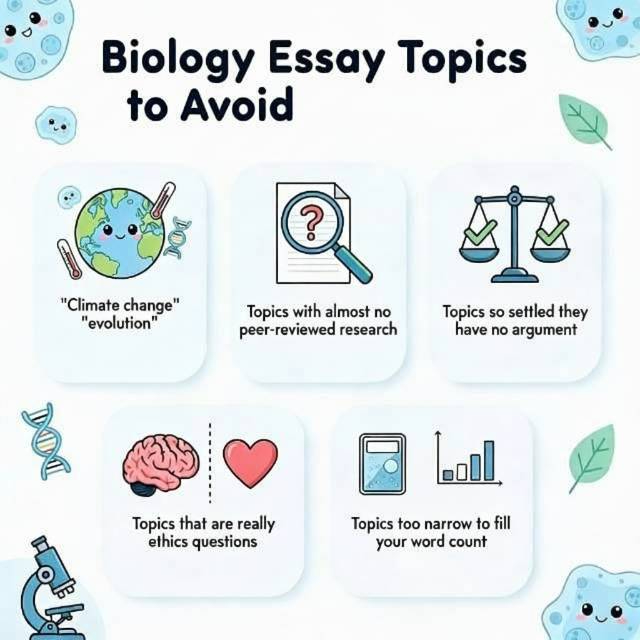
- "Climate change" or "evolution" as a standalone topic. These are fields, not topics. You cannot argue or explain "evolution" in 1,500 words. Pick one mechanism, one organism, or one debate within that field.
- Topics with almost no peer-reviewed research. Exotic or highly speculative topics (consciousness in plants, the biology of luck) can feel original but leave you unable to cite credible sources, which is fatal in a biology essay.
- Topics so settled they have no argument. "Is evolution real?" or "Are vaccines effective?" have scientific consensus answers. An argumentative essay needs genuine debate, not a question science has already answered.
- Topics that are really ethical questions. "Should we clone humans?" leans heavily philosophical. If your essay would work equally well in an ethics class, it needs a more biological angle, mechanism, risk, or scientific feasibility.
- Topics too narrow to fill your word count. The life cycle of one specific beetle species might work for a descriptive paragraph, but it won't sustain 1,500 words without padding. Make sure your topic has enough biological complexity to support your essay's length.
Argumentative Biology Essay Topics
An argumentative biology essay takes a clear stance on a debatable issue. You're not just explaining what something is you're making a claim and defending it with evidence. The strongest argumentative biology topics are the ones where smart people genuinely disagree.
Easy Argumentative Topics
These also work well for high school biology essays. Good sources are easy to find, and a clear position is achievable in 500–1,000 words.
- Should animals be used in medical research? Plenty of angles here ethical frameworks, alternatives like cell cultures, and real scientific stakes. Easy to take a position and find supporting evidence.
- Is GMO food safe for human consumption? A topic with solid scientific consensus on one side and strong public skepticism on the other which makes it ideal for an argumentative essay.
- Should students be required to dissect animals in biology class? A tight, student-relevant topic with clear stakeholders: educators, animal rights advocates, and students themselves.
- Should junk food advertising be banned to combat childhood obesity? Sits at the intersection of biology and public health. Easy to argue either direction.
- Should humans adopt plant-based diets to improve health outcomes? Nutritional science, environmental biology, and public health all feed into this one. Good sources are everywhere.
Standout pick: GMO food safety Why it works: You can take either side; the science is well-documented, and there's a clear tension between scientific data and public perception that makes for a genuinely interesting argument. How to narrow it: Instead of "is GMO food safe," try "should GMO food labeling be mandatory in the United States?" Now you have a specific policy claim backed by biology. |
Intermediate Argumentative Topics
These need a bit more research and a tighter argument. Good for 1,000–1,500-word essays.
- Should gene editing in human embryos be legalized? CRISPR and human germline editing raise real ethical and scientific questions. Strong sources available through NIH and peer-reviewed journals.
- Are humans primarily responsible for the current mass extinction? Forces you to engage with data on extinction rates, habitat destruction, and climate not just opinion.
- Should zoos be abolished or reformed? A classic topic that's more nuanced than it first appears, especially when you factor in conservation breeding programs.
- Is antibiotic overprescription a bigger threat than antibiotic underprescription in developing nations? A comparison argument that requires understanding of resistance mechanisms and global health policy.
- Should organ donation be opt-out rather than opt-in by default? Behavioral science, ethics, and biology intersect here. Surprisingly well-sourced for a biology essay.
- Should the HPV vaccine be mandatory for all school-age children? Public health policy meets virology. Clear stakeholders and strong scientific literature.
Standout pick: Gene editing in human embryos Why it works: It's scientifically grounded, ethically complex, and directly relevant to where biology is heading. How to narrow it: Try "should CRISPR be used to eliminate hereditary diseases in human embryos" You've moved from the broad debate to a specific application with a specific technology. |
Advanced Argumentative Topics
These require stronger scientific literacy and longer essays (1,500+ words).
- Should CRISPR gene therapy be regulated as a medical device or a pharmaceutical? A regulatory science argument that requires understanding both the technology and the policy landscape.
- Is rewilding a viable conservation strategy in urban-adjacent ecosystems? Forces engagement with ecosystem dynamics, population ecology, and real-world case studies.
- Should de-extinction of species like the woolly mammoth be pursued as a conservation strategy? Fascinating territory with serious scientific skepticism on both sides.
- Is synthetic biology's potential to create novel organisms an existential risk or a necessary tool? High-level argument that pulls from biosafety, bioethics, and microbiology.
Descriptive Biology Essay Topics
A descriptive biology essay explains how something works a process, a system, a concept, or an organism. You're not arguing a position; you're making something complex clear. Descriptive topics work best when you're explaining a process most people have heard of but don't actually understand.
Easy Descriptive Topics
Good for shorter essays, including high school assignments. Well-documented, clear processes.
- How does the human immune system fight off a virus? Step-by-step process with clear components (innate vs. adaptive immunity). Easy to structure and source.
- What is photosynthesis and how does it work? A classic the trick is to go beyond the surface-level explanation and cover light-dependent vs. light-independent reactions.
- How does the human digestive system break down food? Organ by organ, enzyme by enzyme straightforward to outline and write.
- What is DNA and how does it store genetic information? Foundational topic. Dozens of reliable sources and clear visual structures to explain.
- How does the heart pump blood through the body? The cardiac cycle, chambers, and valves clear, sequential, and easy to diagram in writing.
- What is natural selection and how does it work? Darwin's core concept, explained through concrete examples like antibiotic resistance or beak variation.
Intermediate Descriptive Topics
These need more depth and a clearer organizational structure.
- How do ecosystems recover after a wildfire? Ecological succession, pioneer species, keystone species a process with real-world examples (NOAA and EPA have solid data).
- Explain the role of mitochondria in cellular energy production. ATP synthesis, the electron transport chain more complex than the "powerhouse of the cell" meme suggests.
- How does the nervous system transmit signals? Neurons, synapses, neurotransmitters, and action potentials are a process essay that maps well to a linear structure.
- How does the human body regulate temperature (thermoregulation)? Sweating, shivering, vasodilation, vasoconstriction a tight feedback loop worth explaining in detail.
- What is the menstrual cycle and how is it hormonally regulated? A multi-stage biological process with clear hormonal drivers. Well-sourced and underexplained in most general curricula.
- How do vaccines train the immune system? Highly relevant and well-documented. Covers antigens, antibodies, memory B-cells, and the difference between vaccine types.
Standout pick: How ecosystems recover after a wildfire Why it works: It's a real, observable process with well-documented case studies (Yellowstone, Australian bushfires), and it connects to current events without feeling forced. How to narrow it: Try "how California chaparral ecosystems recover in the first five years after a wildfire." Now you have a specific ecosystem, a specific timeline, and a searchable body of research. |
Advanced Descriptive Topics
These require technical precision and careful sourcing.
- Describe the biological mechanisms behind antibiotic resistance. Mutation, horizontal gene transfer, efflux pumps detailed, technically demanding, and critically important.
- How does epigenetics alter gene expression without changing DNA sequence? Methylation, histone modification, gene silencing complex but well-documented in peer-reviewed literature.
- Explain the role of the microbiome in human immune function. A fast-moving field. Requires recent sources (post-2015) for the most accurate picture.
- How does the blood-brain barrier work and why does it matter for drug development? Tight junctions, selective permeability, and the implications for treating neurological conditions.
- Describe the process of meiosis and explain how it generates genetic diversity. Crossing over, independent assortment, and the difference from mitosis are technically precise and well-defined.
Compare and Contrast Biology Essay Topics
A compare and contrast biology essay places two biological processes, structures, or concepts side by side, identifying what they share, where they diverge, and why those differences matter. You're not just listing differences; you're building toward a conclusion about what the comparison reveals. This is one of the most commonly assigned biology essay types, particularly in introductory college and high school courses.
Easy Compare and Contrast Topics
These also work well for high school. The concepts are familiar, sources are abundant, and the comparison structure keeps essays organized.
- Mitosis vs. meiosis. The most commonly assigned comparison in biology. Different purposes, different outcomes, same starting material, the contrast is clean and well-documented.
- Aerobic vs. anaerobic respiration. When oxygen is present vs. when it isn't a direct comparison with clear differences in ATP yield, location, and byproducts.
- DNA vs. RNA. Structure, function, and location a foundational comparison with plenty of reliable sources.
- Plant cells vs. animal cells. Cell wall, chloroplasts, vacuole size a descriptive comparison that rewards precise biological vocabulary.
- Bacteria vs. viruses. Two things people often confuse comparing structure, reproduction, and how each interacts with the immune system makes for a focused, useful essay.
Standout pick: Mitosis vs. meiosis Why it works: Every source covers it, the comparison structure writes itself, and the topic rewards students who go beyond listing differences and explain why those differences exist which is where marks are won. How to narrow it: Instead of comparing the full processes, try "how crossing over in meiosis generates genetic diversity that mitosis cannot" Now you have a specific biological mechanism to explain, not just a side by side summary. |
?
Improve Your Biology Essay Draft
Get detailed feedback to refine your essay and improve clarity
Intermediate Compare and Contrast Topics
These need a sharper thesis the comparison should lead to a conclusion, not just a list.
- Sexual vs. asexual reproduction. Genetic diversity, evolutionary advantages, and trade-offs. More interesting than it sounds when you bring in real examples (Komodo dragons, strawberries).
- Prokaryotic vs. eukaryotic cells. Structural and functional differences with evolutionary implications works well at introductory university level.
- Innate vs. adaptive immunity. Speed, specificity, memory two arms of the immune system with fundamentally different mechanisms and purposes.
- C3 vs. C4 plants. Photosynthetic pathways adapted to different environments: a comparison with ecological and agricultural implications.
- Sympatric vs. allopatric speciation. Two routes to the same destination comparing the mechanisms helps explain why biodiversity patterns look the way they do.
- Type 1 vs. type 2 diabetes. Same name, different disease comparing onset, mechanism, and treatment reveals how misleading the shared label is.
Standout pick: Innate vs. adaptive immunity Why it works: The comparison is genuinely meaningful these two systems do different things, work on different timescales, and interact in ways that matter for vaccine design and disease response. It's not just two things that happen to exist in the same body. How to narrow it: Try "how the adaptive immune system's memory function makes vaccines possible, and why the innate system alone cannot achieve the same result" now you have an argument, not just a comparison. |
Advanced Compare and Contrast Topics
These require technical precision and a thesis that goes beyond describing differences.
- C3 vs. C4 photosynthesis pathways under climate stress. Not just what they are, but which performs better as temperatures rise a comparison with direct environmental implications.
- Lamarckian vs. Darwinian evolution. A historical and scientific comparison that also forces you to explain why one model was right and one was wrong.
- CRISPR-Cas9 vs. older gene editing tools (zinc finger nucleases, TALENs). A technical comparison of precision, cost, and off-target effects relevant to anyone writing about biotechnology.
- Prokaryotic vs. eukaryotic gene regulation. Operons, transcription factors, epigenetic control the comparison reveals how complexity scales with organism sophistication.
Cause and Effect Biology Essay Topics
Cause and effect essays explore what happens when one biological thing changes you're tracing a chain from a trigger to its downstream consequences. The structure is inherently logical, which makes these essays easier to organize than you'd expect.
Easy Cause and Effect Topics
These also work for high school essays. Direct chains have well-documented consequences.
- What are the effects of sleep deprivation on the human body? Short-term and long-term consequences, well-documented by sleep science research.
- How does smoking affect lung health? Direct biological consequences cellular damage, inflammation, cancer risk with overwhelming research support.
- What are the health effects of a sedentary lifestyle? Cardiovascular, metabolic, and musculoskeletal consequences. Easy to scope to a 500–750-word essay.
- How does pollution affect aquatic ecosystems? A cause (chemical or plastic pollution) with measurable effects on species diversity, food chains, and water chemistry.
- What happens to the body during exercise? Heart rate, oxygen demand, lactic acid a clean cause-and-effect chain with lots of accessible sources.
Intermediate Cause and Effect Topics
These need a clearer chain of causation and stronger sourcing.
- What are the consequences of monoculture farming on soil biodiversity? Single-crop agriculture depletes soil microbiomes a topic with agricultural and ecological stakes.
- How does chronic stress affect the immune system? Cortisol, inflammation, suppressed immune response well-documented and directly relevant to students.
- What are the biological effects of microplastic consumption in marine animals? A growing research area with NOAA data and recent peer-reviewed studies.
- How does habitat fragmentation affect wildlife populations? Reduced genetic diversity, inbreeding, population collapse cause-and-effect with real conservation implications.
- What are the effects of deforestation on local climate patterns? Transpiration, albedo, rainfall connects forest biology to atmospheric science.
Standout pick: Chronic stress and the immune system Why it works: It's directly relevant to students' lives, backed by decades of psychoneuroimmunology research, and hits an intersection of systems (endocrine + immune) that demonstrates biological thinking. How to narrow it: Try "how chronic academic stress affects immune function in college students," personal relevance, plus a definable population. |
Advanced Cause and Effect Topics
These require multi-step causal chains and engagement with current research.
- What are the long-term ecological effects of introducing an invasive species? Cascade effects on food webs, native species displacement, and ecosystem restructuring.
- How does deforestation in the Amazon affect global biodiversity? Keystone species, endemic species loss, and global carbon cycle implications.
- What are the downstream effects of coral reef bleaching on ocean food webs? Bleaching triggers (thermal stress) ? algae die-off ? species displacement a chain with global implications.
- How does antibiotic use in livestock farming contribute to antibiotic-resistant bacteria in humans? Horizontal gene transfer, gut microbiome pathways, and public health policy implications.
Biology Extended Essay Topics (IB Students)
IB extended essays are a different animal. You need a focused research question, not just a broad topic area. The question should be specific enough to be investigated in 4,000 words and measurable enough to support a real conclusion. Browse these by subfield and use them as starting points, not final answers.
Cellular and Molecular Biology
- To what extent does temperature affect the rate of enzyme activity in salivary amylase?
- How does pH variation affect the structure and function of catalase in potato cells?
- What is the effect of antibiotic concentration on the growth rate of E. coli in controlled laboratory conditions?
Ecology and Environmental Biology
- How does urbanization affect pollinator diversity in suburban green spaces in [your region]?
- To what extent do mangrove ecosystems contribute to carbon sequestration compared to adjacent terrestrial forests?
- What is the relationship between light intensity and species diversity in intertidal zones?
Genetics and Evolution
- How does the frequency of a recessive allele change across generations in a simulated population under selective pressure?
- To what extent does geographic isolation explain genetic variation between [two defined populations]?
Human Biology and Health
- What is the effect of regular aerobic exercise on resting heart rate over a 12-week period in adolescents?
- How does dietary fiber intake correlate with gut microbiome diversity in college-aged students?
Neuroscience and Behavior
- To what extent does sleep duration affect short-term memory performance in high school students?
- How does chronic noise exposure affect stress hormone levels in urban bird populations?
For any IB extended essay topic, narrow to a specific organism, population, or measurable variable before you commit. Your research question should have a "to what extent" or "how does" structure that signals you can measure a result. |
How to Narrow Any Biology Topic (So It's Actually Writeable)
This is the step most students skip, and it's why they get halfway through their essay and realize they have nothing to say.
Here's a simple three part formula:
[Broad subject] + [specific angle] + [defined scope]
If your essay is under 750 words, your topic needs to be narrow enough that you can cover it in three or four body paragraphs. That means one organism, one system, one mechanism, or one event not an entire field.
If your essay is 1,500–2,500 words, you have room for a topic that covers multiple components of a system or compares two related things. Don't artificially inflate a narrow topic just to hit word count.
If you can answer your topic in two sentences, it's not specific enough. If you can't see where your argument ends, it's too broad.
Worked example: Broad topic: "Climate change" Too big for any essay. There are entire journals dedicated to this subject. Add a specific angle: "The effect of rising ocean temperatures on coral reef ecosystems" Better but still broad enough to fill a textbook. Add a defined scope: "The effect of rising ocean temperatures on coral bleaching in the Great Barrier Reef since 2010" Now you have a topic. You can write this in 1,000 words or 2,500 words and stay focused throughout. If you want to see what any of these topics looks like in a finished piece, check out these biology essay examples. |
Write High Quality Biology Essays
Learn how to present scientific ideas clearly and effectively
- Help with research and topic selection
- Scientific writing guidance
- Clear and logical structure
- Professional editing support