Your scholarship application says 100 words maximum, and you have no idea where to start. Below are five annotated 100-word scholarship essay examples across the most common prompt types: tell us about yourself, career goals, why you deserve it, community service, and financial need, with a breakdown after each one showing exactly what every sentence is doing and why it works. If you're new to the format, the four-part structure below takes 30 seconds to read and applies to almost every 100-word prompt you'll encounter. If you need examples for other scholarship prompt types or longer formats, our scholarship essay writing guide covers the full picture.
100 Word Scholarship Essay Examples (Short Essays That Work)
Why 100 Word Scholarship Essays Are Harder Than They Look
Most students assume short means easy. It's actually the opposite.
Writing 500 words is forgiving. You have room to build context, recover from a weak opener, and still land a strong close. Writing 100 words leaves no margin for error. Every sentence has to work. Every word has to earn its place.
The 100-word format is essentially an elevator pitch for scholarship committees: one focused point, delivered with precision and personality. What the committee is actually testing isn't just your story, it's whether you can prioritize and communicate clearly under constraint. That's a skill worth demonstrating.
What this format is not: it's a snapshot. You're not telling your whole journey. You're choosing one moment, one achievement, one goal, one connection to the scholarship, and making it count.
"A 100-word scholarship essay doesn't ask you to tell your whole story; it asks you to choose the one sentence that matters most, then build around it." |
The 4 Part Structure That Works for a 100 Word Scholarship Essay
Before looking at examples, it helps to know what you're building. Almost every strong 100-word scholarship essay follows the same four-part structure:
Part | Function | Target Word Count |
Hook | Opens with a specific claim or scene | ~15 words |
Core Achievement or Goal | Supports the hook with evidence or context | ~40 words |
Scholarship Connection | Explains why this scholarship fits your specific goal | ~25 words |
Closing Impact | Points forward, what you'll do with this opportunity | ~15 words |
You'll almost always use two short paragraphs, not one, with the break after the Core section. Not every prompt maps perfectly to this template; some will shift emphasis toward connection or need, but this framework applies to 80%+ of 100-word prompts.
"The 4-part framework turns 100 words from a blank page problem into a structural puzzle you already know how to solve." |
5 Real 100 Word Scholarship Essay Examples (Annotated)
Here are five original examples, each approximately 100 words, organized by prompt type. After each one, you'll find a brief annotation explaining what every part is doing structurally.
Example 1: "Tell Us About Yourself" Prompt
The Prompt: "In 100 words or fewer, tell us about yourself and why you're applying for this scholarship."
Essay:
Growing up as the oldest of four kids in a single-parent household, I learned to manage more than most teens. I balanced a 3.8 GPA, a part-time job, and helping my younger siblings with homework, not because I had to, but because I chose to. That experience shaped my plan to study social work and work with at-risk youth in underserved communities. The [Scholarship Name] would allow me to reduce my work hours and focus fully on my degree. I'm ready to turn what I've learned at home into a career that helps others do the same.
Annotation:
- Hook (sentence 1): Opens with a specific life circumstance rather than a generic claim. It immediately creates context without wasting words on a warm-up.
- Core (sentences 2–3): Supports the hook with concrete evidence, actual activities, and an actual GPA. This is where vague essays fall apart. Specifics hold.
- Scholarship Connection (sentence 4): Ties the scholarship's function (financial support) directly to a practical benefit (fewer work hours, more study time). It's not just "this would help me," it says how.
- Closing (sentence 5): Points forward. Doesn't recap. Shows what the student will do with the opportunity, not just why they need it.
Expert Tip
If your scholarship requires more space, see our 250 word scholarship essay examples for how the approach shifts at longer formats.
Example 2: "Career Goals" Prompt
The Prompt: "In 100 words or fewer, describe your career goals and how this scholarship will help you achieve them."
Essay:
I want to be an environmental engineer who helps cities build water systems that won't fail the next generation. My interest started when a local water crisis made national news during my sophomore year, and I realized that preventable problems like that come down to underfunded infrastructure and undertrained engineers. I've spent the last two years taking every STEM elective my school offers and volunteering with a local watershed conservation group each weekend. The [Scholarship Name] would fund the civil engineering degree that puts me one step closer to the work that actually needs doing.
Annotation:
- Hook (sentence 1): Opens with a career goal framed as a specific problem to solve, not just a job title. "Environmental engineer who helps cities" is more compelling than "I want to study environmental engineering."
- Core (sentences 2–3): Explains why this goal, grounds it in a real event (water crisis, sophomore year), and shows existing commitment (STEM electives, weekend volunteer work).
- Connection + Close (sentence 4): Combines the scholarship link and forward momentum in one clean sentence. Efficient for a word-tight format.
Example 3: "Why I Deserve This Scholarship" Prompt
The Prompt: "In 100 words or fewer, explain why you deserve this scholarship and what you have done to earn it."
Essay:
I'm not applying for this scholarship because my path has been hard; I'm applying because I've done something with it. After my family relocated twice in three years due to job losses, I transferred schools, rebuilt my friend group, and maintained a 3.9 GPA through all of it. Last year, I launched a peer tutoring program at my new school that now serves 40 students weekly. The [Scholarship Name] supports students who turn adversity into action. I believe that's exactly what I've demonstrated, and what I plan to keep doing through a degree in education policy.
Annotation:
- Hook (sentences 1–2): This avoids the classic "why I deserve" trap, opening with suffering and hoping it speaks for itself. Instead, the student opens with a thesis: I did something with my challenges. That's a confident, specific claim.
- Core (sentences 3–4): Backs the thesis with two pieces of evidence: academic consistency despite disruption, and a real leadership initiative with a measurable result (40 students weekly).
- Connection (sentence 5): Quotes the scholarship's own language back at them, shows research and alignment.
- Close (sentence 6): Ties it forward to a degree and a specific field (education policy), not just "I will use this well."
Example 4: "Community Service/Leadership" Prompt
The Prompt: "In 100 words or fewer, describe a community service or leadership experience and the impact it had."
Annotation:
- Hook (sentence 1): Opens with a problem, low membership, which immediately creates narrative tension. Much stronger than "I am the president of my school's environmental club."
- Core (sentences 2–4): Three concrete results (membership numbers, composting program, parks partnership) plus a sentence on how it happened, then the punchy one-liner: "I didn't inherit momentum, I built it." That's the kind of quotable line scholarship readers remember.
- Connection + Close (sentences 5–6): Explains the logical next step and names the scholarship's specific role. Forward-looking, not just backward-looking.
Example 5: "Financial Need" Prompt
The Prompt: "In 100 words or fewer, describe your financial need and how receiving this scholarship would impact your education."
Essay:
My mother has worked two jobs my entire life to keep our family in a stable apartment. She's never complained about it. I've taken that same approach to school, working 15 hours a week at a grocery store while carrying a full course load and a 3.7 GPA. I'm applying to study nursing because I want to build a career that makes the kind of sacrifices she made unnecessary for my own kids. The [Scholarship Name] would reduce the hours I spend working and increase the hours I spend becoming the person I want to be.
Annotation:
- Hook (sentences 1–2): Establishes financial context with dignity and specificity, a real detail (two jobs, stable apartment) without melodrama. The one-liner "She's never complained about it" creates character in five words.
- Core (sentences 3–4): Shows the student's own work ethic first (15 hours/week, full course load, 3.7 GPA), then connects it to a career goal. This framing puts effort before need, which is exactly the right order for this prompt.
- Close (sentence 5): The closing line reframes financial aid not as charity but as an investment in time, and ends on aspiration rather than hardship.
Expert Tip
For deeper guidance on the financial need prompt specifically, see our financial need scholarship essay guide.
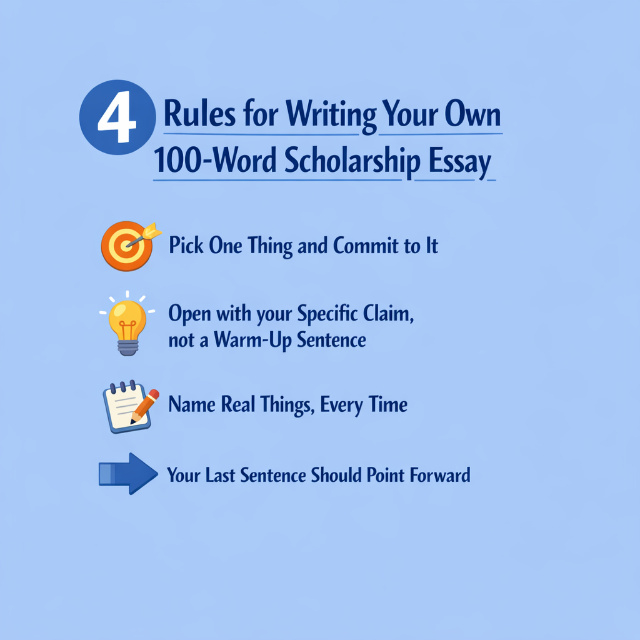
4 Rules for Writing Your Own 100-Word Scholarship Essay
You've seen how the structure works. Now here's how to apply it when you're writing from scratch.
Pick One Thing and Commit to It
The most common mistake in 100-word essays is trying to cover too much. You can't summarize your whole background, mention three achievements, describe your career goals, and connect it to the scholarship in 100 words, not well, anyway. Choose one experience, one goal, or one achievement. Cut everything else. An essay that goes deep on one thing reads as confident. An essay that grazes five things reads as scattered.
Open with your Specific Claim, not a Warm Up Sentence
"I am passionate about helping others" is a warm-up sentence. It doesn't say anything the reader can hold onto. Your first sentence is your thesis, your proof, and your first impression all at once. Start with the thing you're going to prove, not a preamble to it. "I launched a tutoring program that now serves 40 students weekly" does more in one sentence than three sentences of setup ever could.
Expert Tip
For more on this, see our how to start a scholarship essay guide.
Name Real Things, Every Time
Vague language kills short essays. "I volunteered" tells the reader nothing. "I volunteered 120 hours at a food bank over two summers," tells them everything they need. The same goes for GPA numbers, organization names, cities, program names, and measurable outcomes. Specifics are the difference between an essay that feels real and one that feels like a template.
Expert Tip
See our scholarship essay mistakes to avoid guide for the full list of what to cut.
Your Last Sentence Should Point Forward
Don't end by summarizing what you just said; you only have 100 words, and the reader just read them. End with what the scholarship enables: your next step, your specific plan, what you'll do when you get there. "I will use this opportunity wisely" is a dead close. "This scholarship would fund the nursing degree that lets me stop choosing between work and school" is a live one.
Expert Tip
Check out our scholarship essay prompts resource for more examples of strong closes by prompt type.
"At 100 words, there's no room for a warm-up sentence; your first sentence is your thesis, your proof, and your first impression all at once." |
You've got the structure and the examples. Writing your own version, one that fits your prompt, your story, and exactly 100 words, is where most students spend another two hours going in circles. Tell us your prompt and the two or three things about yourself that matter most, and our writers can handle it: you'll get a complete draft back the same day.
Submit a Scholarship Essay You're Proud Of
Our writers know how to pack maximum impact into minimum words.
- Professional scholarship essay writing
- Human-written, AI-free, fully original every time
- Turnaround options from 3-hour rush to standard delivery
- Trusted by students applying to competitive scholarships since 2010
Your scholarship. Your story. Written right.
Our Writers Can Handle ItFrequently Asked Questions
Are there real 100 word scholarship essay examples I can use as a model?
Yes. The five annotated examples above are original models designed to show how different prompts, from "tell us about yourself" to financial need, can be answered in exactly 100 words. Use them as structural templates. Don't copy them directly, because scholarship committees read a lot of essays, and your specific details are what make yours stand out. For a broader look at examples across all prompt types and formats, see our scholarship essay examples guide.
How do you write a 100 word scholarship essay without sounding too short?
Focus on one specific point rather than trying to cover your whole background. A 100-word essay that goes deep on one achievement reads as confident and focused, not short. The essays that feel thin are the ones that try to cover too much ground and end up skimming the surface of everything.
What should be in a 100 word scholarship essay?
A strong 100-word essay typically includes: a specific opening claim or hook, 2–3 sentences of supporting evidence (an achievement, experience, or context), a connection to the scholarship, and a forward-looking closing sentence. That's the 4-part framework described earlier in this article. For formatting rules that apply across all word counts, see our scholarship essay format guide.
Is 100 words enough for a scholarship essay?
For many scholarships, yes. A 100-word prompt is a standard short-form requirement. It tests your ability to communicate under constraint, which is itself a skill that scholarship committees value. If you want to apply to federal scholarship opportunities that typically have longer requirements, bookmark this article and then move on to our 250-word and 500-word guides once you've mastered the shorter format.
Does a 100 word scholarship essay have to be exactly 100 words?
Most scholarships that say 100 words treat it as a maximum, not an exact target. Writing 95–103 words is almost always fine. What you want to avoid is landing significantly under, a 70-word essay signals you didn't take it seriously, or going noticeably over, which can get your submission cut off by application platforms that enforce the limit automatically. Aim for 95–100 words, and you're in the safe range on both ends.
What's the difference between a 100 word and a 250 word scholarship essay?
A 100-word essay fits one focused point with no room for narrative development. A 250-word essay allows you to add a brief story, more context, and a fuller conclusion. You can use scholarship search tools like Fastweb to find scholarships across both word counts.
Alexander W. Verified
Author
Alexander W. is a seasoned academic writer with deep expertise in essay structuring and in-depth research. With years of experience helping students navigate the competitive world of scholarship applications, he specializes in breaking down complex prompts into clear, compelling narratives that resonate with award committees.
Specializes in:
Academic Research
Scholarship Essay Writing
College Application Writing
Essay Formatting & Style
Read All Articles by Alexander W.
Was This Blog Helpful?
On this Page