Your professor assigned a process analysis essay, and you need to know how to actually write one. This guide covers the structure, the outline, how each section works, and what separates a strong essay from a weak one. Everything you need is here: definition, types, a worked outline, section-by-section writing guidance, and a full example.
How to Write a Process Analysis Essay: Structure, Outline, and Examples
What Is a Process Analysis Essay?
A process analysis essay breaks a task or process into sequential steps and explains how something works or how to complete it. The reader finishes the essay understanding either how to do something themselves or why a process unfolds the way it does.
It is one of the most common essay types in both high school and college writing courses. Like definition essays it belongs to the broader family of expository writing, where the goal is to inform rather than argue.
The keyword is sequential. Unlike an argumentative or analytical essay, a process analysis essay lives or dies on the logical order of its steps. If the sequence is wrong, the essay fails, no matter how well each individual paragraph is written.
Two Types of Process Analysis Essay
Before you write a single word, you need to know which type you're writing. The two are structurally similar but serve completely different purposes.
Directional Process Analysis
A directional essay tells the reader how to do something. The reader is the one performing the process. Your job is to give clear enough instructions that they can replicate it successfully.
Common assignments: cooking instructions, DIY guides, step-by-step how-to essays, and any process where the reader is the actor. |
Example topic: How to change a flat tire. |
The test for a directional essay: if someone followed only your essay with no prior knowledge, could they complete the process? If yes, you've done it right. |
Informational Process Analysis
An informational essay explains how something works or how something happens. The reader is not performing the process. The goal is comprehension, not replication.
Common assignments: scientific processes, historical sequences, biological or mechanical explanations, any process the reader observes rather than performs. |
Example topic: How the electoral college determines a presidential winner. |
The test for an informational essay: does the reader finish with a genuine understanding of why each step follows the previous one, not just a list of what happens? |
Most college process analysis assignments are directional. If your prompt says explain how to, it is directional. If it says explain how X works or describe the process by which, it is informational.
Process Analysis Essay Structure
Every process analysis essay has the same three-part structure. What changes is the complexity and number of steps in the body.
Introduction
The introduction does three things: it establishes context, it identifies the process being analyzed, and it delivers the thesis. The thesis is a statement that names the process and signals the essay's approach or angle.
A weak introduction defines the process generically. A strong introduction tells the reader why this specific process matters and what angle the essay takes on it. |
Body (Step by Step)
Each body paragraph covers one step or one logical phase of the process. The paragraph opens with a topic sentence that names the step, explains what it involves and why it comes at this point in the sequence, addresses any difficulties or common errors at this stage, and transitions cleanly into the next step.
The body is where most process analysis essays fail. The two most common problems are steps presented out of sequence and steps explained in isolation without showing how each one sets up the next. Every step should make the previous step feel necessary, and the next step feel inevitable.
Much like classification essays rely on consistent category criteria throughout the body, process analysis essays rely on a consistent sequential logic. If the dependency chain breaks anywhere, the whole essay loses credibility.
Conclusion
The conclusion does not introduce new steps. It summarises the process, restates the significance of completing it correctly, and closes with a thought or observation that gives the essay a sense of finality. That closing thought should reflect on what the process produces, why it matters, or what it enables.
Process Analysis Essay Outline
Here is a worked outline for a directional process analysis essay on a concrete topic. This is not a blank template. Use it as the model for your own outline, substituting your process and steps.
Topic: How to prepare for a job interview
I. Introduction
- Hook: Most candidates lose interviews in the 48 hours before they walk in the door.
- Context: Interview preparation is a process with distinct stages; treating it as a single task is the most common mistake.
- Thesis: Preparing effectively for a job interview requires three sequential stages: research, practice, and logistics, each of which builds the foundation for the next.
II. Step 1: Research the role and company (48 hours before)
- Topic sentence: Effective preparation begins with targeted research, not generic confidence-building.
- What to research: the job description line by line, the company's recent news, and the interviewer's background, if known.
- Why this step comes first: every subsequent step, the answers you prepare, the questions you ask, depend on what you find here.
- Common error: researching too broadly. Focus on the specific role and the specific panel, not the company's entire history.
III. Step 2: Prepare and practice answers (24 hours before)
- Topic sentence: Research is useless without a structured practice session that converts it into rehearsed answers.
- What to do: map your experience to the job requirements identified in step 1; prepare answers to the five most common question types; practice aloud, not just mentally.
- Why does this step follow step 1: your answers need to reference specific things you found in your research; generic answers fail even when the content is good.
- Common error: over-preparing scripts. Practice structure and key points, not word-for-word recitation.
IV. Step 3: Logistics and day-of preparation (the morning of)
- Topic sentence: The final stage converts preparation into presence.
- What to do: confirm the time and location the night before; prepare clothing, materials, and any documents; plan arrival 10–15 minutes early.
- Why this step matters: candidates who are cognitively overwhelmed by logistics on interview day perform below their actual preparation level.
- Common error: leaving logistics to the morning. Every logistical decision made the night before is one less drain on focus when it counts.
V. Conclusion
- Summary: Each stage feeds the next, research informs practice, practice enables presence.
- Significance: Candidates who treat preparation as a process rather than a checklist consistently outperform those who don't.
- Closing thought: The interview itself is the last step in a process that started two days earlier.
This outline structure works for any directional process essay. For an informational essay, the steps become phases or stages rather than instructions, and the topic sentences explain mechanisms rather than actions.
Not sure how to adapt this outline to your specific process? Tell us your topic, the level of the course, and any requirements from your prompt, and our process analysis essay writing help can build the full essay from here, structured around your exact steps and at your required word count.
How to Write a Process Analysis Essay: Section by Section
How to Start a Process Analysis Essay
The introduction has four components. Handle them in this order.
I. The Hook
The hook earns the reader's attention before you ask them to do any work. For a process analysis essay, the strongest hooks identify a consequence: what goes wrong when the process is done badly, or what becomes possible when it is done well.
Weak hook: Making pizza at home is a popular activity for many people. |
Strong hook: Most homemade pizza fails at the dough stage, not because the recipe is wrong, but because the process is rushed. |
The strong hook works because it immediately signals that this essay will tell the reader something they did not know, and it creates a small tension that the essay will resolve.
II. Context
One to two sentences situating the process. What is it? Where does it come from? Why does it exist? Keep this tight. The context paragraph is not the place to define every term.
III. Prerequisites
If the process requires materials, prior knowledge, or specific conditions, name them here. For a directional essay, this is the reader's checklist before they begin. For an informational essay, this is the background knowledge the reader needs to follow the explanation.
IV. Thesis Statement
The thesis for a process analysis essay names the process and signals the essay's approach. A strong thesis does more than announce the topic. It tells the reader what to expect from the analysis.
Weak thesis: This essay will explain the process of writing a research paper. |
Strong thesis: Writing a strong research paper requires three distinct phases: source gathering, structural planning, and drafting, each of which depends on the previous phase being completed correctly. |
The strong thesis names the phases upfront, tells the reader the essay is structured sequentially, and introduces the dependency relationship between steps. That dependency relationship is the central argument of any process analysis essay.
How to Write the Body Paragraphs
Each body paragraph covers one step. The internal structure of every body paragraph is the same.
- Topic sentence names the step and its function in the sequence.
- Explanation covers what the step involves, how to execute it, and why it comes at this point.
- Detail and examples provide specific actions, tools, quantities, timings, or conditions that make the step concrete. This is where vague process essays fall apart. Mixing the ingredients well is not a step. Whisk the dry ingredients for 30 seconds until fully combined, then fold in the wet ingredients with a spatula, using no more than 12 strokes is a step.
- Challenges and errors cover what commonly goes wrong at this stage and how to avoid it.
- Transition is a phrase or sentence that connects this step to the next, making the sequence feel continuous rather than list-like.
Transitional phrases specific to process analysis: before moving to the next stage, once this step is complete, this sets up the following phase, only after X is finished can Y begin, at this point in the process, the reason this step precedes the next.
Expert Tip
Avoid mechanical transitions like firstly, secondly, thirdly. They work for a list. A process analysis essay should read as a sequence with internal logic, not a numbered list in paragraph form.
How to Write a Process Analysis Essay Conclusion
The conclusion has three jobs.
- Summarise the process by briefly restating the key steps or phases in order. One sentence per phase is enough. This reinforces the sequence in the reader's memory and is not padding.
- State the significance by explaining why it matters that this process is done correctly and what successful completion produces. This is the analytical layer that separates a process analysis essay from a set of instructions.
- Close with something that lingers by offering a reflection, a broader implication, or a concrete image of the outcome. The last sentence should feel like an arrival, not like a form being completed.
What the conclusion must not do: introduce a new step, hedge with overall, this essay has shown, or end with a generic call to action disconnected from the process itself.
Process Analysis Essay Example (Directional)
Here is a single body paragraph from a directional process analysis essay on making sourdough bread, showing how the structure above works in practice.
The most critical stage is the bulk fermentation, which takes place immediately after the dough is mixed and before it is shaped. During this phase, typically 4 to 6 hours at room temperature, the wild yeast in the starter consumes the sugars in the flour and produces the carbon dioxide that gives sourdough its open crumb and distinctive flavor. The mistake most first-time bakers make here is treating bulk fermentation as passive waiting. It isn't. Every 30 to 45 minutes, the dough should be folded, pulled from one side, and stretched over itself four times, rotating the bowl between each fold. This builds the gluten structure that will hold the gas produced in the final proof. Skip the folds, and the dough will spread rather than rise. By the end of bulk fermentation, the dough should have grown by 50 to 75 percent and feel alive, slightly domed at the surface, full of bubbles when you look through the side of a clear container. That visual cue, not the clock, is what signals readiness for the next stage.
Notice: the paragraph names the step, explains why it occurs at this point in the sequence, gives specific detail (time, temperature, frequency of folds), identifies the common error, and ends with a concrete cue that transitions to the next step.
You now have the structure, the outline, the section-by-section guidance, and a worked example. What's left is the actual writing, which is where most students lose the most time. If your deadline is tighter than your schedule, our process analysis essay writers can draft the full analysis built around your specific topic, word count, and course requirements. Most drafts come back within 24 hours.
Process Analysis Essay Starters
Here are topics across common categories to help you get started.
Everyday Processes
- How to meal prep for a week on a limited budget
- How to change a flat tire without prior mechanical experience
- How to negotiate a price at a market or car dealership
Academic and Professional
- How to conduct a literature review for a research paper
- How to build a resume with no full-time work experience
- How to prepare for and deliver a class presentation
Tips for Writing a Strong Process Analysis Essay
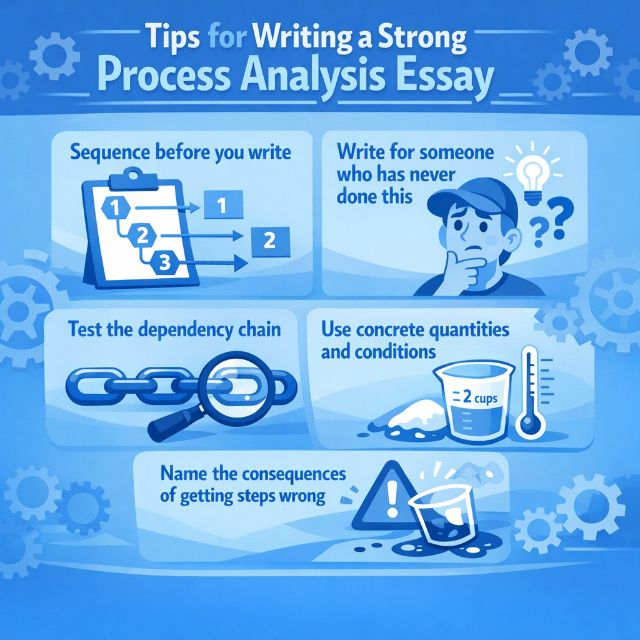
Sequence Before You Write
Before drafting, list every step in order. Read the list back and ask: if I removed any single step, would the process still work? If yes, cut it. If no, it stays.
Write for Someone Who has Never Done This
Even if the process seems obvious to you, assume your reader is encountering it for the first time. The detail that feels unnecessary to include is usually the detail they need most.
Test the Dependency Chain
For each step, ask whether it requires the previous step to be complete. If it does not, question whether the sequence is right. A process analysis essay that could be read in any order is not a process analysis essay. It is a list.
Use Concrete Quantities and Conditions
A moderate temperature is not a process detail. 180°C / 350°F is. Specificity is the difference between instructions someone can follow and instructions someone can only attempt.
Name the Consequences of Getting Steps Wrong
The most useful process analysis essays tell you not just what to do but what happens if you do not. This both educates the reader and explains why each step matters.
You have the structure, the outline, and the section-by-section guidance. What's left is writing the essay itself. Tell CollegeEssay.org's process analysis essay writers your topic, your word count, and your deadline. Most drafts are back within 24 hours.
Frequently Asked Questions
How long should a process analysis essay be?
Most college-level process analysis essays are 1,000 to 2,500 words, depending on the complexity of the process. The right length is determined by the number of steps that genuinely require explanation, not by a word count target. Each step should have its own paragraph, so if you have eight steps, you have eight body paragraphs.
What is the difference between a process analysis essay and a how-to guide?
A how-to guide is purely instructional: it tells you what to do step by step with no analytical layer. A process analysis essay does the same thing but also explains why each step exists, what it achieves, and what goes wrong if it is skipped. The analysis is what makes it an essay rather than a manual.
Can a process analysis essay be written in the first person?
It depends on the assignment type. Directional process essays are often written in the second person because the reader is the one performing the process. Informational process essays are typically written in the third person. First-person is generally avoided in academic process analysis writing unless the assignment specifically asks for a personal or reflective angle.
What tense should a process analysis essay be written in?
Present tense is standard for both directional and informational process analysis essays. Directional essays use the present tense because the instructions apply at the moment the reader performs them. Informational essays use the present tense because the process being described is ongoing or repeatable, not a one-time past event. The past tense is only appropriate when analyzing a historical process that cannot be repeated, such as the sequence of events leading to a specific political decision.
Can I write a process analysis essay about something I have never done myself?
Yes, but the standard for accuracy is higher, not lower. If you are writing about a process you have not personally performed, you need to research it thoroughly enough to anticipate the points where things go wrong, because those are the details that make a process analysis essay credible. A body paragraph that only describes what to do without addressing what can go wrong reads as secondhand, regardless of how well it is written. Primary sources, expert accounts, and instructional materials for the process are your research baseline.
Benjamin Cole Verified
Author
Dr. Benjamin Cole, holding a Ph.D. in English from Stanford, brings a decade of experience in academia and essay composition across a diverse range of writing forms. Specializing in expository and analytical writing, Benjamin has developed deep expertise in informative, classification, definition, exemplification, illustration, problem-solution, process analysis, synthesis, and extended essay formats. His comprehensive understanding of essay typology, from outlining, classification, and definition essays to selecting compelling topics for exemplification and synthesis essays, makes him a trusted authority in academic writing. Benjamin's ability to guide writers in identifying the right essay type and mastering its structure has earned him widespread recognition in essay education and expository writing methodology.
Specializes in:
types of essays
informative essay
classification essay
definition essay
exemplification essay
extended essay
illustration essay
problem solution essay
process analysis essay
synthesis essay
Read All Articles by Benjamin Cole
Was This Blog Helpful?
On this Page