What Is an Engineering Essay?
Before you start writing, it helps to be clear on what you're actually being asked to produce.
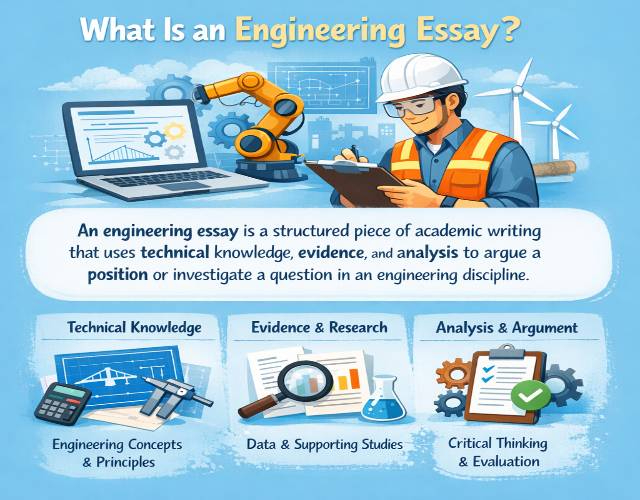
An engineering essay is not a lab report, a design brief, or a technical specification. The goal is to build and defend an argument, not simply to document findings or describe how something works.
There are four main types you'll encounter in engineering programmes:
Argumentative Engineering Essays
Ask you to take a clear position and defend it with evidence. The thesis is a claim, and the body of the essay supports that claim against counterarguments.
Example: Should engineers bear personal liability for infrastructure failures? |
Analytical or Evaluative Engineering Essays
Ask you to assess something, a technology, a design approach, a policy, by examining its strengths, limitations, and implications. The thesis is a judgment.
Example: To what extent has Building Information Modelling improved project delivery outcomes? |
Literature Review Engineering Essays
Ask you to survey and synthesise existing research on a topic, identifying patterns, gaps, and debates in the field.
Example: Review the current literature on carbon capture and storage technologies |
Reflective Engineering Essays
Ask you to examine your own professional or academic experience and draw analytical conclusions from it.
Example: What did your placement experience reveal about the gap between classroom theory and engineering practice? |
Knowing which type you're writing determines how you structure your argument, what evidence you need, and how your conclusion should read. Get this wrong, and the whole essay is built on the wrong foundation.
Steps to Write an Engineering Essay
Step 1: Understand the Engineering Essay Question
The biggest mistake engineering students make is starting to write before they fully understand what they've been asked.
Before you open a blank document, read the essay question carefully, more than once. Work out what type of essay it is.
- Is it asking you to argue a position (argumentative)?
- Assess something's strengths and weaknesses (analytical or evaluative)?
- Reflect on an experience (reflective)?
- Survey existing research (literature review)?
|
Each type has a different structure, and getting this wrong affects everything downstream.
Pay attention to the command word.
- "Discuss" means to explore multiple angles.
- "Evaluate" means weigh up evidence and come to a judgement.
- "Compare" means look at similarities and differences.
- "Analyse" means break something down and examine how it works.
These aren't interchangeable. |
Check the practical requirements before you start: word count, required citation style, whether diagrams are permitted, and submission format. Knowing these upfront saves you a rewrite later.
Looking for fresh ideas? Explore our engineering essay topics to find relevant, engaging prompts for your next assignment. |
Step 2: Research and Gather Evidence for Engineering Essay
Engineering essays are evidence-driven, your personal opinion alone isn't enough. Every major claim you make should be traceable to a credible source, not just your lectures.
Start with academic databases that cover engineering literature: IEEE Xplore, ASME Digital Collection, Google Scholar, and your university library's subject databases. For applied topics, government technical reports, industry white papers, and official engineering standards bodies are often more relevant than textbooks. |
Understand the difference between primary and secondary sources. Primary sources are original studies, experiments, or technical standards. Secondary sources, textbooks, review articles, and edited collections interpret or summarise primary work. Where possible, go to the primary source rather than citing a textbook's version of it.
A good rule of thumb: at least one credible source per major claim. If you're making five main points, you should have at least five solid references, probably more.
One thing many engineering students get wrong: if your essay references technical standards (ISO, BS, ASME, IEEE standards), these need to be cited in a specific format. We cover that in Step 6. |
Step 3: Build Your Engineering Essay Outline Before You Write
Most students skip this. Don't.
A solid outline is the difference between a focused essay and a rambling one. Your outline is your essay's skeleton; if it's weak, the whole thing collapses. Spending 20 minutes on a clear outline saves you hours of structural rewrites later.
A standard engineering essay structure looks like this:
- Introduction: introduces the topic, provides context, and states your thesis
- Background / Context: the technical or conceptual foundation readers need
- Body Sections (2 to 4): your main arguments, each with its own clear focus
- Discussion / Analysis: weighing up the evidence, addressing counterarguments
- Conclusion: restating your thesis and the significance of your findings
Each section should have one job. Write a one-sentence note next to each section in your outline describing what it does. If you can't write that sentence, the section isn't clear enough yet.
Step 4: Write a Strong Engineering Essay Introduction
Your introduction has three jobs: hook the reader, provide context, and state your thesis.
Start with something that earns attention, the significance of the engineering problem you're discussing, a surprising finding from your research, or the real-world implications of the issue. Don't open with a dictionary definition. Don't say "Since the dawn of time." Don't restate the question back to yourself. |
After the hook, give 2 to 3 sentences of context that frame the topic within the engineering field. What's the broader conversation this essay sits within?
Then state your thesis, one clear sentence that tells the reader exactly what you're arguing and why it matters. This should appear in the first paragraph, not buried halfway down the page.
Your introduction should tell the reader exactly what you're arguing and why it matters in the first paragraph.
If you want to see how strong intros are structured in practice, see engineering essay examples to guide your writing. Looking at annotated examples before you draft your own is one of the fastest ways to improve. |
Step 5: Write the Body Sections for Engineering Essay
Each body section handles one main point or argument. Follow the same pattern for each: make a claim, back it up with evidence, analyse what the evidence shows, then connect it back to your overall thesis.
Integrating technical data
- Don't just paste in a table or graph and move on. Introduce the data first ("Table 1 shows..."), then explain what it demonstrates, then connect it to your argument. The data supports your point, it doesn't make the point for you.
Handling diagrams and figures
- Label every diagram or figure (Figure 1, Figure 2, etc.) and every table (Table 1, Table 2, etc.). Always refer to them in the text before they appear, never place a diagram without a text reference preceding it. Then explain what the diagram shows. A diagram that isn't explained adds nothing to your argument.
Handling equations
- If your essay includes equations, number them in parentheses on the right margin (Eq. 1), refer to them by number in the text, and explain what the equation represents in plain language.
Transitions between sections
- Don't announce transitions with "Firstly, Secondly, Thirdly." Let the logic of the argument carry the reader forward. End each section with a sentence that either lands your point or sets up the next one.
Step 6: Handle Citations and References
Engineering essays typically use IEEE, APA, or Harvard referencing; your assignment brief will specify which one. If it doesn't, ask.
Citing correctly isn't just about avoiding plagiarism; it's how you show your marker you've done real research.
Here's the basic format for each style:
IEEE in-text: Use numbered citations in square brackets, [1], [2], [3]. Your reference list is numbered in the order citations appear in the text. APA in-text: Use (Author, Year) format. The reference list is alphabetical. Harvard in-text: Use (Author Year) format, no comma. The reference list is alphabetical. Citing technical standards: This is where most engineering students get it wrong. Standards from ISO, BS, ASME, and IEEE have specific citation formats that differ from journal articles. |
For IEEE style, a standard citation looks like this:
IEEE Std 802.11-2020, IEEE Standard for Information Technology, Telecommunications and Information Exchange Between Systems, IEEE, 2020.
For APA, include the issuing body as the author and the standard number as the title:
International Organization for Standardization. (2015). Quality management systems, Requirements (ISO Standard No. 9001:2015).
Reference management tools like Zotero or Mendeley can handle most citation formats automatically and save you significant time. Purdue OWL has reliable free guides for IEEE and APA formatting.
One rule applies across all styles: if you make a claim that isn't your own original idea, it needs a citation, including when you paraphrase. |
Running Out of Time on Your Essay?
Our writers handle engineering essays daily and deliver on deadline.
Step 7: Write Your Engineering Essay Conclusion
Your conclusion wraps up the argument; it doesn't introduce new ideas.
The structure is simple: restate your thesis in different words, summarise the key points you've made, then offer a broader implication or recommendation based on your analysis.
A good conclusion doesn't just stop; it lands the argument and leaves the reader with something to think about.
Keep your conclusion proportional, roughly 5 to 10% of your total word count. If your essay is 2,000 words, you're looking at 100 to 200 words for the conclusion.
One thing specific to engineering essays: some assignments expect a "Further Work" or "Recommendations" section as part of the conclusion. Check your brief. If recommendations are expected and you don't include them, you'll lose marks regardless of how good the rest of the essay is. |
Step 8: Edit and Proofread Your Engineering Essay
Never edit immediately after you finish writing. Take a break, even a few hours makes a significant difference. You'll catch errors you'd have missed reading it straight through.
Use a three-pass approach:
Pass 1: Structure and argument: Does the essay actually answer the question? Does your thesis hold up throughout? Is the argument logical from the introduction to the conclusion? Pass 2: Clarity and language: Is every sentence clear? Is any paragraph doing more than one job? Are there sentences you'd stumble over if you read them aloud? Pass 3: Technical and mechanical accuracy: Grammar, spelling, punctuation, citation formatting. Are all figures labelled? Are all equations referenced? Are all citations in the correct format? |
Editing is where the essay goes from adequate to impressive. Don't skip it because you're tired.
Read the whole thing aloud before you submit. If you stumble on a sentence, your marker will too. That's your signal to rewrite it.
How to Write an Engineering Essay Across Different Disciplines
The eight steps above apply regardless of which branch of engineering you're writing in. But the way you apply them varies by discipline. Here's what to watch for.
Civil and Structural Engineering Essays
They often hinge on case studies, real infrastructure projects, historical failures, or policy implementations. Your evidence base typically combines primary engineering standards (Eurocodes, ASCE standards, CIRIA guides) with academic research and industry data.
When you use a case study, don't just describe what happened. Analyse the engineering decision-making behind it and connect it to your argument. |
Mechanical Engineering Essays
These Essays frequently require you to handle quantitative data, thermodynamic principles, and materials comparisons. The challenge is making technical depth readable. Don't assume your reader knows what a term means just because it's standard in your field; define it briefly in context, then proceed.
When comparing materials or systems, organise your body sections around clear criteria (performance, cost, safety, sustainability) rather than alternating between options paragraph by paragraph. |
Electrical and Software Engineering Essays
These often engage with evolving standards and fast-moving research. Your citations need to be recent, a five year old paper on machine learning or power systems may already be outdated.
Be precise about version numbers, specification iterations, and standards bodies. "The IEEE 802.11 standard" is not the same as "IEEE 802.11ax-2021," and your marker will notice the difference. |
Environmental Engineering Essays
These frequently sit at the intersection of technical analysis and policy debate. Your argument needs to engage both dimensions. Stating that a technology works at lab scale is not the same as arguing it's a viable solution; you'll need to address cost, scalability, regulatory context, and real-world deployment.
Markers in this discipline expect you to acknowledge trade-offs explicitly rather than presenting one-sided technical optimism. |
Chemical and Biomedical Engineering Essays
They often require precision in how you handle safety data, regulatory standards, and experimental evidence. When citing clinical trials or process safety case studies, identify the limitations of the evidence, study size, conditions, and applicability before drawing conclusions. Essays that acknowledge the constraints of their evidence are always stronger than those that don't.
The discipline shapes your sources, your language register, and the types of evidence your argument can credibly use. Adjust accordingly. |
Academic Writing Style for Engineers
Most engineering students write in one of two ways: either too informally (as if explaining something to a friend) or too rigidly (using jargon and passive voice as a substitute for clear thinking). Neither works.
Good academic engineering writing has three qualities:
Precision Without Impenetrability.
Use technical terms where they're accurate and necessary. Don't use them to sound authoritative. Every technical term you introduce should either be standard in your field (and therefore assumed knowledge for your reader) or briefly defined in context on first use.
Active Thinking, not Passive Reporting.
The passive voice is common in engineering writing and has legitimate uses, particularly when the agent of an action is unknown or irrelevant. But leaning on passive voice throughout an essay can make your argument disappear. "It was found that..." is weaker than "The 2022 study found..." and far weaker than "This finding suggests..." Write sentences that show you're doing the thinking, not just reporting what others did.
Argument Over Description.
This is the single biggest stylistic problem in engineering essays. Description tells the reader what something is. An argument tells the reader what it means, why it matters, or what should be done about it. Every paragraph in a body section should be doing the second of these things, not the first. If you find yourself writing a paragraph that describes how a technology works without connecting it to your thesis, either cut it or rewrite it as analysis.
One practical test: after every body paragraph, ask yourself: "So what?" If the paragraph doesn't answer that question, if it just presents information without connecting it to your argument, it needs to be revised. |
Managing Engineering Essay Word Count Without Losing Argument Quality
Word count is a constraint, not a target. But it's a constraint you need to manage actively, particularly in engineering essays, where technical background can silently consume large portions of your allowance before you've made a single argument.
Before you write, allocate your word count.
A rough split for a 2,000-word essay: - Introduction (150–200 words)
- Background (200–250 words)
- Body Sections (1,000–1,100 words across 3–4 sections)
- Discussion (200–250 words)
- Conclusion (150–200 words).
This gives you a budget for each section and tells you immediately if your outline is overloaded. |
Background is the most common word-count trap.
- Students over-explain technical concepts that their marker already understands, and then run out of room for the actual argument.
- Ask yourself: Does this background material exist to set up my argument, or is it just context I found interesting? If it's the latter, cut it.
Cut throat-clearing sentences.
- The sentence "This essay will now go on to examine..." contributes nothing to your argument. Neither does "Having considered X, it is now possible to turn to Y." These sentences exist because the writer is warming up. Delete them in the editing phase and use the words for actual analysis instead.
If you're over the limit:
- Cut from background and transitions first. Cut any paragraph that describes without analysing. Cut hedging phrases ("it could perhaps be argued that...") in favour of direct claims followed by evidence. Engineering markers reward clarity and precision over elaboration.
If you're under the limit:
- Don't pad, deepen. Add a counterargument and address it. Introduce a second case study that tests your thesis. Develop the implications of your conclusion. More words should mean more argument, not more description.
Common Mistakes That Cost Engineering Students Marks
These are the errors that show up consistently in essays from students who know their material well. The problem isn't technical knowledge. It's how the essay is constructed.
Starting without a thesis
Some students describe a topic for several paragraphs before arriving at a position. By that point, the marker doesn't know what the essay is arguing, and neither does the writer. Your thesis should be in the first paragraph, not the third.
Evidence that Doesn't Connect to the Argument
Data, statistics, and case studies are only useful if you explain what they demonstrate and why that matters for your thesis. An essay that cites a study and moves on, without analysis, hasn't used the evidence; it's just parked it. The data doesn't argue for itself.
Treating the conclusion as a summary
A conclusion that restates each body paragraph in turn adds nothing. The conclusion is where you land the argument, where you tell the reader what your analysis actually shows, what its implications are, and what questions remain. If your conclusion could have been written before you started, it's not doing its job.
Ignoring Counterarguments
Strong engineering essays anticipate objections and address them. If your argument is that Technology X is preferable to Technology Y, you need to acknowledge what advocates of Technology Y would say, and then explain why your position still holds, given that evidence. An essay that presents only one side reads as incomplete and not confident.
Technical Accuracy Without Analytical Depth
You can write a technically accurate essay that still earns a mediocre grade. What markers are looking for, at every level, is evidence that you can not only describe engineering concepts but also reason about them, weigh competing considerations, draw justified conclusions, and acknowledge the limits of your own argument. Accuracy is the floor, not the ceiling.
Over-relying on a Single Source
An essay that draws most of its evidence from one paper, one textbook chapter, or one case study is poorly researched by definition, regardless of how credible that source is. Your argument should be triangulated across multiple independent sources.
Engineering Essay Writing Checklist
Use this PDF as a reference while you write and before you submit.
To Wrap Up!
Writing a strong engineering essay requires clear structure, logical reasoning, and a precise explanation of technical concepts.
By following these steps, you can develop well-organized, analytical essays that effectively communicate engineering ideas and meet academic expectations.
Ready to Get Your Engineering Essay Done?
Get expert help and meet your deadline without the stress.
- Subject-specialist writers in your engineering discipline
- 100% human-written, zero AI content
- Rush delivery from 3 hours
- Unlimited free revisions until you are satisfied