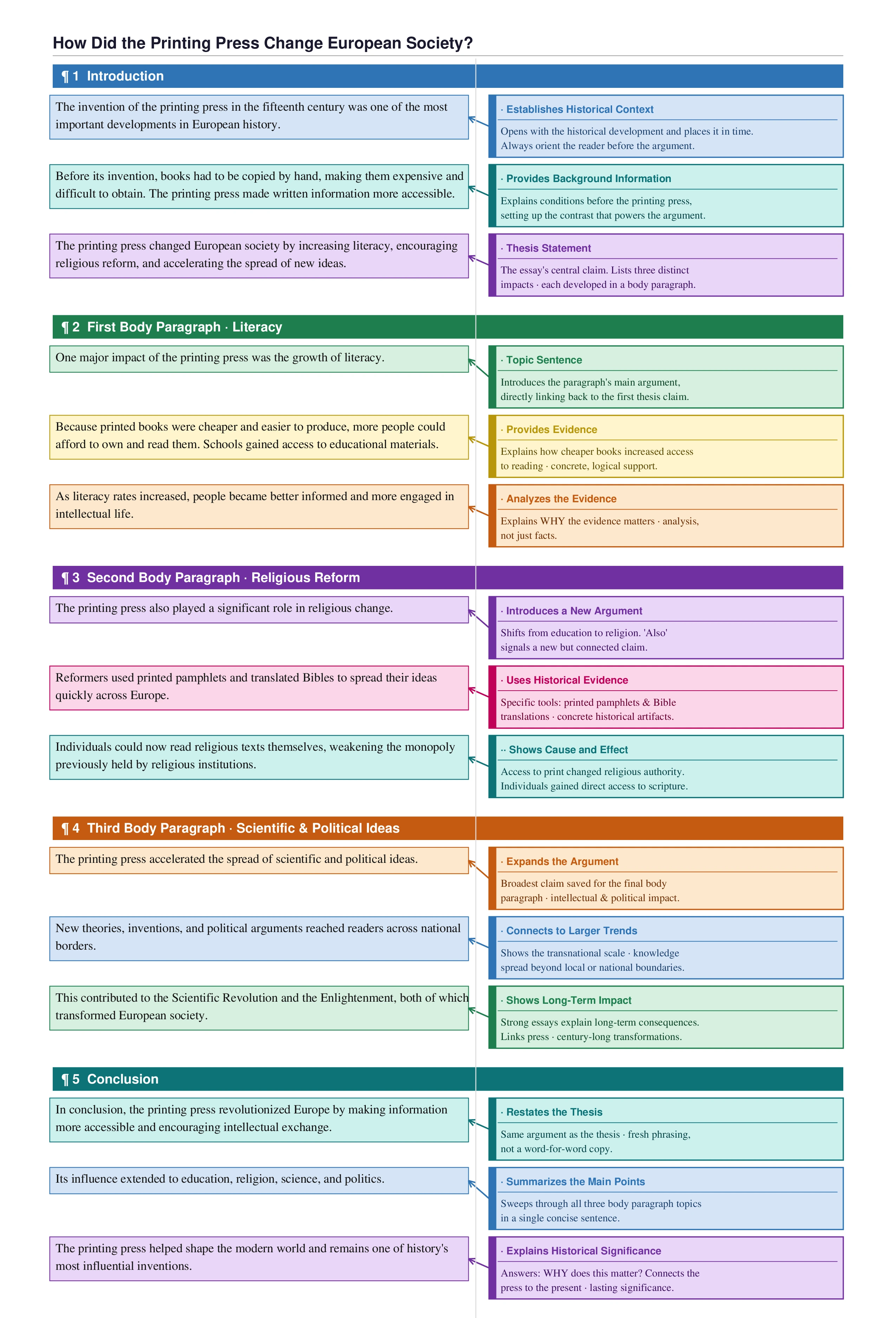
5 Paragraph History Essay Example: How Did the Printing Press Change European Society? with Annotations
A five-paragraph history essay follows a fixed structure regardless of topic or grade level: an introduction with a thesis, three body paragraphs each built around a single piece of evidence, and a conclusion that restates the argument without repeating it word for word. The annotated example below shows how each paragraph functions and where the most common structural mistakes appear.
History Essay Examples by Grade Level and Type
The examples below are organised by level first, then by essay type within each level. Find your grade level, then look for the essay type closest to your assignment brief.
Middle School History Essay Examples
These examples run 400 to 600 words and follow a basic five-paragraph structure. The thesis is direct and the evidence is drawn from a single source or time period appropriate for grades 6 to 8.
High School History Essay Examples (Grades 9–12)
High school history essays typically run 700–1,200 words and require a debatable thesis supported by at least two or three distinct sources. The examples below are labelled by grade and essay type so you can match them to your assignment.
University-Level History Essay Examples
University history essays run 1,500–3,000 words depending on the assignment and require primary sources alongside secondary ones. The thesis must be original not a restatement of consensus and the argument must engage with existing scholarship. Expectations also increase by year: first-year essays establish the basics of academic argument; upper-year essays are expected to engage with historiographical debates and take a position within them.
CollegeEssay.org’s examples reflect the actual sourcing expectations professors use at each level; the university PDFs include both primary and peer-reviewed secondary citations so students can see what the balance looks like in practice.
You can see what the essay should look like but staring at a blank document is a different problem entirely. If you’d rather hand it off, share your topic, level, and deadline with our professional history essay writing service and we’ll match you with a writer who specialises in your era and essay type.
History Essay Examples by Type and Era
If your assignment names a period or type rather than a grade level “write an analytical essay on medieval Europe” or “argue a position on the American Civil War” use this section to find the closest match.
Ancient History Essay Examples
Ancient history essays rely heavily on archaeological evidence and secondary scholarly sources. Primary sources inscriptions, texts, artefacts are available but require careful contextualisation.
Medieval History Essay Examples
Medieval history writing often centres on religious, political, and social change across Europe and the Islamic world. The examples below are drawn from commonly assigned periods.
Modern History Essay Examples
Modern history essays roughly post-1500 tend to have more available primary sources, which means professors expect them to be used. The examples below include both analytical and argumentative forms.
World History Essay Examples
World history essays require you to zoom out connecting events across regions, centuries, or civilisations rather than focusing on one country or period.
American History Essay Examples
American history essays at both high school and university level most commonly cover the Civil Rights Movement, the Civil War, and the role of women; these three topics account for the majority of assigned American history essays.
African History Essay Examples
African history essays assigned at high school and university level most often focus on colonialism and empire; the two examples below cover both and can be used as structural models for either.
European History Essay Examples
European history essays frequently cover the Reformation, the French Revolution, and the Cold War. These examples are drawn from all three.
Argumentative History Essay Examples
An argumentative history essay defends a specific debatable claim using historical evidence. The examples below take a clear position and build the case for it.
Art History Essay Examples
Art history essays analyse visual works in their historical context examining style, meaning, and the social or political forces that shaped them.
You've seen what a strong history essay looks like from a middle school five-paragraph essay to a university-level argument built on primary sources. Writing one that meets your professor's specific expectations, the right argument, the right sources, the right level of analysis is where most students hit a wall. The CollegeEssay.org history essay team delivers fully researched, properly cited history essays within your deadline, written to your exact assignment brief.
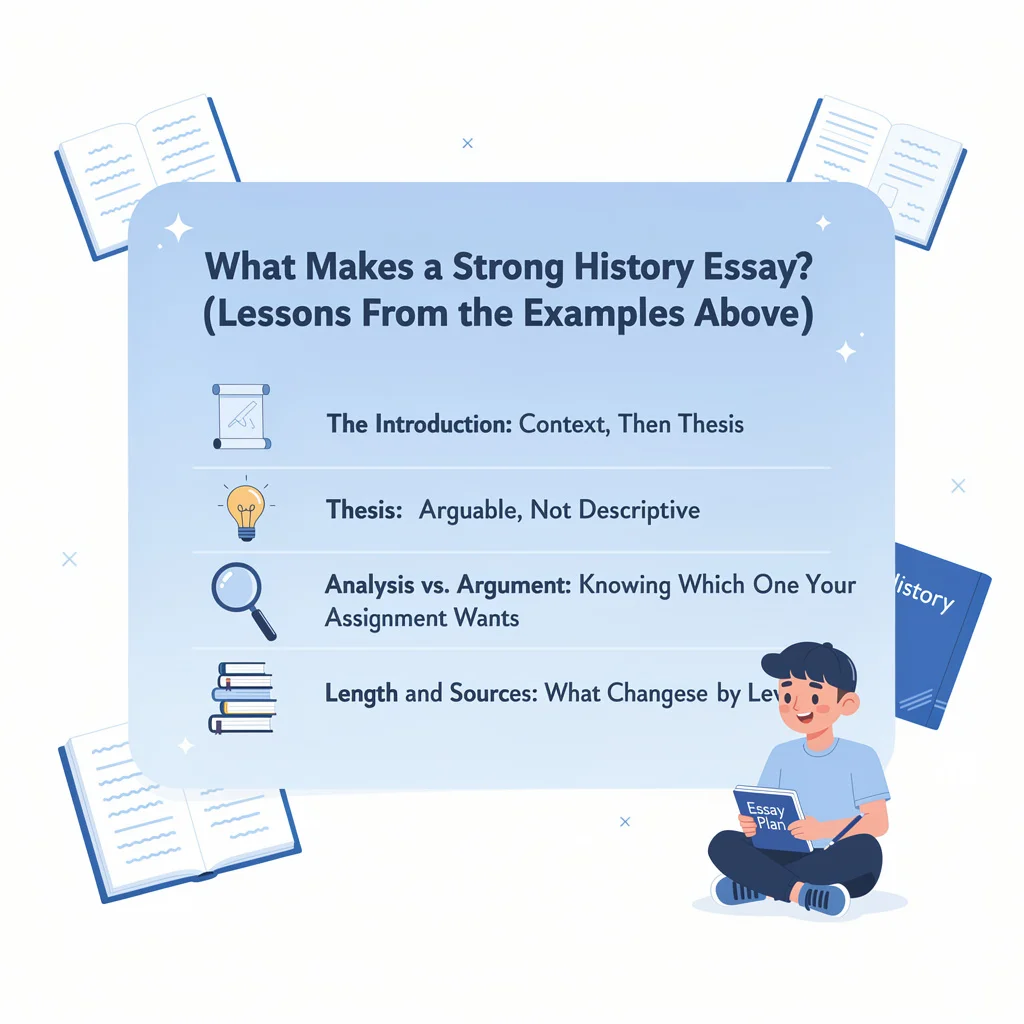
What Makes a Strong History Essay? (Lessons From the Examples Above)
Most history essays lose marks in the same three places: a thesis that isn’t actually arguable, an introduction that takes too long to get to the point, and a mismatch between what the assignment asked for and what the student wrote. Here’s how to avoid all three.
The Introduction: Context, Then Thesis
A strong history essay introduction does three things: it establishes historical context in one or two sentences, states a specific debatable thesis, and signals the main lines of argument. It should be 10–15% of the total word count no longer. The most common mistake is starting too broad (“Throughout history, humans have…”) or with a thesis so vague it has nothing to argue. Compare the middle school and university examples above the thesis gets more specific and more debatable as the level increases, but the structure is identical at every level.
Thesis: Arguable, Not Descriptive
A good history thesis makes a specific, arguable claim about a historical cause, consequence, significance, or comparison. It should not be a statement of fact (“The French Revolution began in 1789”) or a roadmap (“This essay will examine…”). Look at the examples above each one takes a position that a reasonable person could disagree with. That tension is what makes a thesis worth defending, and it’s the single quality professors mark most heavily.
CollegeEssay.org’s history essay team reviews assignments across grade 9 through university level the most consistent marking feedback they see is a thesis that describes rather than argues, which costs marks at every level.
Analysis vs. Argument: Knowing Which One Your Assignment Wants
An analytical history essay examines what happened and why causes, effects, significance without necessarily taking a side. An argumentative essay defends a specific claim and addresses counterarguments. Most high school assignments ask for analysis; most university assignments expect argument. The clearest signal is in the wording of your brief: “evaluate,” “assess,” or “to what extent” means argue; “examine” or “describe” means analyse. Getting this wrong accounts for more lost marks than weak evidence does.
Length and Sources: What Changes by Level
Middle school history essays run 400–600 words from a single source; high school essays run 700–1,200 words with two or three sources; university essays run 1,500–3,000 words and require primary sources alongside peer-reviewed secondary ones. Length and sourcing requirements scale together and the examples above are labelled to reflect those expectations at each level.
Between the grade-level examples, the era and type examples, and the breakdown above, you now have everything you need to understand what a strong history essay looks like and what your professor is actually marking. If your next step is writing one and the blank page isn't cooperating, our history essay writing service handles everything from argument development to source citation, send us your assignment brief and get a draft back within 24 hours.
Frequently Asked Questions