You're writing an IB Extended Essay, and you need to see what a strong one actually looks like. Not a description. The real thing. Below are EE examples organized by subject, each with the research question and a brief note on what makes it worth reading. Find your subject, study the structure, and use these to calibrate before you start writing.
Extended Essay Examples: IB EE Samples by Subject
What Makes a Strong Extended Essay?
Before diving into the examples, it helps to know what you're looking for when you read them. IB examiners score extended essays on five criteria: focus and method, knowledge and understanding, critical thinking, presentation, and engagement. The examples below score well across all five, but what makes them particularly useful for a student is that each one has a research question specific and narrow enough to argue, not just describe.
Keep that in mind as you read. If you finish an example and can't identify the central argument, that's a signal. Strong EEs have one, and understanding why starts with knowing how the format sits within the broader landscape of types of essays.
IB Extended Essay Examples by Subject
English Extended Essay Examples
Example 1 Research question: What do Islamic and Christian followers believe about the end times, and how does each belief influence the religion?
Why it's worth studying: A comparative religious study that moves beyond doctrine to examine how eschatological beliefs shape everyday practice and culture within each tradition. Useful for students writing a World Religions EE who want to see how to handle two parallel subject areas within a single argumentative framework.
Example 2 Research question: What effects do different calcium salts in growth solutions have on the growth of the stems of basil (Ocimum basilicum) plants grown hydroponically?
Why it's worth studying: An original experimental design with clearly defined independent, dependent, and controlled variables, full data tables, regression analysis, and an honest evaluation of limitations. One of the stronger examples of how to document methodology and uncertainty in a lab-based Biology EE.
History Extended Essay Examples
Example 1 Research question: To what extent did German tactical mistakes affect the outcome of the Battle of Stalingrad?
Why it's worth studying: Walks through a clear sequence of compounding German errors, from Hitler's division of Army Group South to the failure to plan for the Russian winter. Useful as a reference for how to structure a military history EE that builds a causal argument across multiple interconnected factors rather than treating each cause in isolation.
Example 2 Research question: To what extent did the British colonial policy of indirect rule in Nigeria cause the Biafran War 1967 to 1970?
Why it's worth studying: A thematically organized essay that engages seriously with historiographical debate, weighing indirect rule against short-term triggers and individual agency as competing explanations for the same event. A strong model for any History EE that needs to demonstrate critical thinking about causation rather than simply narrating what happened.
Psychology Extended Essay Examples
Example 1 Research question: How does harassment affect young homosexuals psychologically?
Why it's worth studying: Anchors a psychological argument in a specific population and a specific outcome, examining the evidence linking harassment to PTSD and suicidality in homosexual youth. A useful reference for Psychology EEs that work from existing studies rather than original experiments, and for how to frame a research question around a defined demographic rather than a general phenomenon.
Example 2 Research question: To what extent is Transference Focused Psychotherapy (TFP) more effective than Dialectical Behaviour Therapy (DBT) in the treatment of Borderline Personality Disorder?
Why it's worth studying: A comparative evaluation of two competing treatment theories using the same diagnostic framework, which is a strong approach for a Psychology EE. Shows how to use theoretical comparison as the backbone of an argument rather than simply describing what each therapy does.
Still not sure your research question is specific enough to produce an essay at the standard you just read? Share your subject, your working question, and where you are in the process, and professional extended essay writing support from our team can help you move from a rough direction to a fully structured, IB-standard draft.
Economics Extended Essay Examples
Example 1 Research question: To what extent has India's 2016 Demonetization act impacted farmers, Kharif sale and Rabi sowing in Sultanganj?
Why it's worth studying: Narrows a major national policy event down to a single village and two specific agricultural cycles, which is exactly the kind of scope that makes an Economics EE answerable within 4,000 words. A strong model for students who want to study a real-world policy intervention using primary or locally sourced data.
Example 2 Research question: How effective has Moscow's Metro pricing strategy been in reducing the negative externalities of car consumption in Moscow?
Why it's worth studying: Applies microeconomic theory, specifically the internalization of negative externalities, to a concrete, verifiable case with real pricing and usage data. Shows how to use a single policy mechanism as the analytical lens for an entire Economics EE without the question becoming too broad.
Physics Extended Essay Examples
Example 1 Research question: How can Hubble's law be used to calculate and evaluate the age of the universe?
Why it's worth studying: An original calculation built from first principles, using distance, angular size, and redshift data from ten galaxies to derive Hubble's parameter and estimate the age of the universe. What makes it particularly useful is the evaluation section, where the student acknowledges the limitation of assuming a constant expansion rate and explains why the result is a lower bound rather than an accurate figure. That kind of honest, rigorous self-evaluation is exactly what separates a strong Physics EE from a descriptive one.
Chemistry Extended Essay Examples
Example 1 Research question: To what extent can the industrial method of synthesis of aspirin be altered to best comply with the principles of green chemistry?
Why it's worth studying: Frames a familiar chemical process within a contemporary industrial lens, evaluating whether the standard esterification method can be made safer and more sustainable by replacing acetic anhydride. A useful model for Chemistry EEs that want to go beyond a lab report and situate their findings within a broader scientific or ethical context.
Example 2 Research question: What is the effect of decreasing temperature on the reaction rate and rate constant of fading of a photochromic dye?
Why it's worth studying: Uses spectrophotometry to measure reaction kinetics across controlled temperature conditions, with the rate constant as the key dependent variable. A strong example of a Chemistry EE built around a single, measurable physical phenomenon, with equipment and methodology accessible to a school laboratory.
Mathematics Extended Essay Examples
Example 1 Research question: How can the hyperbolic cosine function be used to model the catenary curve in bridge structures in Suzhou?
Why it's worth studying: Connects pure mathematical theory to a real-world structural application, using the cosh function to model and analyse the catenary curves found in the bridges of Suzhou. A strong model for Math EEs that want to move beyond abstract exploration and anchor the mathematics in something physically observable and personally meaningful.
Example 2 Research question: How can the area underneath line segments obtained by connecting points of n equal sections from two adjacent sides of a unit square be measured?
Why it's worth studying: Originated from a competition problem the student couldn't solve within a time limit, which is an honest and effective framing for a Math EE. The essay explores multiple solution methods and then extends the problem beyond its original bounds, which is exactly the kind of mathematical curiosity and rigor that distinguishes a strong Math EE from one that just works through a single technique.
Business Management Extended Essay Examples
Example 1 Research question: To what extent is it a good idea for Escan Ltd to end a strategic alliance with Qupid?
Why it's worth studying: The research question is unusually specific and evaluative; it doesn't just ask "what is a strategic alliance," but forces the student to take a position on a real business decision. The essay earns its credibility through primary research (an interview with the owner and a customer survey) and quantitative analysis (balance sheet data, stock turnover ratio), which grounds the argument in actual evidence rather than generic theory. The use of multiple business tools, Force Field Analysis, Fishbone diagram, and SWOT, across a single focused question shows how to deploy the IB toolkit purposefully rather than decoratively.
Example 2 Research question: To what extent is American Eagle Outfitters successful at using the extended marketing mix to influence consumer behavior?
Why it's worth studying: This essay tackles the 7Ps framework through a well-known retail brand, which gives the reader something concrete to visualize throughout. The focus on behavioral economics alongside the marketing mix is a smart angle; it moves the analysis beyond "here is what they do" toward "here is why it works on people," which is a more sophisticated layer of argument. The profitability and stakeholder considerations signal that the student is connecting marketing decisions to business outcomes, which is what separates descriptive Business EEs from analytical ones.
Global Politics Extended Essay Examples
Example 1 Research question: To what extent do Tanzania and Pakistan fail to protect human rights compared to Finland and Norway?
Why it's worth studying: The four-country comparative structure forces genuine contrast rather than a one-sided critique, which makes the argument stronger and more defensible. Grounding the analysis in the tension between cultural tradition and universal human rights gives the essay a real conceptual spine beyond just listing violations.
Example 2 Research question: To what extent is Israel a fully democratic country?
Why it's worth studying: Why it's worth studying: The student's position as an Israeli living in the US adds an honest personal stake to the framing without compromising the analytical angle. Distinguishing democracy as a value from democracy as a form of government early on shows conceptual precision that most students skip, and it gives the essay a cleaner evaluative framework to work with throughout.
World Studies Extended Essay Examples
Example 1 Research question: To what extent did the 2003 invasion of Iraq contribute to the rise of fundamentalism and political instability in the Middle East?
Why it's worth studying: Opens with a primary source (Bush's post-9/11 address) that immediately anchors the argument in real political rhetoric. The essay moves beyond body counts to examine structural consequences, sectarian conflict, state collapse, and ideological radicalization, which is the kind of multi-layered causal analysis World Studies rewards.
Example 2 Research question: To what extent do Virginia Woolf's "A Room of One's Own" and Chimamanda Ngozi Adichie's "We Should All Be Feminists" reflect the changing status of women in their respective societies?
Why it's worth studying: The cross-disciplinary pairing of English Literature and Geography is genuinely well-chosen, literary texts track shifting cultural attitudes, while employment and political statistics provide measurable evidence of change. Using two texts from vastly different eras and contexts (1929 Britain vs. contemporary Nigeria) gives the comparative argument real analytical tension.
Music Extended Essay Examples
Example 1 Research question: To what extent did Sibelius write his Seventh Symphony as a one-movement compression of traditional symphonic form?
Why it's worth studying: The research question is technically precise and genuinely debatable; "compression" is a more interesting frame than simply describing what the symphony does. The student's own identity as a composer gives the analysis a practitioner's ear rather than just a listener's, which tends to produce more specific musical observations.
Example 2 Research question: How is developing variation, a term coined by Arnold Schoenberg, used in the first movement of Johannes Brahms's Symphony No. 2, Op. 73?
Why it's worth studying: Borrowing Schoenberg's analytical lens to examine Brahms is a smart move; it creates an implicit dialogue between two composers and adds historical depth to what could otherwise be a straightforward score analysis. Anchoring the entire essay in a single motive (D–C?–D) keeps the argument focused and traceable throughout.
Visual Arts Extended Essay Examples
Example 1 Research question: To what extent is the similarity between Japanese and Danish fashion a product of direct influence, or a coincidence derived from shared cultural values?
Why it's worth studying: The central question, direct influence vs. parallel evolution, is genuinely unresolved in design history, which gives the essay real argumentative stakes. The students' lived experience in Copenhagen adds observational grounding that keeps the analysis from becoming purely theoretical.
Example 2 Research question: To what extent can the painting "Grain of Sand" by Abdul Mati Klarwein be considered religious art within the context of his installation, the "Aleph Sanctuary"?
Why it's worth studying: Choosing a largely overlooked artist encountered in person at an exhibition is a strong origin story; it signals genuine curiosity rather than a convenient Google search. Framing the question around categorization (is it religious art?) rather than just description forces the essay to engage with definitions and criteria, which produces sharper analytical writing.
Our extended essay writers can produce yours, IB-standard and fully sourced, with the research question, structure, and argument already mapped. You've seen what a strong Extended Essay looks like across every major subject. The harder part is producing one yourself: a research question specific enough to argue, a source base you can access, and a coherent analytical thread for 4,000 words.
A Note on the "50 Excellent Extended Essays"
You may have come across references to "50 Excellent Extended Essays" in various search results. These are not a single downloadable collection. They refer to a set of exemplar EEs compiled and distributed through IBO subject workshops over the years. The IB does not maintain a single public archive of these. Your best sources for official, examiner-marked exemplars are:
- Your IB coordinator or supervisor, who may have access to subject-specific exemplar bundles from IBO professional development materials
- The IBO's My IB platform, which provides authenticated access to official resources, including subject-specific EE examples and mark schemes
- Subject-specific IB teacher forums and the IBO's online curriculum center
The examples on this page are drawn from real student submissions and are useful for understanding structure and argument. For examiner commentary on why a particular essay received the marks it did, official IBO sources are the right place to look.
Tips for Writing Your Extended Essay
These are the decisions that separate a competent EE from an excellent one. Each one is actionable before you write a single word of your draft.
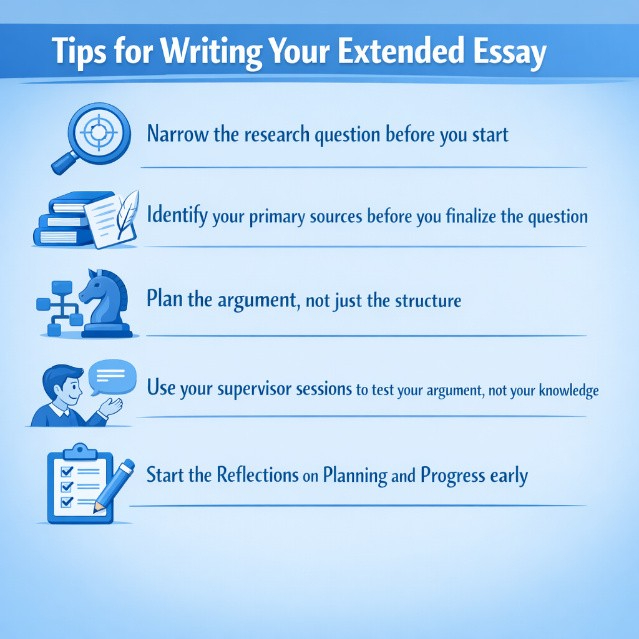
- Narrow the research question before you start. Every example above has a question that is specific to a time period, a place, a technique, a text, or a measurable outcome. If your question could apply to a five-year undergraduate thesis, it is too broad. The extended essay topics guide has strong research angles across every IB subject if you're still deciding on a direction.
- Identify your primary sources before you finalize the question. A common mistake is writing a research question and then discovering the evidence you need doesn't exist or isn't accessible. Before you commit to a topic, confirm that you have access to the data, texts, or studies that would let you actually answer it.
- Plan the argument, not just the structure. Many EEs have the right sections but no central argument threading through them. Ask yourself: what is the one claim I am making that someone could reasonably disagree with? That claim is your thesis, and every paragraph should advance or defend it.
- Use your supervisor sessions to test your argument, not your knowledge. Your supervisor is not there to teach you the content. They are there to help you refine your research question and test whether your argument holds up. Bring drafts, not questions about the subject.
- Start the Reflections on Planning and Progress early. The RPPF is not an afterthought; examiners read it. Your first entry should be written before you've done significant research. How the RPPF fits into the broader structure of the EE, alongside the introduction and body, is covered in the extended essay outline guide.
You've seen what a strong Extended Essay looks like across English, Sciences, Humanities, and Arts, and more importantly, you've seen what a focused, arguable research question looks like in each. The next step is producing one at that standard: a question specific enough to argue, a source base you can access, and an analytical thread that holds for 4,000 words. Tell us your subject, your research question, or the territory you're exploring, and your deadline. CollegeEssay.org's extended essay writers deliver IB-standard drafts with full sourcing and formatting. Most students have a complete first draft within 3 to 5 days.
Frequently Asked Questions
What are some good IB Extended Essay examples?
The strongest EE examples share one quality: a research question specific enough to argue in 4,000 words. Broad questions produce descriptive essays; narrow ones produce analytical ones. The examples on this page are organized by subject, each with the research question and a note on what makes it worth studying before you write your own.
Are there Extended Essay examples for every IB subject?
Yes. This page covers examples across English, History, Psychology, Economics, Physics, Chemistry, Mathematics, Biology, Business Management, Global Politics, World Studies, Music, and Visual Arts. Each subject section includes two annotated examples with the research question stated.
Where can I find the 50 Excellent Extended Essays?
The 50 Excellent Extended Essays refers to a set of exemplars distributed through IBO subject workshops, not a single downloadable collection. The IB does not maintain a public archive of these. Your IB coordinator or supervisor may have access to subject-specific bundles, and the IBO's My IB platform provides authenticated access to official exemplars with examiner commentary.
What is a good Extended Essay research question?
A strong research question is specific to a defined text, time period, place, technique, or measurable outcome. It should be narrow enough to argue a position within 4,000 words and falsifiable enough that someone could reasonably disagree with your answer. The annotated examples on this page show what this looks like across every major IB subject.
For example: To what extent did the British colonial policy of indirect rule in Nigeria cause the Biafran War from 1967 to 1970? (History)?
What do IB Extended Essay examples look like?
A strong EE reads like a focused academic argument, not a report. It opens with a clear research question, builds an analytical case through the body using evidence from primary or secondary sources, and closes by evaluating the extent to which the question has been answered. The examples on this page illustrate this structure across thirteen subject areas.
Benjamin Cole Verified
Author
Dr. Benjamin Cole, holding a Ph.D. in English from Stanford, brings a decade of experience in academia and essay composition across a diverse range of writing forms. Specializing in expository and analytical writing, Benjamin has developed deep expertise in informative, classification, definition, exemplification, illustration, problem-solution, process analysis, synthesis, and extended essay formats. His comprehensive understanding of essay typology, from outlining, classification, and definition essays to selecting compelling topics for exemplification and synthesis essays, makes him a trusted authority in academic writing. Benjamin's ability to guide writers in identifying the right essay type and mastering its structure has earned him widespread recognition in essay education and expository writing methodology.
Specializes in:
types of essays
informative essay
classification essay
definition essay
exemplification essay
extended essay
illustration essay
problem solution essay
process analysis essay
synthesis essay
Read All Articles by Benjamin Cole
Keep Reading
Was This Blog Helpful?
On this Page