Your professor assigned a definition essay, and now you need an outline before you can write a single word. This page gives you the complete structure, introduction, body paragraphs, and conclusion, plus fully populated templates for the standard, extended, and argument-of-definition variants. It is one of several types of essays that follow a fixed outline format, and the structure is straightforward once you see it laid out. The outline format is below; the step-by-step breakdown follows.
Definition Essay Outline: Format and Templates
What Is a Definition Essay Outline?
A definition essay outline is the structural plan for your essay before you write it. It maps every section so that when you sit down to write, you already know exactly what goes where.
Without an outline, definition essays drift. The term gets defined in the first paragraph, and the rest of the essay repeats the same point in different words. An outline prevents that by forcing you to plan three distinct angles before you write a word.
The standard definition essay follows a five-paragraph structure:
|
The extended variant expands the body across multiple defining strategies. The argument of definition variant adds a contested-meaning layer. All three are covered below, each with a skeleton template and a fully populated example.
Standard Definition Essay Outline Format
This is the baseline structure. Use it unless your assignment specifically asks for an extended or argument-of-definition essay.
I. INTRODUCTION
- Dictionary or academic definition of the term
- Background, origin, or history of the term (1-2 sentences)
- Why the term is more complex or contested than the dictionary definition suggests
- Thesis statement: your definition of the term, in your own words
II. BODY PARAGRAPH 1: What the term is (definition by analysis)
- Topic sentence: define the term by its components or characteristics
- Evidence or example that supports this aspect
- Analysis: why this aspect is central to the term's meaning
- Transition to Body Paragraph 2
III. BODY PARAGRAPH 2: What the term is not (definition by negation)
- Topic sentence: clarify what the term is commonly confused with or incorrectly includes
- Evidence or example of the misuse or confusion
- Analysis: why this distinction matters for a full understanding
- Transition to Body Paragraph 3
IV. BODY PARAGRAPH 3: What the term looks like in practice (definition by example)
- Topic sentence: illustrate the term through a real-world or personal example
- The example in detail
- Analysis: how this example captures the full meaning of the term
- Transition to conclusion
V. CONCLUSION
- Restated thesis (in different words from the introduction)
- Summary of the three defining angles covered in the body
- Closing statement: broader significance or implication of the definition
Populated Example: "Courage"
I. INTRODUCTION
- Dictionary definition: "the ability to do something that frightens one" (Oxford)
- The word has roots in the Latin "cor" (heart), historically linked to speaking one's mind rather than physical bravery
- Most people define courage by dramatic physical acts, but the term applies equally to quiet, everyday choices
- Thesis: Courage is the deliberate choice to act on one's values despite fear, regardless of whether the action is visible or dramatic
II. BODY PARAGRAPH 1: Definition by analysis
- Courage requires three components: recognition of risk, presence of fear, and voluntary action
- Example: A student who corrects a teacher's factual error in front of the class
- Analysis: The act is small but meets all three criteria - risk (social embarrassment), fear (present), voluntary action (chosen)
- Transition: Courage defined by its components, however, is only part of the picture
III. BODY PARAGRAPH 2: Definition by negation
- Courage is frequently confused with recklessness, which means acting without fear
- Example: A driver who speeds through traffic because they enjoy the rush
- Analysis: Recklessness involves no fear and no values-based choice; courage requires both
- Transition: Once we know what courage excludes, we can see it clearly in practice
IV. BODY PARAGRAPH 3: Definition by example
- Malala Yousafzai's continued advocacy after being shot is a widely recognized example of courage
- Detail: She returned to public speaking, knowing the risk had not changed
- Analysis: Her example demonstrates that courage is sustained over time, not a single moment
- Transition to conclusion
V. CONCLUSION
- Restated thesis: Courage is a values-driven choice made in the presence of fear, not the absence of it
- Summary: It requires all three components, excludes recklessness, and is illustrated most clearly by sustained action under sustained risk
- Closing: Redefining courage this way makes the concept accessible. Courage is available to anyone who chooses their values over their comfort
Extended Definition Essay Outline
The extended definition essay is a longer, more thorough treatment of a term.
Instead of three body paragraphs covering three angles, it uses multiple defining strategies across as many paragraphs as the assignment requires: etymology, comparison, negation, example, and cultural or historical context.
Use this format when your assignment specifies "extended definition essay," asks for 1,500 or more words, or asks you to thoroughly define a complex or abstract term.
A useful test: if the dictionary definition of your term is genuinely contested, or if the term means something different in different contexts, it warrants extended treatment. "Success" does; it means something different in a corporate boardroom, a rural farming community, and a first-generation college household. "Pencil" does not.
I. INTRODUCTION
- Dictionary or academic definition of the term
- Etymology and historical origin of the term
- Why a single definition is insufficient: the term is contested, evolving, or context-dependent
- Thesis statement: your fully developed position on what the term means
II. BODY PARAGRAPH 1: Definition by etymology
- Topic sentence: trace the term to its roots to show what it originally meant
- Evidence: origin language, root meaning, historical usage
- Analysis: how the root meaning still shapes or contrasts with current usage
- Transition
III. BODY PARAGRAPH 2: Definition by analysis (components)
- Topic sentence: break the term into its essential characteristics
- Evidence: each component explained with an example
- Analysis: why all components must be present for the term to apply
- Transition
IV. BODY PARAGRAPH 3: Definition by comparison and contrast
- Topic sentence: compare the term to a closely related concept
- Evidence: how the two terms are similar and where they diverge
- Analysis: the comparison sharpens the definition by drawing a clear boundary
- Transition
V. BODY PARAGRAPH 4: Definition by negation
- Topic sentence: clarify what the term explicitly excludes
- Evidence: a common misconception or misuse
- Analysis: why the exclusion is necessary for precision
- Transition
VI. BODY PARAGRAPH 5: Definition by example (real-world or personal)
- Topic sentence: illustrate the complete definition through a concrete case
- Evidence: the example in sufficient detail to be convincing
- Analysis: how the example satisfies every component established above
- Transition
VII. CONCLUSION
- Restated thesis, synthesizing all defining strategies used
- Summary of the full definition built across the essay
- Closing: significance of understanding this term precisely
Each body paragraph in an extended definition essay should run longer than in a standard essay. Aim for 200 to 300 words per paragraph, with at least one concrete example per paragraph.
Populated Example: "Resilience"
I. INTRODUCTION
- Dictionary definition: "the capacity to recover quickly from difficulties" (Oxford)
- Etymology: from Latin "resilire," to spring back or rebound. Originally used in physics to describe materials that return to their original shape after stress.
- The physics origin is revealing: the word implies returning to a prior state. But psychological resilience rarely works that way. People who survive serious adversity are not unchanged by it. The dictionary definition misses this.
- Thesis: Resilience is not the ability to bounce back to who you were; it is the capacity to rebuild functioning after adversity has made the previous version of yourself unavailable
II. BODY PARAGRAPH 1: Definition by etymology
- The word "resilience" entered psychological literature in the 1970s, borrowed directly from materials science
- In engineering, a resilient material returns to its exact original shape after compression: steel springs, rubber bands, and certain polymers
- Analysis: The borrowed metaphor is imprecise for humans. A person who loses a child, survives a natural disaster, or exits a long abusive relationship does not return to their original shape. The etymology gives us the word's starting point and immediately reveals its limitations when applied to people.
- Transition: If bouncing back is the wrong metaphor, what are the actual components of human resilience?
III. BODY PARAGRAPH 2: Definition by analysis (components)
- Psychological resilience requires three elements: the presence of genuine adversity, the maintenance or recovery of functioning, and the passage of time
- Each component matters: adversity must be real, not merely uncomfortable. Functioning must be measurable. Time distinguishes resilience from the immediate. An adrenaline response that gets people through an acute crisis.
- Analysis: A person who holds it together during a crisis and then collapses three months later was not resilient. They were running on reserves. Resilience is the longer arc.
- Transition: Knowing the components clarifies what resilience is similar to and where those similarities break down
IV. BODY PARAGRAPH 3: Definition by comparison and contrast
- Resilience is frequently conflated with grit, toughness, and stoicism but each is distinct
- Grit is the sustained pursuit of long-term goals despite setbacks (Duckworth, 2016). It is forward-oriented and achievement-focused. Resilience is response-oriented: it addresses what happens after a loss, not during a pursuit. Stoicism is the suppression of emotional response. Resilience requires emotional processing, not suppression.
- Analysis: Conflating these terms produces bad advice. Telling a grieving person to "be resilient" when you mean "be stoic" asks them to do something that will make them worse, not better.
- Transition: Knowing what resilience is not also clarifies what would disqualify something from being called resilience at all
V. BODY PARAGRAPH 4: Definition by negation
- Resilience is not the absence of distress, and it is not a fixed personality trait
- A common misconception: resilient people do not feel the impact of adversity as deeply as others. Research on bereaved parents, combat veterans, and cancer survivors consistently contradicts this. Resilient individuals report high levels of distress. They simply do not stay in the non-functioning state as long (Bonanno, 2004).
- Analysis: Calling someone resilient because they appear unaffected is often a failure to observe them closely enough, or a projection of what observers find comfortable to witness.
- Transition: With these distinctions in place, we can identify what genuine resilience looks like in a real case
VI. BODY PARAGRAPH 5: Definition by example
- Malala Yousafzai's trajectory after being shot by the Taliban in 2012 illustrates resilience in the full sense of the term
- She did not return to who she was before October 9, 2012. She became a global advocate, wrote a memoir, founded the Malala Fund, and addressed the United Nations, none of which she had done before the attack.
- Analysis: This is why the physics metaphor fails. Yousafzai did not spring back to her original shape. She used the adversity as the material from which a new shape was built. That is what the definition must capture: not return, but reconstruction.
- Transition to conclusion
VII. CONCLUSION
- Restated thesis: Resilience is the capacity to rebuild functioning after adversity, not to return to a prior state but to construct a workable life that incorporates the experience rather than erasing it
- Summary: The etymology points toward return; the components point toward reconstruction; the contrast with grit and stoicism reveals what resilience requires emotionally; the negation clarifies that distress is not the opposite of resilience; and Yousafzai's example shows the full definition in action
- Closing: If we define resilience as bouncing back, we will keep measuring it wrong and giving people in genuine distress the wrong kind of help
Argument of Definition Essay Outline
An argument of a definition essay argues that something does or does not meet the criteria for a particular classification. This is not just defining a term. It is making a case that a specific subject belongs or does not belong in a specific category.
Common assignment framing: "Is X a form of Y?" or "Does X qualify as Z?" The outline structure reflects the argumentative layer. If your assignment is a classification essay that also requires definition work, the argument of definition structure is often the right fit.
I. INTRODUCTION
- Introduce the term being defined and the subject being classified
- State the classification question (does X qualify as Y?)
- Briefly acknowledge that this is contested or non-obvious
- Thesis statement: your position on whether X meets the definition of Y and the grounds for that position
II. BODY PARAGRAPH 1: Establish the definition criteria
- Topic sentence: define Y by its essential characteristics
- Present the agreed-upon or authoritative definition
- Identify the specific criteria X must meet to qualify
- Transition: now we can evaluate X against these criteria
III. BODY PARAGRAPH 2: First criterion: Does X meet it?
- Topic sentence: state the criterion and your position
- Evidence: show how X does or does not satisfy this criterion
- Analysis: evaluate the strength of the match
- Transition
IV. BODY PARAGRAPH 3: Second criterion: Does X meet it?
- Topic sentence: state the criterion and your position
- Evidence
- Analysis
- Transition
V. BODY PARAGRAPH 4: Address the counterargument
- Topic sentence: acknowledge the strongest case against your position
- State the counterargument fairly
- Refute it: explain why the counterargument does not change the classification
- Transition
VI. CONCLUSION
- Restated thesis: X does or does not qualify as Y based on the criteria established
- Summary: which criteria were met, which were not, and why the net conclusion holds
- Closing: why this classification question matters and what is at stake in getting it right
Populated Example: "Is Cyberbullying a Form of Violence?"
I. INTRODUCTION
- Cyberbullying involves the repeated use of digital platforms to harass, threaten, or humiliate another person. Violence is typically understood as physical force used to harm. At first glance, the two have nothing in common.
- Classification question: Does cyberbullying meet the criteria for violence, or is the term misapplied when used that way?
- The question is contested. Legal systems, school policies, and researchers disagree. Some reserve "violence" for physical acts; others argue that harm is harm regardless of delivery mechanism.
- Thesis: Cyberbullying qualifies as a form of violence because it satisfies the three criteria that define violence in its most defensible form: intent to harm, a power imbalance between perpetrator and target, and documented psychological damage to the victim
II. BODY PARAGRAPH 1: Establish the definition criteria
- Violence, defined rigorously, requires three elements: intentional action directed at a target, a power differential that prevents equal response, and harm to the target, physical or psychological
- The World Health Organization's definition of violence (2002) includes "psychological harm" explicitly and does not require physical contact. This is the authoritative definition this essay will use.
- Criteria checklist: (1) intentional action directed at a specific target; (2) power imbalance; (3) documented harm, physical or psychological
- Transition: With these three criteria established, we can evaluate cyberbullying against each
III. BODY PARAGRAPH 2: First criterion: intentional action
- Cyberbullying meets the first criterion. It involves deliberate, targeted behavior, not accidental contact or incidental offense.
- Evidence: Studies consistently find that cyberbullying involves repeated, intentional acts: creating fake profiles to humiliate a specific person, sharing private images without consent, and coordinating group harassment campaigns. These are not accidents.
- Analysis: The intentionality is often more sustained in cyberbullying than in physical confrontations. A single physical altercation ends when participants separate; a cyberbullying campaign can run continuously across multiple platforms simultaneously.
- Transition: Intentionality alone does not make something violent. The power imbalance criterion must also be met.
IV. BODY PARAGRAPH 3: Second criterion: power imbalance
- Cyberbullying typically involves a significant power imbalance, one that the target cannot neutralize by logging off
- Evidence: Targets of cyberbullying face asymmetric exposure. Content shared about them reaches audiences they cannot control, is often permanent or screenshot-preserved, and can involve coordinated groups acting against a single individual. The perpetrator controls the information environment; the target does not.
- Analysis: The power imbalance in cyberbullying is often more durable than in physical confrontations, precisely because digital content persists and spreads beyond the original interaction.
- Transition: With two criteria met, the counterargument rests almost entirely on the third: whether psychological harm counts as harm at all
V. BODY PARAGRAPH 4: Address the counterargument
- The strongest objection is that violence requires physical contact, and cyberbullying, by definition, involves none
- Proponents of this view argue that extending "violence" to non-physical acts dilutes the term, makes it less useful, and conflates serious physical harm with hurt feelings.
- Refutation: This objection fails on the evidence. Research on cyberbullying targets documents outcomes including depression, anxiety, and suicidal ideation that are clinically indistinguishable from outcomes in physical assault victims (Hinduja & Patchin, 2010). If the harm is equivalent, limiting the category to physical acts is not precision. It is a category error that protects perpetrators by mislabeling what they do.
- Transition to conclusion
VI. CONCLUSION
- Restated thesis: Cyberbullying meets all three criteria for violence as defined by the WHO: intentional action, power imbalance, and documented psychological harm
- Summary: The intentionality criterion is clearly met and often exceeded in persistence. The power imbalance is structural and durable. The psychological harm is clinically documented. The physical-contact objection does not hold against the evidence.
- Closing: The classification matters because what we call something shapes how institutions respond to it. Schools that treat cyberbullying as a social conflict rather than a form of violence consistently underrespond, and students pay the cost.
Still not sure how to turn this outline into a full essay? Tell us your term, your angle, and your deadline, and our writers will handle the custom definition essay writing from structure to final draft.
How to Build Your Definition Essay Outline in 5 Steps
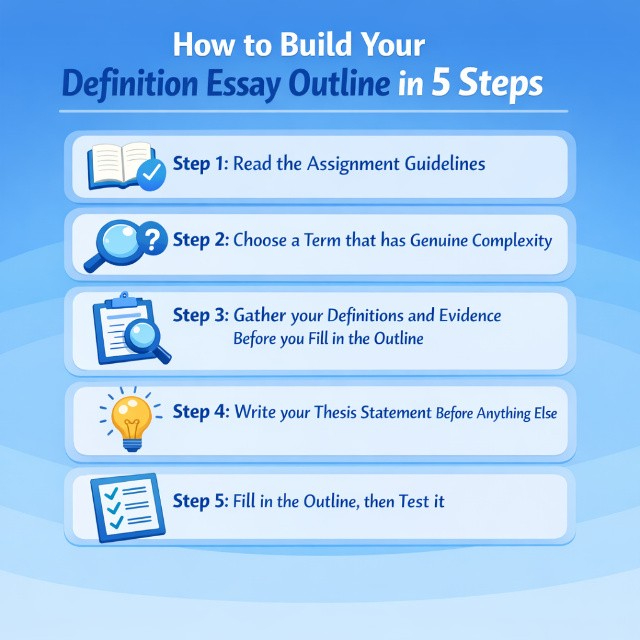
Step 1: Read the Assignment Guidelines
Before you open a blank document, read every line of the assignment sheet. Note the required word count, formatting style (MLA, APA, Chicago), and whether your professor has specified a variant: standard, extended, or argument of definition.
If the assignment says "define an abstract concept," you are almost certainly writing a standard definition essay. If it says "thoroughly examine" or gives you a long word count, it is likely an extended essay. If it asks whether something "qualifies as" or "can be considered" something else, that is an argument of definition.
Getting this wrong means rebuilding the structure after you have already started writing. |
Step 2: Choose a Term that has Genuine Complexity
The most common definition essay mistake is picking a term that is too concrete or too simple. Sky, pencil, and chair are closed topics, one correct definition, no interesting angles to explore.
Good definition essay terms have at least two of the following properties:
- Multiple competing definitions (freedom, justice, success, see the definition essay topics page for a full list organized by complexity)
- Meaning that shifts across cultures or historical periods (marriage, democracy, hero)
- Common misuse or confusion with a related concept (sympathy vs. empathy, confidence vs. arrogance)
- A dictionary definition that fails to capture how people actually experience the term (love, grief, belonging)
Step 3: Gather your Definitions and Evidence Before you Fill in the Outline
Before you populate the outline, collect the following:
- The dictionary or academic definition (Merriam-Webster, Oxford, or a subject-specific dictionary for technical terms)
- The etymology, what language the word comes from and what its root originally meant (Etymonline.com is the most reliable free resource for this)
- At least two real-world examples that illustrate the term as you are defining it
- At least one counterexample or commonly confused term
If your term has multiple competing academic definitions, do not try to reconcile all of them in one essay. Pick the definition closest to your thesis and engage with the others as counterarguments or contrasts. The goal is a coherent argument, not a survey of the literature.
Step 4: Write your Thesis Statement Before Anything Else
Your thesis is the single most important sentence in the outline. It is not the dictionary definition. It is your argued position on what the term means, what it excludes, and why the distinction matters.
A strong definition essay thesis follows this structure: [Term] is [your definition], distinguished from [commonly confused concept] by [the key differentiating characteristic].
Two examples, one weak and one strong:
Weak: "Courage is when someone does something even though they are scared." This restates the dictionary entry and adds nothing. |
Strong: "Courage is the deliberate choice to act on one's values in the presence of fear, distinguished from recklessness by the presence of a values-based motive rather than the mere absence of normal caution." This is arguable, specific, and excludes something, which means it can be proved. |
Write the thesis before you fill in any body paragraphs. Then check every body paragraph against it. If a paragraph does not connect back to the thesis, it either needs to be reframed or cut.
Step 5: Fill in the Outline, then Test it
Once you have your thesis and your evidence, populate the outline template for your variant. When it is complete, run this four-question test:
- Does each body paragraph cover a distinct angle on the term? If two paragraphs say essentially the same thing, merge them or replace one.
- Does every piece of evidence connect to the thesis? If it supports a different definition than your thesis, cut it regardless of how interesting it is.
- Does the conclusion restate the thesis in different words rather than copying it verbatim?
- Would someone who read only the topic sentences of each body paragraph understand your full argument?
If the answer to all four is yes, the outline is solid. Start writing.
Common Outline Mistakes to Fix Before You Write
- All three body paragraphs make the same point. If paragraphs 1, 2, and 3 are all essentially saying "courage involves facing fear," the essay has one body paragraph repeated three times. Each paragraph must isolate a genuinely distinct angle.
- The thesis just restates the dictionary definition. "Courage is the ability to face fear" is a dictionary entry, not a thesis. A thesis makes a claim that could be argued against.
- Body paragraphs have no analysis. Listing an example and moving on is description, not argument. Every body paragraph needs a sentence or two that explains what the example proves about the term's meaning. The evidence shows; the analysis tells.
- The conclusion copies the thesis verbatim. The conclusion should synthesize the three body paragraphs to show how they collectively build the full definition. It does not just restate the introduction.
You've got the structure. The outline is the easy part, every section mapped, every move accounted for. The harder part is filling it in with an argument that actually holds together. If that's where you want help, have our definition essay writers build the essay around this outline. You hand them the topic and the constraints; they deliver a finished definition essay ready to submit.
You have the outline. Now comes the writing, getting from this structure to a finished definition essay that actually holds together. CollegeEssay.org's definition essay team handles that part: share your term, your required length, and your deadline, and you'll get a complete, properly structured definition essay back. Most orders are delivered within 24 hours.
Frequently Asked Questions
What is a definition essay outline?
A definition essay outline is the structural plan for your essay, mapping every section before you write a word of draft prose. It covers the introduction, each body paragraph with its defining strategy, and the conclusion. A complete outline takes 30 to 60 minutes to build and saves several hours of revision later.
What is the difference between a definition and a definition essay?
A definition is a single statement of what a term means. A definition essay is a full academic argument that earns that meaning through evidence and reasoning, covering etymology, components, comparisons, and examples. The dictionary gives you the conclusion; the essay builds the case for it.
What is an extended definition essay?
An extended definition essay uses multiple defining strategies across five or more body paragraphs to treat a complex or contested term thoroughly. It is the right format for terms like justice, resilience, or democracy whose meanings shift across contexts. Simple, concrete terms do not warrant this treatment.
What is an argument of a definition essay?
An argument of a definition essay argues that a specific subject does or does not qualify as a member of a particular category. Common framings are Is X a form of Y? or Does X qualify as Z? It requires both rigorous definition work and persuasive argumentation, making it more demanding than a standard definition essay.
How long is a definition essay outline?
Length matters less than completeness. Every body paragraph slot should have a topic sentence, at least one piece of evidence identified, and an analysis note before you consider the outline ready. In practice, this typically runs one to two pages.
Do I need a thesis statement in my outline?
Yes, and write it before you fill in the body paragraphs. The thesis is your argued position on what the term means, not the dictionary definition. Every body paragraph should connect back to it.
Benjamin Cole Verified
Dr. Benjamin Cole, holding a Ph.D. in English from Stanford, boasts a decade of experience in academia and critical essay composition. Specializing in Shakespearean studies and literary theory, Benjamin has contributed significantly to the field. His critical essays have been published in renowned academic journals, and he has been honored for his outstanding contribution to literary scholarship.
Keep Reading
Was This Blog Helpful?
On this Page