250-Word College Application Essay Example
A 250-word college application essay works by committing to a single transformation, a before and an after, rather than summarizing your high school career in two paragraphs. Admissions readers reviewing short essays remember the one that stays with a specific moment; the essays that try to cover too much blur together. The example below anchors the entire essay to one change: from silence to self-expression.
300-Word College Application Essay Example
A strong 300-word college application essay focuses on one specific moment and uses the extra words over 250 to add one detail that earns its emotional weight. Use those words on specificity, not on additional stories. Use the extra words to add one specific detail that earns the emotional weight you are aiming for. The example below uses a debate loss as the setup, but the essay is actually about learning to listen, which is a subtler and more memorable quality than the obvious alternative: writing about winning.
500-Word College Application Essay Example
A 500-word college application essay has enough room for a clear narrative arc: a specific experience, what it revealed, and what that means for who you are going into college. For supplemental essays and some Common App prompts, 500 words is the upper limit; treat every sentence as either earning its place or cutting it. The example below uses a multicultural upbringing and a trip abroad as the structural spine, then builds to the implications.
If you are still working out how to frame your topic or structure your draft from scratch, the full college application essay writing guide covers every stage of the process before you start writing.
If you have read through these examples and found a structure you can use but are not sure how to adapt it to your own story, especially if your situation involves something harder to frame like a setback, a gap year, or a background that does not fit a standard template, you can write my admission essay with support from CollegeEssay.org and get a draft that is genuinely yours.
College Application Essay Example About Yourself
A college application essay about yourself works when it shows one specific quality through a concrete moment rather than summarizing your background in general terms.
A college essay about yourself, the most common prompt type, asks you to reveal something about your background, identity, interest, or talent that is meaningful to you. The committee is not looking for your resume in paragraph form. They want to understand how you think and what you value. The essay below centers on the process of self-discovery, showing the shift from external pressure to internal clarity through specific activities and leadership experiences.
Harvard College Application Essay Example
A Harvard application essay is not structurally different from any other personal statement, but it needs to demonstrate intellectual curiosity that goes beyond coursework and a clear sense of what you want to contribute, not just consume, at the university. The essay below centers on literature as a vehicle for social impact, showing how a personal passion connects to larger concerns about equity and representation.
Johns Hopkins College Application Essay Example
A Johns Hopkins application essay typically rewards intellectual specificity over broad ambition: the ability to name the actual problems you want to work on, not just the field you find interesting. The essay below uses scientific curiosity as its spine and builds from childhood observation through hands-on research to a clear sense of where that curiosity leads.
“Why This College” College Application Essay Example
A strong “Why This College” college application essay names specific programs, experiences, or values at that school and connects each one to something concrete and true about the applicant. Admissions readers have seen thousands of essays that call their school “unique” and “diverse.” The essay that works names specific programs, experiences, or values, and then explains why those particular things matter given who the applicant actually is. The Yale essay below uses three distinct dimensions of the university (faculty, social responsibility, student community) and anchors each to a genuine personal value.
You have read almost every major example type and worked through the principles behind them. The hard part now is doing all of this with your own story: your prompt, your deadline, your specific history. For professional college admission essay writing help that starts from your material and stays in your voice, CollegeEssay.org has writers who specialize in exactly this kind of work.
Engineering College Application Essay Example
An engineering application essay should demonstrate how you actually think, not just that you like math or want to build things. Admissions committees reading engineering essays are looking for students who can see problems, not just solve them. The essay below uses engineering as a lens for understanding human systems, connecting a personal drive toward innovation to the specific academic environment at Georgia Tech.
Computer Science College Application Essay Example
A strong computer science college application essay reveals the specific problems or questions that drew you to CS rather than simply stating that you enjoy coding or find technology interesting. The essay below uses a progression from first code to deeper application (AI, data analysis) to convey intellectual curiosity, and connects that progression to the academic environment at Carnegie Mellon.
Graduate School Application Essay Example
A graduate school application essay, sometimes called a statement of purpose, needs to do three things: explain what experience has prepared you for this work, name the specific questions you want to pursue, and show that you understand what the program offers and why it is the right place to pursue them. The example below is written for a Master of Public Health application, but the structure applies broadly across graduate programs.
For examples across other graduate programs, see our graduate essay examples collection.
Nursing School Application Essay Example
A nursing application essay should establish your motivation for the field, ground that motivation in specific experience, and show that you understand what the work actually involves, not just the idealized version of it. Admissions committees for nursing programs are looking for students who have encountered the difficulty and complexity of care and chosen it anyway. The essay below builds from personal experience to clinical exposure to a clear statement of purpose.
For more samples from nursing applicants, see our nursing essay examples collection.
Honors College Application Essay Example
A strong honors college application essay demonstrates intellectual curiosity that goes beyond your transcript by showing a question you followed past the point where it was assigned. The essay below uses a footnote as its inciting moment and builds from there into a genuine research interest that is still unresolved.
Which Common App Prompt Does Each Example Best Fit?
Most of the essays on this page fit more than one Common App prompt but each has a natural home based on its structure and central move. The key is choosing the prompt that fits your story most naturally, then writing the essay that story demands rather than reshaping your story to fit a prompt. Here is how the essays on this page map to the most common prompt types.
- Background, identity, or talent: About Yourself essay; Honors essay (intellectual identity traced to a single discovery)
- Challenge or failure: 300-word debate essay (the loss is the turning point)
- Belief or idea you questioned: Honors essay (revision of assumed regional history)
- Accomplishment that sparked personal growth: 250-word poetry essay; 500-word Diversity essay (both center a transformation)
- Topic that makes you lose track of time: Engineering, CS, and JHU essays (sustained intellectual passion, no problem-overcome framing)
- Graduate and Nursing essays: outside the Common App framework; their structure (experience, limitation, purpose) applies to any statement-of-purpose format
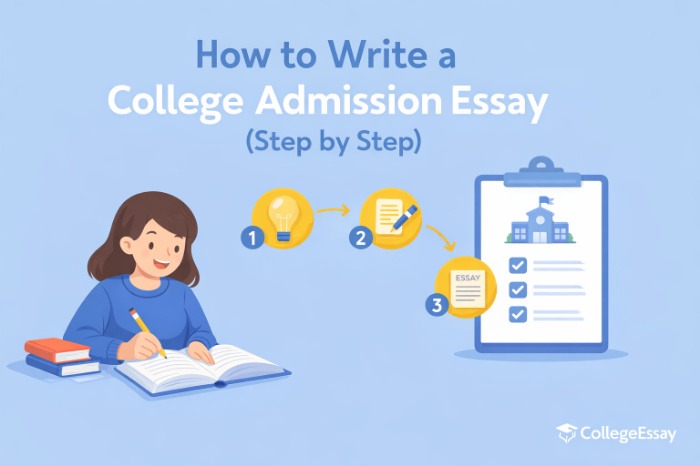
How to Write a College Application Essay That Gets Read
The essays that get read all share the same underlying moves: a specific opening, one story told completely, visible thinking, and a closing that earns its conclusion. CollegeEssay.org’s writers find that college application essays centered on one specific experience consistently produce stronger drafts than those covering multiple achievements. The college application essays that actually work are specific about one moment in your life and clear about what it meant to you.
1Start with a Specific Moment, Not a General Observation
Opening with a concrete scene (a physical detail, a specific action, a named moment) gives the reader something to hold before you ask them to care about anything. Openings that begin with “I have always believed...” or “Growing up, I learned...” start with a claim the reader has no reason yet to trust.
2Tell One Story, Not Five
The impulse to pack the essay with accomplishments (three clubs, two sports, a summer program) produces a document that reads like a resume with transitions. One story told fully, with the right specific detail, reveals more about a person than a catalog of achievements.
3Show the Thinking, Not Just the Conclusion
Readers trust conclusions only after they have seen the thinking that produced them. Show the process, the work, or the doubt before naming what you learned. The conclusion (“I became a better advocate than an arguer”) lands because the evidence arrived first.
4Name What Changed
Every strong college essay has a before and after. The change does not have to be dramatic. It can be a shift in how you think about something, or a moment where you realized something you had been doing intuitively was actually a skill. But a reader needs to leave the essay knowing something about you that they did not know at the start.
5The Last Sentence Is the Second Most Important Sentence
After the opening, the closing line is where the essay either lifts or collapses. The best closing sentences complete the arc without restating it, giving the reader something to sit with. “I intend to keep following it” works because it leaves the story open in the right way.
6Proofread for Vagueness, Not Just Errors
Every sentence that contains “journey,” “passion,” “impact,” “the world,” or “society” without a specific referent should be rewritten. These words are not wrong. They appear in strong essays, but only when they are anchored to something concrete that makes them earn their place.
You have read twelve examples across every major format and prompt type, and you now have a set of principles to evaluate your own draft against. The next step is applying all of this to your specific story, your deadline, and your prompt, and that is where most students get stuck. If you want a professional writer working from your draft or your notes, trust CollegeEssay.org with your college admissions essay and get a polished, original essay back in time for your deadline.
Frequently Asked Questions